Although I’m far from ready to have a beta reader (much less than editor) read my WIP, I am very glad I came upon this post on editing and pricing from The Sarcastic Muse. [Note to self: Add to Evernote for future reference.]
I was chatting with my cousin a few weeks ago about freelance work. He used to work as a graphic designer—doing logos and such—and so he knows how difficult it can be to find work or, at the very least, to find people willing to pay for good work. Business owners would ask to have a professional logo made for next to nothing. And I thought: If that’s all the money they were willing to put into their business, then what does that tell me they think their company is worth?
The same issue occurs in the editing world, too. While many writers do understand that quality editing takes time and doesn’t come cheap, others seem to underestimate just what exactly editing entails—and what exactly they’re paying for.
I understand why writers may wish to find cheaper editing options—monetary issues or otherwise—but as with any business (and publishing novels is…
Well, it began several hours ago (or longer depending on where YOU live). And how did I spend the first day of the new year? Cleaning, doing laundry, reading blog posts, making dal for dinner. You know, fun stuff. (Well, making dal is fun in part because I use a slow-cooker.)
But perhaps the biggest, most important thing I did was close out all the Clemency novel-in-progress posts. Remember, I said I was going to do this. Now it remains for me to print the thing story and proceed with *reading, reviewing, editing, repeat from * until finished.
I do hope everyone has had a Happy New Year’s Eve and an even happier New Year’s Day.
Lea is wondering whether any one out there can recommend editing software. Now I’m interested too. I wouldn’t expect any software to take the place of a professional (and warm-blooded) editor. However, software might help with making my copy as “clean” as possible before it goes to the editor. Y’all have any thoughts on this?
I have been researching Manuscript Editing Software for the last few hours. So far I have found some interesting things! I even tested one out a little bit. I honestly think this might be helpful for me at the moment. Even if all the program ends up helping me with is pointing out certain words and phrases I use way too often.
I do know that this is no replacement for a real, professional Editor. But until the day I can afford one, I might as well do everything I can to edit my work. For now it shall be beta readers and Editing Software and whatever else I can find.
Have you ever tried Editing Software? What do you think of it?
This is me creating a post for easier re-blogging because the last one was kind of crammed with too much personal information. So from my other services page, this is a list of what I have to offer. Please feel free to contact me via my Contact page or my email address cnfaust@outlook.com :)
Formatting
eBook: For $10 an hour I will format your eBook for Amazon KDP (or various other eBook distributors, including Lulu and Nook). This usually takes me between 2 – 4 straight hours depending on what kind of shape the book is in when I get it. Work hours can be considerably less.
Print: For $12 an hour I will format your book for Amazon Createspace (or various other print distributors, including Lulu). This usually takes me between 4 – 6 hours depending on the shape the book is in when I get it…
This is a wonderful post for all of you currently writing fiction and needing advice/suggestions about character arcs. As I was reading Debbie’s post, I realized that I provided different arcs for different characters in my last two NaNoWriMo novels. That’s a good thing, but I hadn’t put much thought into why I was doing that. Debbie’s post actually gives me an understanding of what I’ve done and (hopefully) how to make sure the arcs worked for the characters.
1. Character arcs are not 100% necessary. I’m going to get this out of the way first thing.
This argument is made all the time, and there’s some truth to it. There are some very successful characters that never have a character arc. James Bond is the one most mentioned. While he was retooled somewhat when Daniel Craig took over the role in the movies, the character has never undergone a significant arc. Miss Marple never has an arc, or Hercule Poirot, or Stephanie Plum.
See a pattern here? They’re all characters in a long-running series of stand-alone books. While there are series characters that have arcs (I would argue Indiana Jones is an example) most don’t have them. Mainly because having the characters change would disrupt the series too much.
2. However, not giving your character one can simply be laziness on your part. Just because there are…
On the trail at Chimney Rock, Point Reyes National Seashore Park, California July 2012
It’s been a week since I submitted my final word count to Camp NaNoWriMo and my brain still feels as empty as this great expanse of sky. I’ve written little since: mostly comments, an attempt at poetry during a downturn in my mood, and the ubiquitous note-keeping I do at my day job. I had thought of planning to edit one or both of the novels I’ve written in the past 6 months. Remember, they are both first drafts so editing will open the opportunity (and challenge) of rewriting. But … always there is a but … my physical environment is suffering from neglect and my other projects are demanding their due.
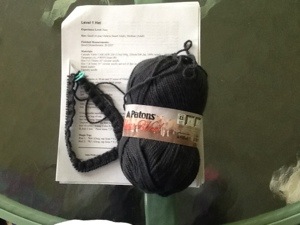
For one, I’m engaged in The Knitting Guild Association’s (TKGA’s) Master Hand Knitting Program, Level 1. For those of you interested in such endeavors, here’s a link: http://www.tkga.com/?page=AboutTKGAMasters
I actually had completed Level 1 almost 20 years ago, started Level 2 and then just quit. I am an avid knitter and have been knitting for over 40 years. I can also sew and crochet, but knitting has always defined me. I’ve made everything from baby blankets to cardigans to socks to shawls to scarves to pullovers. As the years go by, my knitting has become simpler, except for the socks and a venture into Entralec.
In recent years, I’ve resisted patterns like cardigans that require lots of finishing. Even with socks, I prefer to knit toe-up two-at-a-time because that method requires the least amount of planning and finishing. So why am I enrolled in the Level 1 Master program again? (Beside the fact that after 20 years, the association has updated its standards and requirements.) In truth, because I thought if I ever attempt to sell my knitting, it might be helpful if I could be “certified” as a Master Knitter and for that, you need to complete all three levels of the Master program. But knitting is labor-intensive and selling would only work if I was willing to do it for free. And, once knitting becomes a job, the joy goes out of it for me.
My writing is much like my knitting: I love the process (the knitting, the writing). I love the end product (the sweater, the novel), but I don’t like everything I have to do to get there (the sewing of seams, the editing). And, as with knitting, once the “fun” goes out of writing, so goes the writing.
After all these years of writing and knitting, I feel like I’m still discovering myself as a writer and a knitter. And I’m starting to let go of that urgency to “Be” something or someone, to define myself by someone else’s precepts. I’m a contrary student: I love to learn but I hate instructions. I love to find out something new, but I hate being told what to do.
Yet I intend to finish Level 1 of the Master program, even if I have to write a two-page, single-spaced report on blocking (really, is there that much to be said on blocking?). Level 2 will depend on how much of Level 1 I might be asked to re-do. And with my writing, it will be easier to simply create anew rather than rework what I already have. We’ll see. For now, I have some knitting to finish.
You must read today’s guest blogger at the Writer’s Resource Center, Suzanne G. Fox! Her post, “So Much in Common: The Truth About Editing and Bull Riding,” is both entertaining and informative. My favorite similarity of the several that she lists is that while technology helps, it’s talent and training that make the difference. Here’s a clip from her post:
“Bull riding doesn’t require a lot of fancy equipment-a rider could probably get by with just a bull rope, a cowboy hat, and a set of spurs, and no amount of fiddling with these basics seems to make much difference in his performance. The great “Razor” Jim Sharp didn’t even wear chaps-he always rode in blue jeans. Likewise in editing-fast computers and access to the Chicago Manual of Style online may save some time, but in the end, it’s what you’ve learned and how you practice it, plus your innate command of the language, that determine your success.”
Now go and read the rest of her post by clicking here.
Another entertaining and informative post from a guest blogger at the Writer’s Resource Center: “A small sheik escaped” and other editing execises to energize your writing by L.A. Ramsey. L.A. shares writing bloopers (AKA typographical errors) as well as the hilarious story of how she lost a sixth-grade spelling contest. Her post is another fine example of blending just enough personal detail with professional knowledge to make for a fun read. Here’s a teaser: “Of all the things in human existence to be ignited by–a skylark, Picasso’s man strumming a blue guitar, a flapper wobbling to the tune of the Charleston, a kid’s gap-toothed grin–mine was a small sheik.” Now click here and read the rest of her post.
John Hewitt of the Writer’s Resource Center is on hiatus for a few weeks and has engaged a great group of bloggers to fill in for him. One of that great group is . . . yours truly :-) I am thrilled to be listed among some phenomenal bloggers. For a full list, click here. John has also challenged us to see who will generate the most comments, so please visit his blog every day and participate in our discussions about writing! (Of course, you should already be visiting his blog every day, but think of our challenge as giving you extra incentive.)
The month of guest bloggers is off to a great start with writer and editor Lillie Ammann’s post Get Rid of Ugly Wordiness: How to Cut Your Novel Down to Size. She provides five critical editing steps that apply to short stories as well as to novels.

 I was chatting with my cousin a few weeks ago about freelance work. He used to work as a graphic designer—doing logos and such—and so he knows how difficult it can be to find work or, at the very least, to find people willing to pay for good work. Business owners would ask to have a professional logo made for next to nothing. And I thought: If that’s all the money they were willing to put into their business, then what does that tell me they think their company is worth?




 Marie at 1 Write Way