One of my favorite authors is now offering his services as an editor! Don’t waste time reading me. Just click on through and see what Kevin Brennan can offer you.
Welcome to my shingle-hanging announcement, folks! As of today, I’m open for business as an editor of indie books destined for publication on Amazon et al.
I’m calling the operation Indie-Scribable. Indie for the indie part, and “scribable” for scribes. Clever, eh?
I haven’t talked about it on the blog, but for most of my career I was an editor. I started at a medical publisher back in St. Louis, copyediting three or four different journals — such learned organs as Investigative Ophthalmology and Visual Science, the Journal of Allergy and Clinical Immunology, and, my favorite, the Journal of Enterostomal Therapy! Oh joy.
After that I was managing editor of the American Heart Association journal, Circulation, and then the Journal of the American College of Cardiology.
Lea is wondering whether any one out there can recommend editing software. Now I’m interested too. I wouldn’t expect any software to take the place of a professional (and warm-blooded) editor. However, software might help with making my copy as “clean” as possible before it goes to the editor. Y’all have any thoughts on this?
I have been researching Manuscript Editing Software for the last few hours. So far I have found some interesting things! I even tested one out a little bit. I honestly think this might be helpful for me at the moment. Even if all the program ends up helping me with is pointing out certain words and phrases I use way too often.
I do know that this is no replacement for a real, professional Editor. But until the day I can afford one, I might as well do everything I can to edit my work. For now it shall be beta readers and Editing Software and whatever else I can find.
Have you ever tried Editing Software? What do you think of it?
If you are serious about your writing, you’ve probably searched for the magic formula that will guarantee publication of your work. I hate to be the one to break this to you, but there is no magic formula.
Writing is hard. Writing well is hard work. Writing well enough to see your work published takes time, dedication, ruthless editing, and yes, a bit of luck.
Luck isn’t something you have much control over . . . but you do have control over time, dedication, and ruthless editing.
Millions of words have been written about finding and making time to write, so you’re probably working on that, and you’re already dedicated to your craft or you wouldn’t be reading Stephen King’s On Writing and searching blogs for ideas on how to make a living in this crazy business.
That leaves ruthless editing as your ticket to instantly improving your writing.
On the trail at Chimney Rock, Point Reyes National Seashore Park, California July 2012
It’s been a week since I submitted my final word count to Camp NaNoWriMo and my brain still feels as empty as this great expanse of sky. I’ve written little since: mostly comments, an attempt at poetry during a downturn in my mood, and the ubiquitous note-keeping I do at my day job. I had thought of planning to edit one or both of the novels I’ve written in the past 6 months. Remember, they are both first drafts so editing will open the opportunity (and challenge) of rewriting. But … always there is a but … my physical environment is suffering from neglect and my other projects are demanding their due.
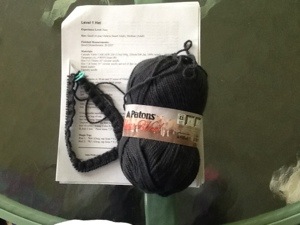
For one, I’m engaged in The Knitting Guild Association’s (TKGA’s) Master Hand Knitting Program, Level 1. For those of you interested in such endeavors, here’s a link: http://www.tkga.com/?page=AboutTKGAMasters
I actually had completed Level 1 almost 20 years ago, started Level 2 and then just quit. I am an avid knitter and have been knitting for over 40 years. I can also sew and crochet, but knitting has always defined me. I’ve made everything from baby blankets to cardigans to socks to shawls to scarves to pullovers. As the years go by, my knitting has become simpler, except for the socks and a venture into Entralec.
In recent years, I’ve resisted patterns like cardigans that require lots of finishing. Even with socks, I prefer to knit toe-up two-at-a-time because that method requires the least amount of planning and finishing. So why am I enrolled in the Level 1 Master program again? (Beside the fact that after 20 years, the association has updated its standards and requirements.) In truth, because I thought if I ever attempt to sell my knitting, it might be helpful if I could be “certified” as a Master Knitter and for that, you need to complete all three levels of the Master program. But knitting is labor-intensive and selling would only work if I was willing to do it for free. And, once knitting becomes a job, the joy goes out of it for me.
My writing is much like my knitting: I love the process (the knitting, the writing). I love the end product (the sweater, the novel), but I don’t like everything I have to do to get there (the sewing of seams, the editing). And, as with knitting, once the “fun” goes out of writing, so goes the writing.
After all these years of writing and knitting, I feel like I’m still discovering myself as a writer and a knitter. And I’m starting to let go of that urgency to “Be” something or someone, to define myself by someone else’s precepts. I’m a contrary student: I love to learn but I hate instructions. I love to find out something new, but I hate being told what to do.
Yet I intend to finish Level 1 of the Master program, even if I have to write a two-page, single-spaced report on blocking (really, is there that much to be said on blocking?). Level 2 will depend on how much of Level 1 I might be asked to re-do. And with my writing, it will be easier to simply create anew rather than rework what I already have. We’ll see. For now, I have some knitting to finish.
You must read today’s guest blogger at the Writer’s Resource Center, Suzanne G. Fox! Her post, “So Much in Common: The Truth About Editing and Bull Riding,” is both entertaining and informative. My favorite similarity of the several that she lists is that while technology helps, it’s talent and training that make the difference. Here’s a clip from her post:
“Bull riding doesn’t require a lot of fancy equipment-a rider could probably get by with just a bull rope, a cowboy hat, and a set of spurs, and no amount of fiddling with these basics seems to make much difference in his performance. The great “Razor” Jim Sharp didn’t even wear chaps-he always rode in blue jeans. Likewise in editing-fast computers and access to the Chicago Manual of Style online may save some time, but in the end, it’s what you’ve learned and how you practice it, plus your innate command of the language, that determine your success.”
Now go and read the rest of her post by clicking here.
Another entertaining and informative post from a guest blogger at the Writer’s Resource Center: “A small sheik escaped” and other editing execises to energize your writing by L.A. Ramsey. L.A. shares writing bloopers (AKA typographical errors) as well as the hilarious story of how she lost a sixth-grade spelling contest. Her post is another fine example of blending just enough personal detail with professional knowledge to make for a fun read. Here’s a teaser: “Of all the things in human existence to be ignited by–a skylark, Picasso’s man strumming a blue guitar, a flapper wobbling to the tune of the Charleston, a kid’s gap-toothed grin–mine was a small sheik.” Now click here and read the rest of her post.
Or short story or whatever creative project you seem to always be working on but never completing. Take David Jace’s advice and be the god you know you are. In his guest entry at the Writer’s Resource Center, Jace admonishes us that “Writers Must Be Gods.” As gods, we can decide whether our characters live or die, marry or divorce. We can decide when enough is enough, and that the story must come to an end. Our characters, our plots depend on us being gods, and, actually, so do our readers. Check out Jace’s entry for an empowering (pun intended) missive.


 Marie at 1 Write Way