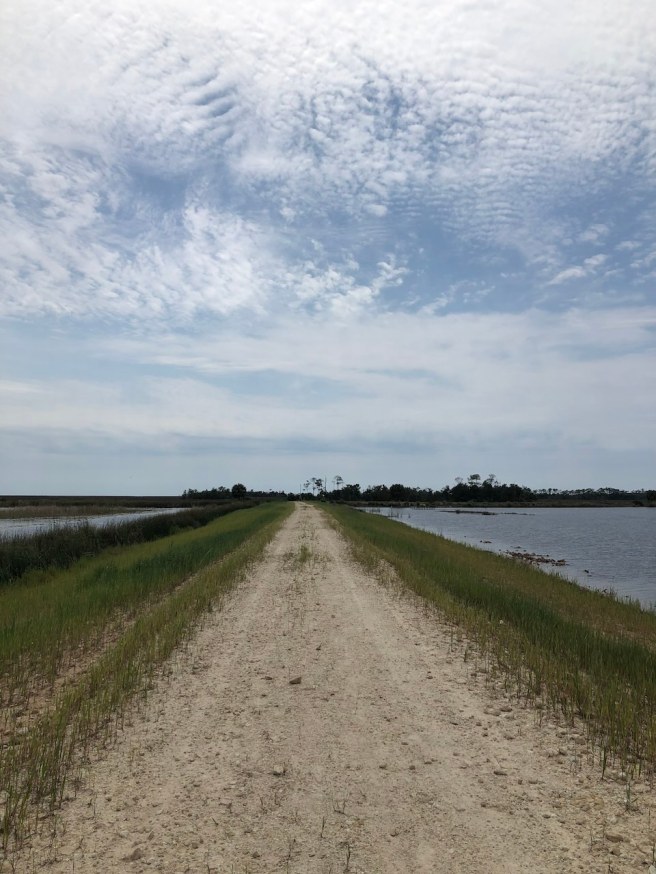
St. Marks National Wildlife Refuge, Stony Bayou, March 29, 2021
I’ve been down this dike before with you. I often veer off our path gaping at clouds in the wide blue sky, shuttering a desire to leave my bike and explore the bayous. It’s why we’re here, to feel the expanse of nature, the filling of our souls. Often ordinary but glorious cumulus clouds fill the sky.
There are clouds today but these clouds are clearly foreign, such an exotic clutter against the blue cloth of the sky. Thin cotton rolls layer above our heads. Is this what they call a “mackerel sky,” I wonder but don’t ask out loud. You wouldn’t hear me anyway. You’re too far ahead. I always fall behind when we travel this dike. I want to stretch my arms, embrace the whole of the sky. I fall in love with these clouds like I fell in love with you.
***
I’m participating in Merril’s prompt for dVerse Prosery Monday. Click here if you want to join in. Frankly, I have no idea what I’m doing, but I seem to be attracted to challenges where I’m limited to 144 words or less. I suspect it’s because I’m working on a novel … lol.
I felt the staccato snap of each vertebrae in my spine as I lengthened and then twisted my torso in Trikonasana (Triangle Pose) and wondered how much longer I could keep looking up at the ceiling before I lost all feeling in my neck.
The yogi urges me to take two more waves of breath and then release—slowly—back up to Virabhadrasana II (Warrior Two).
Pause.
Then I am exhorted to drop my right arm down and behind, grazing the back of my left thigh with my hand, and lift my left arm, shining my heart to the ceiling for Reverse, or Proud, Warrior.
I inhale,
then exhale,
then inhale and slowly straighten my left leg for Stargazer, my favorite pose because it reminds of you.
I imagine us both reaching for the stars, me metaphorically and you literally with your fancy camera and telescope.
The shutter of your camera snaps in time with each of my vertebrae.
***
I wrote this a few years ago in an online poetry class. I don’t know what you call it, if it’s a poem or just a bunch of sentences. The form was originally one paragraph but I like this better. I was practicing yoga one night at a local studio and, yes, thinking about my husband who was out in the wilderness taking photos of the stars.
First, the confession: I’ve been away in body as well as in mind. For two years my husband had been planning this road trip. For one year, it’s been almost an obsession with him and then with me. And, into the mix, as if it weren’t enough to be planning and obsessing over a road trip, I started a course of study that might lead me to a “second career.” (See my previous post here.) Sometimes I think I purposely set up roadblocks to writing. Anyone else I know would have been blogging about this trip, before and during. But not me. No, I was discreet. Only those who had a need to know knew of our plans. Now I’m back to my hot, humid home and our three cats who have (yet again) proven that they are loyal to whose-ever hand that feeds them, be it my hand or the pet sitter’s.
I’ll write about our trip later. For now I’ll just say that we drove to Casper, Wyoming, to view the Total Solar Eclipse. We saw it. It was a sight that will last me the rest of my life. Now, on to my review of Luanne Castle’s chapbook: Kin Types.
***
Click on this cover to go to Finishing Line Press.
I took Kin Types on the road with me. It’s a very slim volume of poems which I received in the mail only a few days before our trip. I slipped it into one of my bags, sensing that the thirty pages of poetry and prose belied a depth and density that I’ve come to anticipate with Luanne’s writing. And yet I still wasn’t prepared for the wealth of stories I found among those pages.
Our first night out, in Olive Branch, Mississippi, I pulled Kin Types from my bag, thinking I would read a poem or two while my husband showered, before we turned off the lights. Instead, I read all the poems, totally captivated by the stories of Luanne’s ancestors. In her acknowledgement, she wrote:
for those who came before me
whose stories I was privileged
to try to inhabit, if only for a moment
Thanks to Luanne and another friend of mine (I’m talking about you, Jane), I’ve developed an interest in my own ancestry: who was it that came before me, what happened to them, how (if at all) their existence has informed my own, besides the obvious connection of DNA. So, with a slight chill, I read the first sentence of “The Nurturing of Nature and its Accumulations”:
Anything that happened to my grandmother before she got pregnant imprinted the genes she shared with my father and then with me.
When we study our ancestry, we are trying to learn about ourselves. It’s an ego trip. It’s “all about me.” There is that element in Luanne’s poems, that she unearths these stories in order to learn more about herself, about how “those who came before” her made her who she is today. With Kin Types, though, the self interest is but one element. Luanne writes these poetic portraits with such sympathy, with such deep understanding (appreciation, perhaps even love) for the circumstances each ancestor faced and suffered through, that they almost literally walked off the page and into my heart. The most poignant of these is “And So It Goes,” a prose piece that reads like a novel, the courtship and separation (through death) of Pieter and Neeltje, their beginning and their end. Americans like to romanticize our ancestors’ struggles as they set new roots in what was a “new” world, trying to escape poverty or boredom, oppression or suppression. But their lives, especially the women’s lives, were not the stuff of romantic adventure:
Neeltje did things without fanfare or explanation, and that’s how she died. [. . .] he realized that even though she’d been at his side since their teens, he had the sense he didn’t know her. [. . .] He’d made her a mother many times over, but she had been only a girl.
Death is everywhere in these poems, as it was everywhere in the lives Luanne writes about:
Nine children born to Neeltje. Two funerals. (“And So It Goes”)
Gerrit is buried / twice, once in Santiago and / later near his brother in Kalamazoo. (“More Burials”)
His dark blond curls were so / like her brother Lucas when a baby / and not yet the young man she kissed / in his black coffin. (“New Life, New Music”)
She listens to her husband outside the church / door, reads the casualty lists, hovers around / those waiting. Now her big brother’s letter / like his touch on their dying mother’s cheek, / is enough. (“Once and Now”)
One, / two, and then a third was lost / and a fourth born. (“The Fat Little House”)
Death is everywhere but so is life. The death of babies, of brothers to war, of women dying without “fanfare or explanation” occurs among the birth of babies, the growth of families, the setting of roots. It is history; not just that of Luanne’s ancestry but of everyone’s ancestry.
What Kin Types did for me, both as a writer and a reader, is help me realize that my own family history, presumably boring and uneventful compared to those who can claim lineage to kings and generals, was anything but boring and uneventful for the people who lived those lives. Their lives might only be expressed in a few handwritten lines across decades of census taking, a marriage certificate here, a death certificate there. Only a few photographs may exist. But each atom of information is a spark to a story.
Like DNA, the histories found in Kin Types are the building blocks of a poet. Luanne’s poetry gives her ancestors’ stories a living, breathing quality that make them unforgettable. I’m grateful to Luanne for sharing her histories and for inspiring me to continue my own exploration.
***
If you don’t already know Luanne, please visit this post where she graciously answered my questions about writing poetry: An Interview with Luanne Castle.
You can get your own copy of Kin Types at the Finishing Line Press website: Kin Types.
Hello, everyone, I have a guest today: poet, family historian, and fellow cat hoarder lover, Luanne Castle.
Many of you might already know Luanne from her blog, Writer Site, or her website, Luanne Castle, or perhaps you’ve already read her first book of poetry, Doll God, winner of the 2015 New Mexico-Arizona Book Award.
I’m excited to tell you that Luanne has a new chapbook coming out, this one with poetry AND prose AND women’s history.
Luanne and I thought it would be fun to lob her a few questions about poetry writing, something I’m always fascinated by but wary of trying.
How did you decide to make Kin Types a collection of poetry and prose? Why not just poetry?
The mixed genre came about because a couple of paths I was on coincided.
My first book, Doll God, is a collection of lyric poems, the type of poetry I had been writing for years. Then you and I took that flash nonfiction course from Apiary Lit with Chelsea Biondolillo. I had signed up so I could try out a new genre. The experience took me to the border between nonfiction and poetry—and when I saw the border, I realized that it was a movable, even erasable border. We wrote prose poems and lyric essays. We experimented with embedding documents into our own writing. I felt so free to be able to move freely and spontaneously between two genres I love: poetry and nonfiction prose.
Since 2012 I’ve written the blog The Family Kalamazoo showcasing family stories, the results of genealogical research, and antique photographs from my family collection. Although I had worked on this research off and on since college, the blog gave me a connection to strangers who held information to what I was researching. And as I wrote up stories for blog posts about various ancestors, neighbors of my ancestors, and others, I loved making the connections between documents–such as census reports, death certificates, and newspaper articles—and the shaping of story.
After taking the Apiary course, the work I had been doing for The Family Kalamazoo began to inform my writing. I wrote poems, prose poems, and flash lyrical essays based on my research. The stories of these people—especially the women–who had been long dead began to come alive for me. They lived in my dreams and my waking thoughts; they informed my conversations and decisions. When I began to compile the pieces into a chapbook, I couldn’t leave the lyric essays behind just because they weren’t technically considered poetry. To me the prose and the poetry were the same thing: imaginatively informed, lyrically described stories of real people who lived before us.
How do you write poetry? I took an online poetry class a few years ago and was fascinated by the different ways poets wrote. One poet described how she would start with one word and then build word associations until a poem emerged. Others were more interested in form, like how can to describe a sunset in a haiku.
I usually write a poem after I notice something beautiful or strange or an oddity I am curious about. This new image strikes against something I already know. Maybe I see a mother quail pushing a newly hatched chick out of the nest and wonder why. I might do a little research, and my mind starts receiving lots of images and it’s as if a match has been struck and the flame leaps from its tip. That’s the beginning of the poem. If I push it too soon, it doesn’t work, but when the time is ready I might add in another essential element. I might mix elements of a traditional fairy tale with scientific theories from astronomy or physics. It’s the juxtaposition, the balance, the fight between disparate parts that make some of the best poems.
I want to explain what I mean by my mind getting images from research. I don’t record dry facts very well. My brain converts information into images. In this way, science and nature are gifts to me because what scientists think of as facts, I process as sights, sounds, smells, touch, and taste. Poems crave images, not information or facts.
In many of the Kin Types poems, the juxtaposition or fight that produces poetry comes from the interrogation of supposedly factual historical documents with the nuances of complex emotions and hidden and unrecorded human dramas. In one poem I took an early death of a mother and studied what happened to her young son after he and his siblings were orphaned. I wrote the poem from her perspective as if she could see from beyond the grave what had happened to her children. Who could feel more about their paths in life than their mother? In Kin Types I converted fact into image to create what the reader feels from a poem.
Although I have worked with form as a writing constraint, that process is not how I usually come to a poem. A writing constraint is always helpful. It can be arbitrary: write a poem in 10 lines of 10 syllables each and include the word orange. Or it can be specific: write a Shakespearean sonnet. But the point is that by hitting up against the boundaries of the constraint the poet doesn’t have the whole world from which to create a poem. It focuses and helps the poet shape the poem. Form is the typical way to create constraint. A sestina, a villanelle, a sonnet, these all are an aid. For me, however, I find that my best work doesn’t come from having to adhere to a certain form, but letting the poem find the form that is most suitable for it. So some poems want to be prose poems. Some want to be skinny and long free verse. But I could change my mind tomorrow and start to write in a particular form. The variety is astonishing, and I don’t want to settle into a familiar old groove.
How do you know when a poem is complete, finished, ready for prime time? Prose seems to be relatively easy to figure, especially, of course novels and short stories. Even flash fiction often has the expected beginning, middle, and end. But poetry is different. Or is it?
That’s the big question! It even warranted a poem written about it by Naomi Shihab Nye. It’s called “How Do I Know When a Poem Is Finished?” In the most practical sense, as with any writing, only the editor has the final say on when a piece is finished. I’ve had poems and stories published with no changes made and others where an editor has several eager ideas—sometimes fabulous, sometimes mysterious. I’ve also published a piece with changes by an editor and then reprinted the same piece and the new editor has different ideas for changes. At least once, the advice was contradictory. Feeling a piece is finished is the same for me whether it’s a poem or prose. When I’ve let it gel for a couple of weeks, if not longer, and have revised as much as I feel I can, I either need a second opinion or I feel good about the piece. If I feel that I want to share it with readers and not an editor, it’s a go. But, still, occasionally I’ll read something I’ve published and want to reach into the letters on the page or screen and snatch some, re-arrange, or add a few.
***
Many thanks to Luanne for answering questions I’ve always wanted to ask a poet! I hope you, Dear Reader, have enjoyed this and are eager to pre-order your copy of Kin Types. If The Finishing Line doesn’t get enough pre-orders, then Kin Types won’t go to press so waste no time because the deadline is April 28, 2017.
I’m sure by now that you’ve all heard the story of the “wovel” on NPR. (If not, you can read about it here.) The wovel is a web novel, a deceptively simple idea of serializing a novel on the web. This one has a twist that will surely create a horde of wovelites–at the end of each installment, the reader gets to vote on what happens next in the story. Victoria Blake, former editor of Dark Horse Comics, started this upstart of a publishing venture, actually posting not just a free serialized novel in which readers can direct the turn of events, but also posting other FREE writing. Yes, go to Underland and see for yourself. The wovel, Firstworld, is being written by Jemiah Jefferson, the author of a series of vampire novels including Wounds and Fiend. No, she is not a widely published author (like Stephenie Meyer, for example), but I think we should keep our eye on her. And drink up all the free prose available at Underland. Some might scoff at the idea of giving away art for free, but what better way to attract an audience?

 Many of you might already know Luanne from her blog,
 Marie at 1 Write Way