• Home
  • My Story
  • Book Reviews
  • Contact Me

Marie at 1 Write Way

  • What Is Your Favorite Writing Space?

    March 31st, 2013

    A brief exchange between me and another blogger about the need for solitude in which to write led me to thinking about what would be the perfect writing space.  Writers have lives that include families, friends, coworkers, and pets.  Those who have children (especially young children) can find it very hard to secure a quiet spot for writing, if that is what they need.  I like reading about other writers’ work spaces and see the variety from an ascetic outbuilding to a corner room overflowing with books and papers ( http://www.pw.org/content/writing_spaces; http://www.themillions.com/2012/02/where-we-write.html). I know perhaps one or two people who have the ability to tune out everything around them and be perfectly focused on their writing in the midst of total noisy chaos.  I am definitely not one of those people.

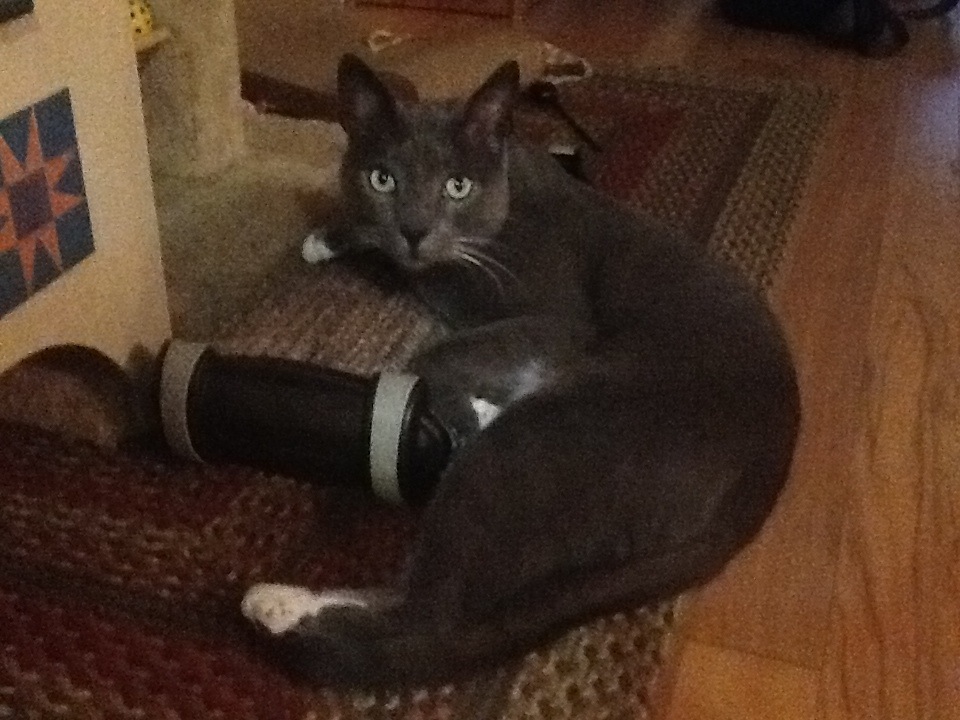
    I need complete quiet, which shouldn’t be too hard since it’s just me and my husband and three cats.  However, the oldest cat, Luisa, can be very vocal, especially when you put a closed door between you and her.  I have a room of my own where I do most of my writing, but Luisa “shares” the room with me.  When I’m in there, she has to be in there too.  If I’m lucky, she’ll eventually curl up on the guest bed and fall asleep.  Usually, though, she has to “Meow” and Me-OOOW” and paw at my chair several times before she settles down.

    Luisa

    As I face opening day of Camp NaNoWriMo, I wish I could spirit myself to the St. James Hotel in New Orleans where, during NaNoWriMo 2012, just me, my iPad and a keyboard huddled together and wrote for hours while my husband was at a conference in another hotel. My first day I wrote over 4,000 words.  What a joy it was!

    WritingSpace_NOLA

    Of course, most of those words were crap, but to have unbroken concentration was liberating.   And right now I can only fantasize about an ideal writing space.  More than likely I’ll be folded into a corner of our couch (which also serves as my reading and knitting corner) with my iPad on a TV tray and the keyboard on my lap.  If I’m lucky, I can sneak some time at work, although I can’t prevent surprise visits from colleagues and I’d probably get written up if I put a “Do Not Disturb” sign on my door.  Actually, such a sign would attract attention,  not deflect it.

    And there is that room of my own (except when I share it with Luisa).  My 20-inch Mac desktop has a lot more flexibility than my iPad; much easier to hop between Pages and Evernote and FireFox, multitasking my way through a novel.  No surprise that I write less when I’m on my desktop than with my iPad ;)  Even now, as I try to write this post, I spend most of my writing time jumping back and forth between Evernote, Pinterest, and Calibri … looking for pictures to add, downloading books to my Kobo … when I’m supposed to be writing.  So the iPad will win out as my best avenue to focused writing.  It was truly wonderful in NOLA.

    What is your favorite writing space?  How does where you write help you write?

    Do you have a fantasy writing space?  I often imagine myself going on a retreat of some sort, preferably one where everyone has to take a vow of silence.  Or a lonely cabin in the woods … or on the beach … or in the desert.  For me, location would not be so important as solitude. While I got a lot of writing done in New Orleans, it was NEW ORLEANS and so my afternoons and evenings were spent walking and eating and talking with my husband.  In other words, I could have gotten a lot more writing done if I had been in a city I really didn’t care for and if I had been by myself. Then again, you could argue I had the best of both worlds for a few days ;)

    Share this post:

    • Click to print (Opens in new window) Print
    • Click to share on X (Opens in new window) X
    • Click to share on Facebook (Opens in new window) Facebook
    • Click to email a link to a friend (Opens in new window) Email
    • More
    • Click to share on LinkedIn (Opens in new window) LinkedIn
    • Click to share on WhatsApp (Opens in new window) WhatsApp
    • Click to share on Tumblr (Opens in new window) Tumblr
    • Click to share on Pinterest (Opens in new window) Pinterest
    • Click to share on Reddit (Opens in new window) Reddit
    • Click to share on Pocket (Opens in new window) Pocket
    • Click to share on Telegram (Opens in new window) Telegram
    Like Loading…
  • Yes, I Have Regrets: Part 2

    March 27th, 2013

    In an earlier post, I wrote that I do feel regret over some things I’ve done (or not done) in my life.  These posts are driven in part by the fact that I have less than half of my life to live and I’m still not living the way I want to.  Of course, it’s taken me this long to figure out what I want to do for the remainder of my life (besides eat great food, have great sex, read great books and listen to great music, most of which I do enjoy now).  What I want to do it be true to myself.  Perhaps my biggest regret is feeling that I’ve been living (and am still living) a lie for the past 20+ years.  Career-wise, I’ve taken a path far away from where I originally started.  I was never good at math, abysmal at statistics when I was high school and college, but today I am a “health statistics analyst,” spending my days writing SQL code to make disparate data sets “communicate” so my state can eventually have a complex understanding of the health and health outcomes of its citizens.  Nice work, actually, and it pays well.  But it is not at all what I had intended, and even though the work is interesting and my coworkers are wonderful, supportive, dedicated people, I could walk away and never miss the job, never think to myself, “if only I had written more code.”

    My detour began when I was a teenager.  I grew up in a very small, sparsely populated area of the Northeast where the local jobs tended to be at fast-food restaurants.  I hated high school but I loved community college and often wondered if I could make a career out of being a college student.  (I nearly succeeded, having been to five universities/colleges, obtained two masters degrees, finished two years of doctoral coursework and a spattering of miscellaneous classes.)  The problem is I didn’t want to teach, and all my advisers argued that the only way I could write was if I also taught.  As I’ve said in previous posts (and I will say often), I am a shy, sensitive introvert.  I spent most of my childhood trying to disappear into corners and shadows.  In college, I would drop classes if any of the assignments involved presentations (except for those classes I was compelled to take in order to get my degree).  Ironically, because of my foray into public health, the list of presentations I’ve given over the last ten years is longer than the body of my resume.  But I still hate giving presentations.

    I just wanted to write, but I was too naive and introverted to figure out how to make a living at it without having to teach as well.  I was the only one in my immediate family who had even set foot in a college, and for that I was an oddity.  Becoming a teacher would have made me even more odd in their eyes.  I kept trying to come up with more marketable plans, ideas for jobs that my family would appreciate and understand (like owning a greenhouse or working in a hospital), but I was very unhappy at every thing I tried.  The only times when I was happy was when I was reading literature, writing, and sitting in class.

    So I made a hard left at a detour and moved to the other side of the continent, upsetting my family, not finishing college (yet), not knowing what the hell I was getting myself into.  On the West Coast, I had the opportunity to be true to myself but unfortunately I got stuck in a rut with drugs and drinking and general flaying about.  I was a mess.  It’s a long story about how I eventually cleaned myself up (with plenty of help from someone who is still in my life).  But once I was cleaned up and again thinking about how can I make a living as a writer, I took a hard right on another detour and wound up in the Southeast.  It’s too embarrassing to say exactly where I am.  Although the current fix I’m in has paid well and allowed me to save and anticipate a comfortable if modest retirement, it’s taken a chunk of my life.  Worse, it has nearly destroyed me as a writer.

    While I was studying writing and literature, I felt validated as a writer and encouraged by my peers and professors.  But at the time the local job market for writers and editors was pathetic and eventually I embarked on yet another detour, this time into the social sciences.  You don’t write up research findings like you write a short story.  It didn’t take long before I was convinced that I was a mediocre writer.  Only by participating in NaNoWriMo a few years ago, did I realize how I had screwed myself as a writer, let myself down by internalizing the judgments of others.

    And now that I’m facing retirement in a few years (hopefully with the same good health that I have now), I want to stop taking detours.  I want to get back on The Path and not believe it’s too late.  This blog is one step in that direction.  Zoetrope.com has made it possible to participate in a writing group without having to change out of my jammies, and NaNoWriMo gives me that somewhat gentle kick-in-the-butt to just sit down and write.  Times like these, I have regrets, but they just give me more drive to make up for lost time.
    Share this post:

    • Click to print (Opens in new window) Print
    • Click to share on X (Opens in new window) X
    • Click to share on Facebook (Opens in new window) Facebook
    • Click to email a link to a friend (Opens in new window) Email
    • More
    • Click to share on LinkedIn (Opens in new window) LinkedIn
    • Click to share on WhatsApp (Opens in new window) WhatsApp
    • Click to share on Tumblr (Opens in new window) Tumblr
    • Click to share on Pinterest (Opens in new window) Pinterest
    • Click to share on Reddit (Opens in new window) Reddit
    • Click to share on Pocket (Opens in new window) Pocket
    • Click to share on Telegram (Opens in new window) Telegram
    Like Loading…
  • March 26th, 2013

    Another thought-provoking blog post from Eric John Baker … this one on writing groups.

    The first writing group I ever belonged to was in my community college and we actually called ourselves a “literary guild.”  We had a faculty adviser and a small stipend to produce a literary magazine.  They were a very encouraging, supportive group and the faculty adviser provided much needed guidance.  Everyone was published in the journal.  No one was left out.  We also had quarterly readings and met for group readings and critiques about once a week.  For a very young writer, it was a wonderful experience.  But I was very young (still in my teens) and everyone was so much older (like 20 or so) and I was pretty much treated with kid gloves which was fine because my skin was very thin.  I wrote more than I would have without them, and my writing improved because they did offer constructive criticism.

    That said, I haven’t had quite the same experience since.  I’ve tended to “join” groups such as university writing workshops, probably trying to replicate the experience of my community college days.  I like having a faculty member who guides the group; the faculty is usually the one (for me, anyway) who offers the most useful advice.  And I have gained, both in quantity and quality, from the workshop experience.  But occasionally someone rakes you over the coals, and having that happen in public is unnecessarily humiliating.  It can stop your writing dead in its tracks and has no useful purpose.  I don’t think a writer has to have a thick skin.  She just has to keep writing.

    I recently commented on Eric’s blog about an experience I had many years ago but still resonates with me today.  I was taking an Article & Essay Writing class for my graduate degree in English. We had been assigned to small groups where each of us would read and critique the other student’s paper. A couple of students in my group were PhD students. I chose to write a book review of a biography of Virgina Woolf and was quite pleased with the scholarly style of my paper (omniscient third-person). I believed the PhD students would like it, even praise it for being far advanced for your average Masters student. But they were not pleased. They tried to be kind but before they could even get the words out I knew what they were going to say: it was boring. My paper was boring. I don’t know if there is any more devastating critique of writing but to say that it is boring. They did try to be kind (they actually were very nice people), but their struggle to find something redeemable in my review was painful to watch. And I was devastated and I know I didn’t hide it very well. Later that day I went home and cried and cried and cried. I would have stopped writing, too, except that this was for a class and I didn’t want to flunk it.

    I had to revise my paper. That was part of the course. That was the purpose of the groups: to get feedback and then revise. But every time I sat at the computer and started to revise, I broke down crying. I felt ashamed that I had even thought of myself as a writer. Still, I had to do something. And then I remember one thing that each of the students said to me: “I want to know what you think of the biography. What did the biography mean to you?” And then I realized what they meant and why the review was boring to them. It was such an objective review that there was no life to it. It was as dry as the desert. So I threw away the original and started over. I wrote about my personal interest in Virgina Woolf and why I thought this particular biography was the best of all that I had read. I wrote about why it interested me as a writer. I used “I” throughout my review.

    I submitted the final paper to the class at large and had the pleasure not only of hearing that it was wonderful to read, but also that it was far, far better than what I had originally turned in. On a lark, I sent the review to the Journal of Biography and a year later it was published. When I received the galleys for my review, I compared the edited copy to my original. They had only changed one word.

    I came so close to just giving up. Fortunately, I had an obligation to deal with that paper and, fortunately, I had received excellent advice. I had only needed to be open to it.  I only had to write the kind of book review that I would enjoy reading!

    So groups are tricky.  I’m partial to university-style writing workshops but maybe that’s because they are so familiar to me (having spent the bulk of my adult life in college).  I shy away from local writing groups because  I’m shy.  I’m not physically or psychologically comfortable in group settings.  Instead I prefer online writing groups such as Zoetrope.com.  I’ve gotten a mix of feedback from writers on Zoetrope, but there’s always at least a couple that provide good, solid criticism.  And I can read those critiques in the comfort and solitude of my room.


    Eric the Gray's avatarEric the Gray

    [Full disclosure: I do not belong to a writing group]

    Writers are often told by the experts to join a writing group. Having other writers critique your work can help you identify your weaknesses and improve your ideas, so the reasoning goes. Therefore, writing groups are good. That makes sense to me.

    I’m not convinced it’s true, though. In my recent post about self-doubt, some people commented that they lost their motivation to write or otherwise had their confidence shattered after being bashed by other writers in a writing group. I’ve encountered similar claims in the past.

    Speaking broadly, the problem with expert advice in an arts-related field is the lack of supporting science for its validity. How do we know writing groups are necessary? Because an expert said so? Because it seems logical? It’s very possible that, if you took a random sample over an appropriate time frame, a…

    View original post 498 more words

    Share this post:

    • Click to print (Opens in new window) Print
    • Click to share on X (Opens in new window) X
    • Click to share on Facebook (Opens in new window) Facebook
    • Click to email a link to a friend (Opens in new window) Email
    • More
    • Click to share on LinkedIn (Opens in new window) LinkedIn
    • Click to share on WhatsApp (Opens in new window) WhatsApp
    • Click to share on Tumblr (Opens in new window) Tumblr
    • Click to share on Pinterest (Opens in new window) Pinterest
    • Click to share on Reddit (Opens in new window) Reddit
    • Click to share on Pocket (Opens in new window) Pocket
    • Click to share on Telegram (Opens in new window) Telegram
    Like Loading…
  • Self-doubt, self-publishing, and other selfish writer-isms

    March 24th, 2013

    Self-doubt, self-publishing, and other selfish writer-isms.  This blog post by Eric John Baker is worth a read not just for the post itself, but also for the comments.  The debate of traditional vs self-publishing is still raging, only now I think with more nuance.  Not only is it easier to produce hard copies of our novels, poems, and stories, but there are also more venues for selling your work than there were just a few years ago (think:  Amazon, Smashwords).  Writers aren’t stuck with the old vanity presses that took your $$$ and gave you a printout with a cardboard cover in return.  Each route has its downside, though, and deciding which way to go is tricky.  Getting picked up by a traditional publisher can take years, even with an agent.  Sending out submissions can be time-consuming, costly (postal fees), and deflating (as when the number of rejections you get equal the number of submissions you’ve sent).  Self-publishing might be less expensive (relative to postal fees of submissions) and quicker, but then who is going to market your book, who is going to make it sell?  Then again, even in traditional publishing, writers are expected to go on book tours.  They might have help with their itineraries, perhaps some of their travel expenses are reimbursed.  But they are the ones selling their books, they are the ones doing the hawking.  Getting published by a traditional press might give a writer a bit more “legitimacy,” but the writer still has to put as much if not more work into the process, especially post-publication when the book is suppose to sell and make the publisher a lot of money.

    I suspect that eventually I will self-publish.  I’m not a patient person generally, and I’m getting less patient as I get older.  I am easily dismayed by rejection letters (especially form letters).  And I’m an introvert, a shy, sensitive introvert.  Not the person you want to send on a book tour.  I won’t give up entirely on traditional publishing.  I can still keep submitting and hope that the rejection letters eventually become more personalized.  But given the short time-frame I have before me, the best I can hope for is to bring a novel or collection of short stories to a point where it is ready for prime-time (meaning I will employ a professional editor) and then self-publish and, in my own quiet way, spread the news and hope for the best.  And the best might be the two or three total strangers who pay to read my book.  And that will be okay.

    Share this post:

    • Click to print (Opens in new window) Print
    • Click to share on X (Opens in new window) X
    • Click to share on Facebook (Opens in new window) Facebook
    • Click to email a link to a friend (Opens in new window) Email
    • More
    • Click to share on LinkedIn (Opens in new window) LinkedIn
    • Click to share on WhatsApp (Opens in new window) WhatsApp
    • Click to share on Tumblr (Opens in new window) Tumblr
    • Click to share on Pinterest (Opens in new window) Pinterest
    • Click to share on Reddit (Opens in new window) Reddit
    • Click to share on Pocket (Opens in new window) Pocket
    • Click to share on Telegram (Opens in new window) Telegram
    Like Loading…
  • Why Did Creighton Commit Suicide?

    March 21st, 2013

    Recently I finished the first season of Treme. By the last episode I was truly hooked. I had wiped away tears when LaDonna’s brother was finally found (dead), sung along with Davis as he recorded his campaign song, swayed to Antoine’s “bone”, and embraced Creighton’s righteous rages on YouTube (FYYFF!). And as one who loves literature and whose greatest influences were English teachers, I embraced Creighton himself. How I would have loved to have had classes with him! I wanted him to keep “speaking Truth to Power,” and to write the book he wanted to write.

    And then they killed him. The writers had Creighton do something that was not only unexpected, but seemingly out of character.  Oh, they dropped heavy hints:  his passionate kiss good-bye to his wife, stopping his daughter to tell her he thought she looked very pretty, his calmness before the storm.  And The Awakening.  OMG, he’s talking about Edna’s suicide as if it were some hard-fought-for prize.  I practically shook my flat-screen TV, screaming at Creighton not to look so longingly at the water, as if that were the only place he would find peace. I could barely sleep that night, asking myself the same question over and over: Why? Not just, why did Creighton do it; but also, why did the writers do it? Why did the writers choose suicide for Creighton and not the stroke or heart attack that seemed far more likely given his appetites, girth, and volatility.  Why not the death that seemed inevitable if boring?

    I found an answer of sorts in a paper by Julia Leyda (http://www.academia.edu/1682220/What_a_Character_Creighton_and_Excess_in_HBOs_Treme_Draft). Leyda points out little clues or red flags spread across Season 1 that suggest Creighton was a doomed character. He was already going off the edge in the very first episode when he lost his cool with the British interviewer and threw the man’s microphone in the water. I thought that whole scene was funny. I was used to seeing Goodman perform outlandish, crazy characters (think The Big Lebowski) and I thought Creighton was more of the same. Yes, there were hints that all was not right with him, that he was stressed and probably depressed. But I don’t think those hints add up to suicide. They could have led to more and more drinking, maybe smoking, more behaviors that would have led to a “natural” death. Was a natural death for Creighton too “banal” for the series’ writers?

    And here’s my true gripe:  I think the Treme writers got lazy. For whatever reason, Goodman wouldn’t be back for Season 2 so they had to get rid of Creighton. What’s easier than a suicide? Guy jumps in water, family devastated, life (and series) goes on. Except Creighton had less reason to kill himself than any of the other characters, and he had the best reasons to live (mainly, a loving and lovingly eccentric family). And it seemed so out of character that Creighton would think his suicide would be anything less than a betrayal to his family. He, of all the characters, would know how cruel such an action would be.

    I don’t buy Creighton’s suicide. I don’t buy that such an important character, one that, “in his excesses and extreme emotions such as grief and rightgeous anger, represents that city’s critique of the failures that led to the devastation” (Leyda), would off himself in the first season. Maybe in the second season … maybe, but then, I think not.

    Share this post:

    • Click to print (Opens in new window) Print
    • Click to share on X (Opens in new window) X
    • Click to share on Facebook (Opens in new window) Facebook
    • Click to email a link to a friend (Opens in new window) Email
    • More
    • Click to share on LinkedIn (Opens in new window) LinkedIn
    • Click to share on WhatsApp (Opens in new window) WhatsApp
    • Click to share on Tumblr (Opens in new window) Tumblr
    • Click to share on Pinterest (Opens in new window) Pinterest
    • Click to share on Reddit (Opens in new window) Reddit
    • Click to share on Pocket (Opens in new window) Pocket
    • Click to share on Telegram (Opens in new window) Telegram
    Like Loading…
  • An important public service announcement

    March 16th, 2013

    Share this post:

    • Click to print (Opens in new window) Print
    • Click to share on X (Opens in new window) X
    • Click to share on Facebook (Opens in new window) Facebook
    • Click to email a link to a friend (Opens in new window) Email
    • More
    • Click to share on LinkedIn (Opens in new window) LinkedIn
    • Click to share on WhatsApp (Opens in new window) WhatsApp
    • Click to share on Tumblr (Opens in new window) Tumblr
    • Click to share on Pinterest (Opens in new window) Pinterest
    • Click to share on Reddit (Opens in new window) Reddit
    • Click to share on Pocket (Opens in new window) Pocket
    • Click to share on Telegram (Opens in new window) Telegram
    Like Loading…
  • Yes, I Have Regrets: Part 1

    March 15th, 2013

    I often claim that I have no regrets, that life happens and it all works out in the end.  Like, if I hadn’t had that accident that nearly amputated my leg, I wouldn’t have received training for a new job and I wouldn’t have gotten a new job at the firm where I eventually met my future husband.  Except I don’t really mean that.  I do have regrets.  Lots of them.  And for that incident in particular (because the accident was in fact my fault), I always think that we would have met up some other way, if it were truly our destiny to be together.  I’m a romantic but not so much of a masochist that I think I should have had to injure myself to meet the man of my dreams.

    I don’t wallow in my regrets (at least not often), but I try to learn from them.  Like, when I gained a chunk of weight because (in part) we had moved from an urban area where my feet were my primary mode of transport to the suburbs where the Almighty Automobile rules the streets.  I didn’t make the necessary effort to keep my weight in check so while adjusting (badly) to the odd concept that I had to make time to walk, my clothes got tighter and tighter.

    That weight gain was regrettable because there came a time when I needed very much to feel sexy and attractive, and I was anything but.  Just roll me in flour …

    Adding insult to fattiness, I’ve had to double-down with exercising and dieting.  I’ve got my waist back along with a more presentable butt, but I still have a long way to go to get back to my pre-suburbs weight (if ever).  At least I don’t feel as self-conscious in downward facing dog as I used to.

    Lesson learned is that when the weight comes off, it must stay off.  Think black lacy thongs.  Not an attractive thought where you’re 20+ pounds overweight.  So the weight is being shed slowly but surely, and one at a time the thongs are moving from the bottom of my underwear drawer to the top.

    Share this post:

    • Click to print (Opens in new window) Print
    • Click to share on X (Opens in new window) X
    • Click to share on Facebook (Opens in new window) Facebook
    • Click to email a link to a friend (Opens in new window) Email
    • More
    • Click to share on LinkedIn (Opens in new window) LinkedIn
    • Click to share on WhatsApp (Opens in new window) WhatsApp
    • Click to share on Tumblr (Opens in new window) Tumblr
    • Click to share on Pinterest (Opens in new window) Pinterest
    • Click to share on Reddit (Opens in new window) Reddit
    • Click to share on Pocket (Opens in new window) Pocket
    • Click to share on Telegram (Opens in new window) Telegram
    Like Loading…
  • Public vs Pubic Hair

    March 10th, 2013

    For as long as I can remember, I’ve been obsessed with my body hair.  Except for the hair on my head, I hate my body hair.  I shaved my legs for the first time when I was 12 and have nurtured a deep resentment toward my body hair every since.  I am near neurotic about plucking errant hairs from my upper lip and eyebrows, but that pales compared to the disdain I have for the hair that sprouts below my waist.  I have done everything short of electrolysis and the Brazilian wax.  I am truly dismayed that my body hair has not diminished over time; rather, it’s done the opposite.  Possibly due to a cruel twist of fate, the hair below my waist and on my face has thickened and darkened as if to say, “I’ll make a man out of you yet!”  I fight back as best as I can without breaking the bank for weekly wax jobs.  I draw the line at Brazilian waxes for the totally sensible reasons that I am (1) totally opposed to pain and suffering, and (2) at my age, I don’t think a hairless mons veneris would be terribly attractive, least of all to me who would have been the one going through the pain and suffering.  And I have done some research (both visual and conversational) on pubic hair removal.  Results are mixed.  Women I’ve met who have had Brazilian waxes were usually happy to let their pubic hair grow back.  Porn films I’ve surveyed (yes, really, I’ve watched porn just for the sake of analyzing the variety of hairy to hairless Venus mounds) reveal that some women apparently shave (mons veneris with a 5 o’clock shadow), some like to leave a little tuft of hair (aesthetics?), and some seem to have indulged in the full Brazilian wax thing.  I’m trying to find a happy in-between …

    The best thing about waxing is that, if one is disciplined (which I tend not to be), eventually the hair does thin and grow back more slowly and sparsely.  At least, on my legs.  My bikini area is another story.  Since I don’t wear bikinis, I tell myself there’s no urgency to wax there.  Of course, it’s also awkward and somewhat painful.  The need to wax is all in my mind.  I spend 95% of my time fully clothed (a bit less during the summer months when sleeping naked is necessary to sleep at all).  I have a life partner who professes to love me as I am and never says anything disparaging like, “Really, couldn’t you at least trim around the edges of your panties?”  But every time I drop my pants, I cringe at the dark hair curling up between my thighs.  I’ve had some missteps with taming that hair:  an infected hair follicle from incorrect waxing can be rather painful and scary.  Shaving with a razor leaves razor burn and an almost unbearable itchy sensation as the hair grows back (as it does, rapidly).  Shaving with an electric shaver is fine for a quick deforestation, but it only lasts for a few hours.  Who cares?  Who cares except me?

    If it weren’t for the scars on my thighs and lower right leg, I might not care at all.  When I was 23, I severely injured my lower right leg.  Now it is disfigured and the skin on the front of my thighs look like a peach-and-white patchwork quilt.  Adding insult to injury, hair grows on only half of my lower right leg, the half that was not injured, the half that was not skin-grafted.  So, unless I tackle the hair on the rest of my body, I look and feel like a freak.  So there it is.  You’d think I’d be over it by now, but, no, not even close.  Recently I called my partner from the mall crying because, when I was trying on shoes, I got a glimpse of my leg in a mirror and saw it’s ugliness.  I see my naked leg every day, sometimes several times a day, but seeing it in a mirror, seeing it as other people must see it, is always a kick in the stomach.

    So I obsess and curse the hormones, genes, whatever, that cause my body to sprout hair where (in my opinion) it has no place being.  And I keep waxing.

    Share this post:

    • Click to print (Opens in new window) Print
    • Click to share on X (Opens in new window) X
    • Click to share on Facebook (Opens in new window) Facebook
    • Click to email a link to a friend (Opens in new window) Email
    • More
    • Click to share on LinkedIn (Opens in new window) LinkedIn
    • Click to share on WhatsApp (Opens in new window) WhatsApp
    • Click to share on Tumblr (Opens in new window) Tumblr
    • Click to share on Pinterest (Opens in new window) Pinterest
    • Click to share on Reddit (Opens in new window) Reddit
    • Click to share on Pocket (Opens in new window) Pocket
    • Click to share on Telegram (Opens in new window) Telegram
    Like Loading…
  • A Horror Story: When Readers of a Self-Published Book are Offered Refunds (and Not By the Author Herself … But She’s Paying for Them)

    March 8th, 2013

    For anyone who is self-publishing in the hopes of attracting a publisher, here’s a horror story for you:  If A Publisher Offers You a Contract for Your Self-Published Book, Will You Be Forced (By Amazon) To Refund Past Customers Who Bought It?.  You can also read the writer’s original post here: http://www.jamiemcguire.com/amazon-beautiful-disaster-emails/.  What is happening to this author doesn’t make any sense at all.  The original book isn’t “defective” like a short wire in a waffle iron (and then those companies rarely inform their customers of the defect and offer a refund).  Is (part of) the lesson that one avoid doing business with Amazon?

    Share this post:

    • Click to print (Opens in new window) Print
    • Click to share on X (Opens in new window) X
    • Click to share on Facebook (Opens in new window) Facebook
    • Click to email a link to a friend (Opens in new window) Email
    • More
    • Click to share on LinkedIn (Opens in new window) LinkedIn
    • Click to share on WhatsApp (Opens in new window) WhatsApp
    • Click to share on Tumblr (Opens in new window) Tumblr
    • Click to share on Pinterest (Opens in new window) Pinterest
    • Click to share on Reddit (Opens in new window) Reddit
    • Click to share on Pocket (Opens in new window) Pocket
    • Click to share on Telegram (Opens in new window) Telegram
    Like Loading…
  • On the fence with Christopher Hitchens

    March 2nd, 2013

    Seems like one either loves or one hates Christopher Hitchens (http://www.thedailybeast.com/newsweek/2013/02/25/richard-seymour-s-tawdry-christopher-hitchens-bio.html).  I was in either camp at different points in Hitchens’s life.  My antipathy toward Hitchens had started with his relentless attacks on Clinton during Clinton’s presidency and while Hitchens was writing for The Nation.  At first, I was mostly disenchanted, throwing off Hitchens as just a gadfly who liked to stir things up and get talked about.  I’m not an apologist for Clinton, but I often felt that Hitchens (and others) were always lying in wait for Clinton to screw up so they could crow and strut about in their righteousness.

    His support for the 2003 invasion of Iraq was the tipping point for me.  I wanted nothing to do with him after that.  I don’t think I actually believed that he believed that the invasion was a good thing.  Rather, to me, he was just pandering.  He was a narcissist who would say and do anything to get airtime or his words in print.

    And then I heard he was dying and that he wasn’t suddenly converting to organized religion in an attempt to save his soul.  I waited for that conversion, but it never came.  What did come was his appreciation for those people who said they would pray for him, especially those who said they would pray without attaching any strings.  He didn’t slight them, ridicule them for their beliefs.  I think he might have actually felt a bit humbled, just as anyone might feel humbled when total strangers with whom you have nothing in common, wish you well, wish that you don’t suffer, wish that you survive.    A sadness crept slowly over me as I heard about or read bits and pieces of Hitchens’s last days.  I felt uneasy about his illness, his impending death.  It’s so much easier to criticize people when they are healthy and you think they are going to be around, annoying you, for a very long time.

    And then I read Mortality.  A beautiful, slim, tastefully produced volume of Hitchens’ last essays and notes.  With Mortality I began to understand that here was one very complicated guy.  In his essays for The Nation, he could be such an asshole, throwing ad hominids around as if they were bon mots of cleverness.  But in Mortality, his humanity rises to the surface.  I could feel his vulnerability, his curious attention to the cancer that would ultimately kill him, his surprise that he wouldn’t be around to see his children marry, his desire to live, his desire that his cancer have a greater purpose than just to kill him (for example, that new treatments could be tried on him and, even if they failed, what might be learned could save someone else).  Whether or not he realized it, by continuing his writing and detailing what his cancer was doing to him and how he was surviving from one day to the next, he was in fact giving that cancer a greater purpose.

    After reading Mortality, I went on a bit of a Hitchens’ binge.  I felt obsessed with him, but something held me back from going out and buying all of his books.  A friend told me how she had finished with Hitchens after he wrote an essay for the The Nation in support of 2 Live Crew and the lyrics of their songs.  She had been offended by his statements regarding rape, how rape is every male adolescent’s fantasy, wink, wink.  I was crushed.  There’s nothing funny about rape.  I tried in vain to find the essay, to read it for myself, in the hope that I would interpret his words differently and prove her wrong.  I did find the context:  2 Live Crew had been arrested in Florida on obscenity charges.  OK, so this was a free speech issue, a censorship issue, but Hitchens could have supported 2 Live Crew’s right to free speech without calling their lyrics “poetry” and suggesting that since rape is every male adolescent’s fantasy, we are hypocrites if we are offended by those same lyrics.

    Looking for this essay brought me to his other essays excoriating Bill Clinton and Elie Wiesel and my respect for Hitchens did another nosedive.

    I had to stop and think.  Hitchens was a gifted writer with an incredible store of knowledge, a facility with language that was seemingly innate.  But he was a human being who, in my humble opinion, did not always use his gift in ways that were respectful of it.  His ad hominid attacks were nothing for him to proud of, no matter how “funny” or “humorous” his admirers claimed they were.  People who engage in such attacks are not advancing the discussion, the debate; they are distracting us from it.  They are showing off; you don’t necessarily come away any more enlightened about the subject than you were when the debate started.  Hitchens was merely being an entertainer and a glib one at that.  He was an extrovert who seemed to engage in little if any introspection.

    In an interview with Mother Jones (http://books.google.com/books?id=IecDAAAAMBAJ&pg=PA12&dq=christopher+hitchens+rap+Jack+and+Jill&hl=en&sa=X&ei=-VYyUe6iMeTx0wGN2oGABg&ved=0CDAQ6AEwAA#v=onepage&q=christopher%20hitchens%20rap%20Jack%20and%20Jill&f=false)  he claimed surprise that anyone would think he was a misogynist.  Best as I could tell, his surprise was genuine.  Other interviews with him and his friends suggest he was a great friend to have, very loyal, unless your last name is Blumenthal.  Again, I think he was oblivious to how his actions, his words, his language, could do irreparable harm to a relationship that he claimed to hold dear.  I don’t think he really meant any ill-will (except, of course, toward Clinton).

    Can one be on the fence with Christopher Hitchens?  Would he turn over in his grave if he knew that I (or anyone) felt sorry for him, felt that he was a small man with a big gift?  I mean small in the sense of him being needy, like the rest of us.  We are all needy, but he certainly never wanted anyone to see him as such.  Now until his voice was adversely affected by his cancer treatments, did he realize that he was nothing without his voice (and by extension, his writing):  “To lose this ability [speech] is to be deprived of an entire range of faculty:  It is assuredly to die more than a little.”  As an introvert, I have often (and still do) take pleasure in being silent, without a voice so to speak.  But that is not Hitchens and, perhaps, that is one reason why my heart softened when I read his words.  He was his voice; without his voice, he might never have been as successful (and as polarizing) a personality as he was.

    I am still obsessing about Hitchens, clipping articles and interviews into my Evernote account and wondering why he has this hold on me now.  What does it matter?  I would have meant nothing to him if he had ever met me.  Perhaps there’s some envy here:  He wrote and said what he damn well pleased.  I am constantly censoring my own work to the point that it rarely is viewed by anyone but me. So maybe some envy, and definitely some regret that I didn’t appreciate the man more while he was alive.

    Share this post:

    • Click to print (Opens in new window) Print
    • Click to share on X (Opens in new window) X
    • Click to share on Facebook (Opens in new window) Facebook
    • Click to email a link to a friend (Opens in new window) Email
    • More
    • Click to share on LinkedIn (Opens in new window) LinkedIn
    • Click to share on WhatsApp (Opens in new window) WhatsApp
    • Click to share on Tumblr (Opens in new window) Tumblr
    • Click to share on Pinterest (Opens in new window) Pinterest
    • Click to share on Reddit (Opens in new window) Reddit
    • Click to share on Pocket (Opens in new window) Pocket
    • Click to share on Telegram (Opens in new window) Telegram
    Like Loading…
←Previous Page
1 … 109 110 111 112 113 … 121
Next Page→

Create a website or blog at WordPress.com


Loading Comments...
 

    • Subscribe Subscribed
      • Marie at 1 Write Way
      • Join 2,350 other subscribers
      • Already have a WordPress.com account? Log in now.
      • Marie at 1 Write Way
      • Subscribe Subscribed
      • Sign up
      • Log in
      • Report this content
      • View site in Reader
      • Manage subscriptions
      • Collapse this bar
    %d