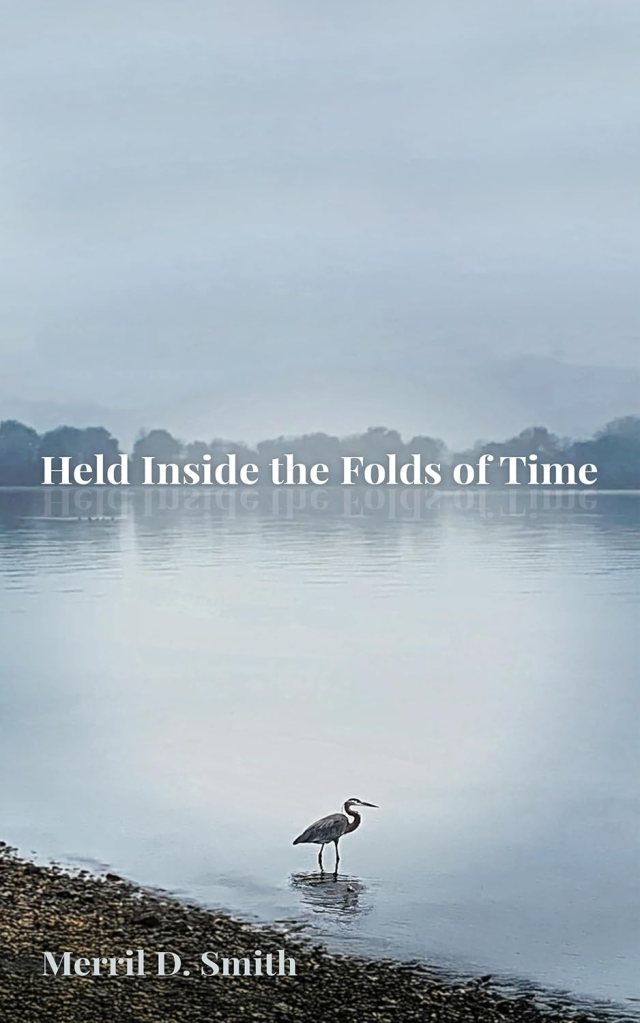
It was 4 o’clock. A pot of tea, nestled in a blue and white tea cozy that Maggie had knitted, sat off-center on the small kitchen table. Usually it would be in the center, within reach and with matching teacups and plates of vanilla biscotti forming a semi-circle. This afternoon, however, in the center was a book of poetry: Held Inside the Folds of Time.
The three cousins–Mary, Maggie, and Melissa–sat gazing at the cover, a misty shoreline with a lonely egret in muted colors of blue, gray and white.
“There’s something meditative about that cover,” Melissa said. She had picked the book for them to discuss before she put it on display at her bookstore. Maggie and Mary had been surprised by her choice: Melissa generally preferred cozy mysteries. Although they had known each other since infancy, for over 30 years, they still surprised each other.
“Well, there’s something meditative about all the photos in the book, too, and the poems.” Mary took a sip of her tea and paused. She felt Maggie’s and Melissa’s eyes on her. “The photos are beautiful, almost all nature photos, and exquisitely reproduced. I’d put a frame around any of them.”
“Oh, indeed,” Maggie said. “Jane’s Studio Press created a beautiful book. I’m glad you bought the hard cover. And the poems … ” Her eyes drifted away from her cousins and they knew to wait.
“So many of the poems mention her mother, Smith’s mother, either obliquely or directly, that sense of time passing but not memory, not the essence of the person you loved and who’s no longer with you. And … and so many of these poems, they could be about anyone, not necessarily a mother, but maybe a lover?” She looked back at her cousins. They were all widows, and they all still grieved.
Melissa took the book from the center of the table, opened it, and after leafing through a few pages, stopped and read out loud:
still, they were pages bound in a book,
the marginalia and notes
all part of the same story,
stitched together with invisible thread;
he lived hemmed in her mind’s seams, hung
on memory crossbeams, on lines
remembered and words unspoken
not in this life, not anymore,
She set down the book. “We are still “stitched together” with our husbands, aren’t we, even though they died a long time ago? I mean, I feel this way about my mom, too, sort of … we weren’t that close.”
Mary smiled. “That’s the wonderful thing about poetry. A poem can be interpreted differently depending on the reader. These poems made me feel like I was drifting in and out of time, across time, in and out of the universe. Smith takes us to other countries, helps us to see the world through the eyes of a child, looks to the past and to the future. I love what she writes here, about stars.” Mary took the book from Melissa and quickly found what she was looking for. She cleared her throat.
because if you're a star

even indigestion
is beautiful.
“I’ll never look at stars again without thinking of them as having indigestion or “laying luminous eggs / to hatch new stars, to fledge new worlds.” Stars are, like, the past and the future at once.”
“There’s so much about these poems that I love. I can’t say I have a favorite, but, of course, the last one, the one I read last, stays with me. ” Maggie took the book from Mary and opened to the last poem, “All and After.”
But I think of the prospect, extant
other worlds--the one where
you still live

in a hidden valley of improbable
possibility,
separated from me
by a dimensional barrier--

your outstretched hand
(floating)

never--but almost--
touching mine.
She looked up at her cousins. “Wouldn’t it be fun to read each of these poems to each other? Kind of like we’re already doing?”
Melissa and Mary froze, their cups of tea just inches from their lips. Mary gave a sideways glance toward Melissa.
“You chose the book, Melissa.” Mary cocked her head. “Should we have a formal reading?”
Melissa took several sips of her tea before putting the cup down. She looked hard at Mary and then Maggie, noting their failed attempts to not smile at her. “Okay, fine. But then why not invite Randy … ” (Mary raised her eyebrows.) “… and a few other people.” She suddenly sat up straight. “I got it! Let’s do it at the bookstore! We can invite anyone who comes in to join us! I’ll get the calendar.”
Melissa pushed back from the table and went off to get her day planner. Maggie and Mary looked at each other.
“All right then,” Maggie said. They smiled at each other as they each reached for a biscotti.
Thank you for reading! I hope you enjoyed this different kind of book review, and I truly hope this review has spurred you to get your own copy of Held Inside the Folds of Time, available at Amazon. I strongly recommend the hard copy. It is gorgeous, and a good reason to also check out Jane’s Studio Press. If you don’t already subscribe to Merril’s blog Yesterday and today: Merril’s historical musings, be sure to sign up. Her blog is full of wonderful poems and photos and reflections on world affairs, family, theater, movies, cooking and cats!
If my mother were alive today, she’d be 103. As it was, she died roughly a month shy of 100. Merril’s poems about grief and loss have helped me navigate my own grief for a mother that I mostly did not get along with, at least not until the last 15 years of her life. So I can say now that I miss her and sometimes I feel her near.
From “Frosted Rose”:
I’ve seen her. Women in shops, on streets, in care homes, on TV. My mother.
Perhaps someday, me.
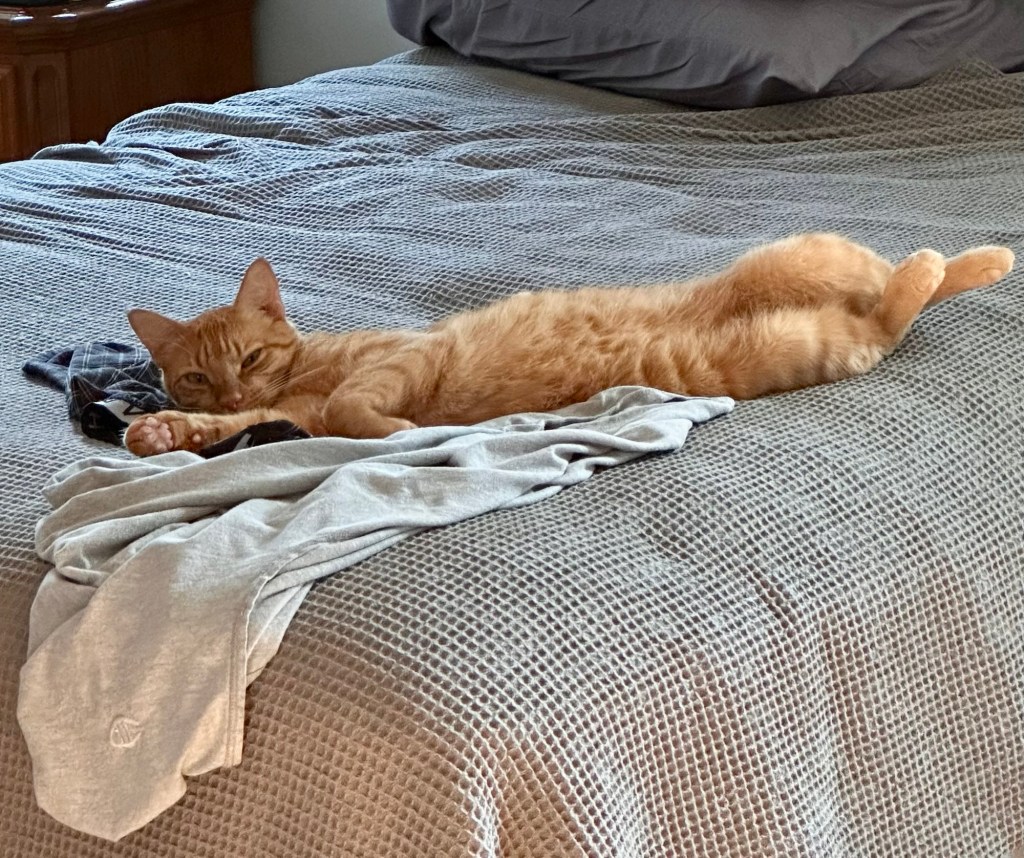
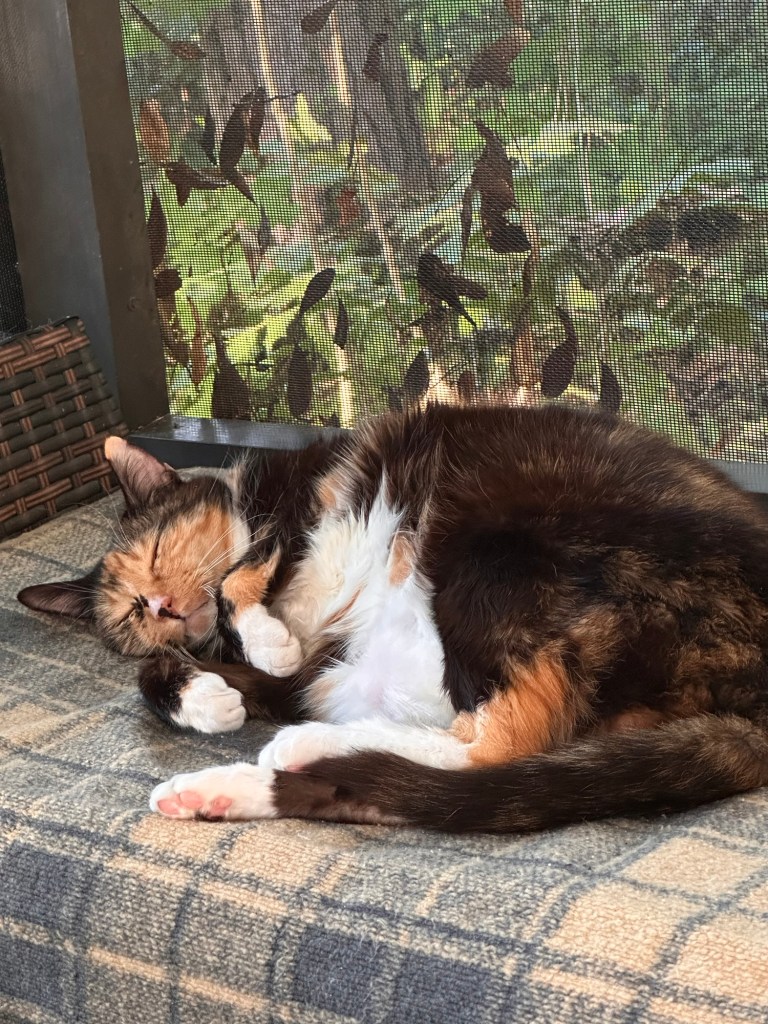
Here’s your reward for reading this far …