To all you book lovers and readers out there: Heed Rosie Amber! Book reviews are the best way to promote your favorite indie author and they are NOT difficult to write! Consider Rosie’s tips for writing a book review and then go forth and write them :)
Category: Book Review
-
A Different Kind of Book Review: Eating Bull by Carrie Rubin #MondayBlogs #bookreview @sitting_bulls
Hello, dear friends. I’m on a roll. Make that a whole-grain roll. Here is another “different kind of book review,” this time of Eating Bull by Carrie Rubin. Carrie is not just a writer but she’s also a physician and public health advocate, a powerful combination evidenced by her novel. I’d add humorist as well since she’s quite adept at that humor so particular to the medical professions. You have been warned.
Without further ado, a different kind of book review of Eating Bull …
***
Maggie stared at the plate of garlic french fries that the waitress had just placed in the middle of their table, after also depositing a black-bean burger with Provolone cheese in front of her, a quarter-pound Angus burger with blue cheese in front of Mary, and one with Brie in front of Melissa. Beside each of their plates stood tall glasses of iced Coke Zero. “Save room for dessert, ladies! Today we have several kinds of cheesecake!” The waitress trotted away from them, her blond ponytail bouncing away, her petite figure hugged gently, almost lovingly, by stretch denim.
“Bet she doesn’t eat here.” Melissa scowled, shrugged and then took a bite of her burger. Melissa was thin too. No matter what she ate or how much she ate, she had always been and, no doubt, always would be thin. She was thin to the point of angularity, but aside from a couple of bad spells when she stopped eating because of stress, she had, best as her cousins could tell, a healthy appetite.
And for that, Mary and Maggie harbored some resentment toward her. They both “watched” their weight and seemed to be in a perpetual struggle to just maintain the status quo. For Maggie, that meant walking an extra mile or two whenever the waistband of her favorite jeans was a bit too snug for comfort. For Mary, it meant fasting until she get her jeans zipped without having to lie on the bed.
Maggie hadn’t touched her food yet and was still staring at the fries, their delicate garlic scent making her stomach grumbled.
Melissa looked her. “It’s like that line in the book: ‘Like a dog in search of a bone, he longed to scamper after the scent.’ All the smells in this restaurant conspire to make us hungry, or think we’re hungry.”
“Oh, but we are hungry. It’s been, what, six hours since breakfast? I don’t feel guilty about ordering this food and, Maggie, you shouldn’t either.” Mary wiped away some blue cheese that frosted the side of her mouth. “Just skip supper tonight, or have something light.”
Melissa snapped her fingers in front of Maggie and her cousin jerked back to awareness.
“Sorry, I was just thinking. Thinking of why we had decided to discuss the book here. I mean, it’s about obesity and serial killers for goodness sake and we’re sitting here with the vehicles of death ready for consumption.” Maggie popped a few fries into her mouth and then picked up her burger, eyeing it for the best line of attack.
Mary snorted. “Vehicles of death! Well, I get it. I have to admit, after reading Eating Bull, I didn’t think I’d ever have a burger again. Thank goodness, we don’t have any fast-food places in this town.”
Melissa nodded and scarfed down a few fries. “But that’s only because we have too small a population. Even when the slopes are open, most skiers stay across the lake, not here. And there you do see places like Mickey D and Burger King.”
“Well, since we’re here and we think we can rationalize eating burgers while discussing the novel, what did you think of it?” Maggie had chosen Eating Bull for their book club so she could rationalize steering her cousins to do the discussing while she ate.
“Oh, I loved it,” Mary mumbled through a mouthful of fries. She swallowed, then took a big gulp of soda. “I don’t think I’ve ever come across a thriller that made me laugh. Carrie Rubin has that kind of humor you hear among medical and public health professionals, all very tongue-in-cheek but still spot-on.”
“Yeah, she has that unflinching perspective. How did she describe one character? “Her wide ass an egg crate of dimples”? Egad, I had to drop the book and then my pants to check out my own butt when I read that!” Melissa laughed out loud, something she rarely did. Her cousins stared at her for a moment, incredulous that, of the three of them, she’d be the one worried about what her ass looked like.
“Out of context, some of her descriptions may seem harsh, like when Jeremy describes his presence as like “an orca in a kiddie pool.” But it was Jeremy thinking that about himself, so I felt okay about laughing, but then I also felt sad.” Mary pushed around the fries with her fingernails, as if unsure whether to have any more.
“Yes, there’s the humor, the dark humor, but I was also impressed with how sympathetic she made the serial killer.” Maggie pushed aside her plate, her burger half-eaten. “I don’t know if schizophrenic is the right word or not, but he hears a voice, something telling him what to do. He’s a very sick man and at the extreme end of the spectrum on health and fitness. Jeremy was at the other end. His mother, Connie, somewhere in the middle. I thought of her as being like the rest of us. She didn’t need to be perfect. She just needed the tools and the support to live a healthier life.”
“What did you think about Sue the Warrior?” Mary smiled as she asked. She had really liked the character of Sue but she wasn’t sure why. They had nothing in common.
“She was a warrior, wasn’t she? Almost to the point of pissing me off though.” Melissa pushed her plate away, a limp piece of lettuce being the only remnant of her burger. “I mean, she had an uphill battle, trying to take on the fast-food industry, and I could understand why she wanted to. As a public health nurse, she knows it’s just not fair to expect that you only need self-discipline to control your weight and be healthy. It’s easy for people who have quick access to healthy food and safe neighborhoods, but near impossible for people like Jeremy. Every time he walked to school, he ran the risk of being beat-up by bullies, and the only safe places for him are the fast-food places.”
“Every time Jeremy thought of going to the vending machine, I wanted to yell “No, don’t go!” But I understood the pull. What’s the point of denying yourself your comfort food when you already feel like a failure? But why did Sue almost piss you off?” Maggie looked directly at Melissa, willing herself to not look at the chocolate peanut butter cheesecake being delivered to the table in front of her.
“Well, maybe I’m being a little harsh. It’s just that she was so focused on “the greater good,” that she lied by omission, keeping her husband out of the loop, endangering her life and their home. Even keeping information from Connie. She was playing with fire and sometimes she was just too righteous about it.”
Maggie nodded, practically ducking as a triple berry cheesecake entered her peripheral vision. The colors of the cheesecake also reminded her of the first killing scene in the novel. She might have to avoid red and yellow food for a while.
Mary made a loud sucking sound with her straw and then quietly burped. “Overall, what I really liked about this novel is the complexity of the characters. Everyone has flaws. Sue isn’t perfect and that makes her believable. An imperfect warrior, if you will. Jeremy is a sweet kid but also a coward, although understandably so. Connie is a good mom but has lousy judgment about men. Darwin, well, he’s a serial killer so I guess no redeeming qualities there. But everyone else has their pluses and minuses, even the minor characters.”
“And the novel’s not preachy, either. Sue is preachy, but the novel overall is not preachy. There’s a good, well-paced plot. I also like how she wrote from different perspectives, Sue, Jeremy, and even Darwin. It’s always creepy to get inside the head of a psychopath, but the why of his killing people is critical to the story.” Maggie looked around for their waitress. She waited to pay the bill and get out of there.
“And it ends as it should end, but Rubin keeps you on the edge, especially in the last few chapters. I swear, even though I figured out who Darwin was early on, part of me still felt unsure until almost the end. So many people seemed capable of being Darwin, which is a scary thought by itself.” Melissa raised her hand and snapped her fingers, calling out “Check, please” as their waitress dropped off one amaretto cheesecake and three forks to a table of three young women. For a moment, she thought … and then she thought not.
Mary piled their plates, a habit long held over from her summers waitressing at this same restaurant. “At least, this isn’t a fast-food place. I’ll grant that most of the food is high in calories, but at least it’s cooked fresh and you can make substitutions. I can’t believe I worked here after school. That was almost thirty years ago.”
“Yes, well … .” Maggie smiled up at the waitress as she handed her the check. “I am glad Jake is keeping this place in the family and not caving into super sizing everything and offering deals for more food than is safe to eat.”
As they stood up to leave, Melissa directed her cousins’ attention to the table of three women sharing a slice of cheesecake. “Next time,” Maggie said. “No burgers but we could have coffee and share one of those.” The other two smiled as they followed her out of the crowded restaurant.
***
Well, my friends, I hope you enjoyed this review and will waste no time in picking up a copy of Eating Bull, available at Amazon. Bon appétit!
-
Hello, dear friends. It’s time for another “different kind of book review.” The novel I chose is Silk for the Feed Dogs by Jackie Mallon. You might already know Jackie through her blog at https://jackiemallon.com/ And if you don’t, I suggest that you make your way over there now and have a look around. I’ll wait.
Jackie writes about fashion and most of her posts now link to FashionUnited. Jackie has such a wonderful way with words that even if I don’t have a clue about the designer or design she is writing about, I still enjoy reading her posts. And I always learn something. Much as I felt upon reading her novel. So, without further ado, a different kind of book review …
***
Maggie pulled open the little drawers of the antique Singer sewing machine. They were full of bobbins and feet for every possible stitch. The apparatus for the zig-zag stitch was in its own plastic green box. The machine had been her mother’s, handed down by her maternal grandmother. Maggie’s mom had sewn most of her clothes when she was little, the machine humming through the day, somewhat like the “whirr of the Singer, which was neurotic, and monotonous” that Kat’s mom had used.
Maggie had finished reading Silk for the Feed Dogs by Jackie Mallon and felt obliged to reacquaint herself with her sewing machine, if not sewing itself. Maggie was a knitter, not a seamstress, and she was reconciled to that, although … .
Mallon’s novel about a young Irish woman named Kat who goes from an Irish dairy farm to a high fashion house in Milan reminded Maggie that once upon a time she had fancied finding herself in fashion. Like Kat, she had had an eclectic but creative edge with the clothes she made for herself: flowing kimono-style blouses made of gold curtain material; squares of old lace handkerchiefs stitched together for short summer skirts. Unlike Kat, she couldn’t draw to save her life. And then she got painful bruises from the knee press of the old Singer. Finally, she picked up a ball of yarn and two knitting needles and never looked back.
“But, Kat, oh, what a character!” Maggie’s cousins had barely sat down at the kitchen table when she started talking about Silk for the Feed Dogs the night before, her selection for that month’s book club. Melissa and Mary were in attendance, but Randy was AWOL, which was okay with Maggie since she knew Mary’s fiance wasn’t really interested in reading about the escapades of a young fashion designer in Italy.
Melissa held a lemon mini-scone in one hand and pulled the book toward her with the other. “I do like this cover. It’s almost like a collage, and don’t you have an old sewing machine like that?”
“Except mine has a knee press instead of a treadle. That’s one of the reasons why I chose this novel. Just from the cover you can tell this will be an intriguing story. Why is this young woman asleep at an oversized sewing machine with fabric covering her almost like a quilt?”
“I was hooked from the first line,” Mary interjected as she pulled the book away from Melissa and flipped through the pages. “Ahem … ‘I heard the engine of the old red Massey Ferguson fart into life and I emerged running, scrambling to get my wellies on.’ This is how we meet Kat, on her family’s farm, about to help her ‘Da’ with birthing a calf. Her mom gets a sewing machine that Kat wants no part of and yet she winds up going to a London art school for fashion design.”
“And at a young age, too, which suggests to me that she had a calling, a real drive to pursue fashion as a career.” Maggie suddenly felt wistful. What was it like to have that kind of drive when you were only in your teens?
“The juxtaposition between where she came from and where she went is profound, but …” Melissa paused to take a sip of her hot tea. Maggie and Mary waited, albeit a tad impatiently. “But, it was too fast for me. Literally from the first chapter to the second with no idea as to why she flipped from wanting no part of her mom’s sewing machine to being almost obsessed by clothing and fashion.”
“Well, I felt that way too at first, but …” Maggie paused to take a sip of her tea and then a bite of her scone. Melissa raised her eyebrows. “But, she does weave bits of her childhood life into the novel and she has phone conversations with her mom throughout. I got the sense that she was a headstrong young girl who was pretty much encouraged to do anything she wanted. Yet, her family eked by. Remember, she could only have one cat when she was growing up because they couldn’t afford to feed more. But sewing was a part of her mother’s life and I think Kat just inherited that gene, even if she fought against at first.”
“I agree, Maggie. She presents the question, how did she go from this to that, but …” Mary paused and took a sip of her tea and then just stared at the few remaining scones as if trying to decide whether she wanted another. Maggie stifled a laugh and Melissa rolled her eyes up to the ceiling. Mary looked away from the scones. “But she lets the reader figure it out by weaving, as you say, bits of her childhood into the narrative. This novel is about her adventures in the fashion world. Perhaps there will be another novel about her childhood.”
“Oh, that would be wonderful!” Maggie leaned forward, apparently finished with teasing Melissa. “This was such an entertaining novel. Mallon is an exceptional writer, don’t you think. Listen to this.” Maggie took the book and flipped to a dogeared page.
‘Fields with low-growing crops were crinkly like raffia, those mowed smooth were like cashmere, and one farm of land was so raked and tailored right to its sharp corners defined by trim hedgerows that it reminded me of a Max Mara wool crombie with fur collar that I’d admired recently in a magazine.’
Melissa nodded. “From that passage you definitely get the idea that fashion is in Kat’s blood. I don’t even know what a Max Mara wool crombie is … .”
“Right, I had to look some of that up,” Maggie interrupted. “But that’s fine because I’m not a fashion designer, not even into fashion, not any more anyway.”
“And while there is a lot about fashion in this novel, the characters practically pop off the page: Kat herself; Edward, her gay friend who entices her to Milan; Lynda, the crazy fake designer in London and her codependent assistant Celeste; Signora Silvia, Eva, Paola, and Arturo, and all the Italian men who tried to seduce her–”
“With some succeeding,” Melissa interjected with a grin.
“Yes, if it weren’t for Randy, I’d probably would have booked a trip to Italy after reading Silk.”
The cousins went silent for a few moments, each contemplating their misspent youth in a small town in northern New York state where Italian men were nil.
Maggie jerked herself out of her reverie. “And then she gets this amazing assignment at the House of Adriani, the top fashion house. I never knew how hard people had to work at these places and how you have to keep checking your back for knives. She achieves her dream and then, well, it’s interesting what she does then.”
“Yes.” Mary sat back in her chair, the mood in the kitchen suddenly somber. “I came away from this novel with a deep respect for Kat. She doesn’t always show good judgement, but who does and, besides, what kind of story would it be if she did. But she had a moral code that she wasn’t going to compromise for anyone. And you feel that it was a code she was raised with, instilled by her father and mother. Her loyalties are put to the test a number of times, but she has integrity and a strong sense of fairness. She understands how the fashion world works. She just has to decide if she could work within such a system.”
Maggie gave a soft laugh. “If it had been me, they would have chewed me up and spit me out the first day, if I ever even got that far.” She looked up to see both Melissa and Mary frowning at her. “When I was in junior high, I wanted to be a fashion designer. But I can’t draw and my imagination only went so far. I definitely didn’t have the focus or skill set that Kat has. Still, it was a fantasy and that’s one of the things I enjoyed about this novel. For the time it took to read it, I could vicariously enjoy a world that I know I will never be part of it.”
“And isn’t that why we read novels?” Melissa poured some tea into Maggie’s cup.
“Isn’t that why we read at all?” Mary reached for the plate of scones. She’d take the last cinnamon scone.
***
I hope you’ve enjoyed this review, but no doubt, you’ll enjoy Silk for the Feed Dogs even more. Head over to Amazon to pick up a copy now!
-
I am honored that Susan Toy, author supporter extraordinaire, has posted one of my “different kind of book review” on her blog, Reading Recommendations Reviewed. This particular review is of S.K. Nicholls’ Red Clay and Roses, a wonderful book that blends a bit of fiction with a lot of facts. Go on over to Reading Recommendations Reviewed and then pick up a copy of Red Clay and Roses for yourself :)
reading recommendations reviewed
![Pageflex Persona [document: PRS0000031_00016]](https://1writeway.com/wp-content/uploads/2016/01/ebook.jpg?w=300&h=463)
Red Clay and Roses
by S.K. NichollsA Different Kind of Book Review
Melissa set the tray of coffee mugs, sugar bowl and creamer on the table, and quickly began to pour the coffee. Her hands shook a bit and she missed Maggie’s cup by a hair. Maggie cocked an eyebrow in wonder. Mary was fixing plates of mini-scones and cookies for them to nibble on, oblivious to her cousin’s anxiety. This was their first book club meeting, although Melissa wondered if a book club could have as few as three people and still be a club. She told herself it didn’t matter. Now that she and Maggie were living in town, it would be a way for the three cousins to see each other regularly.
“Well, I can’t wait to talk about the book we read for tonight.” Mary put the plates of goodies on the…
View original post 1,146 more words
-
Hello, dear friends! What an interesting week it’s been. And exhausting given that I had the luxury of roughly two weeks of staycation. Returning to work after any length of hiatus is never easy. But, still, my year started off great and I hope yours did too. To start off, when we went to have New Year’s Day lunch with friends, I got this surprise:

Yup, this is the little man (the one being held, not the one with the beard) for whom I knitted a little hat and cardigan. (Sorry it’s not a better picture but the lighting was low.) There was much oohing and ahhing around as well as gratitude that the day was cold enough for him to be all bundled up. Although I’ve knitted a fair number of garments for babies and children, I’ve rarely seen them worn in the flesh. Usually I get photos or perhaps a thank-you note since most of my handmade gifts travel thousands of miles to their recipients. I can’t imagine a better start to the New Year than this!
Now, I said going back to work is never easy. You may recall my
complainingmentioning that my office mates and I were being moved back to the building from which we came two years before. I wasn’t particularly happy about this move, especially since it was done over the holidays. Also, I had a lot of wall decals to remove since I didn’t want to get accused of “interfering with state property.” So, with this move, I had resolved to spend less time “nesting” in my new digs. I consider myself a short-timer now so there’s no need to get too cozy. Yet, I have my priorities: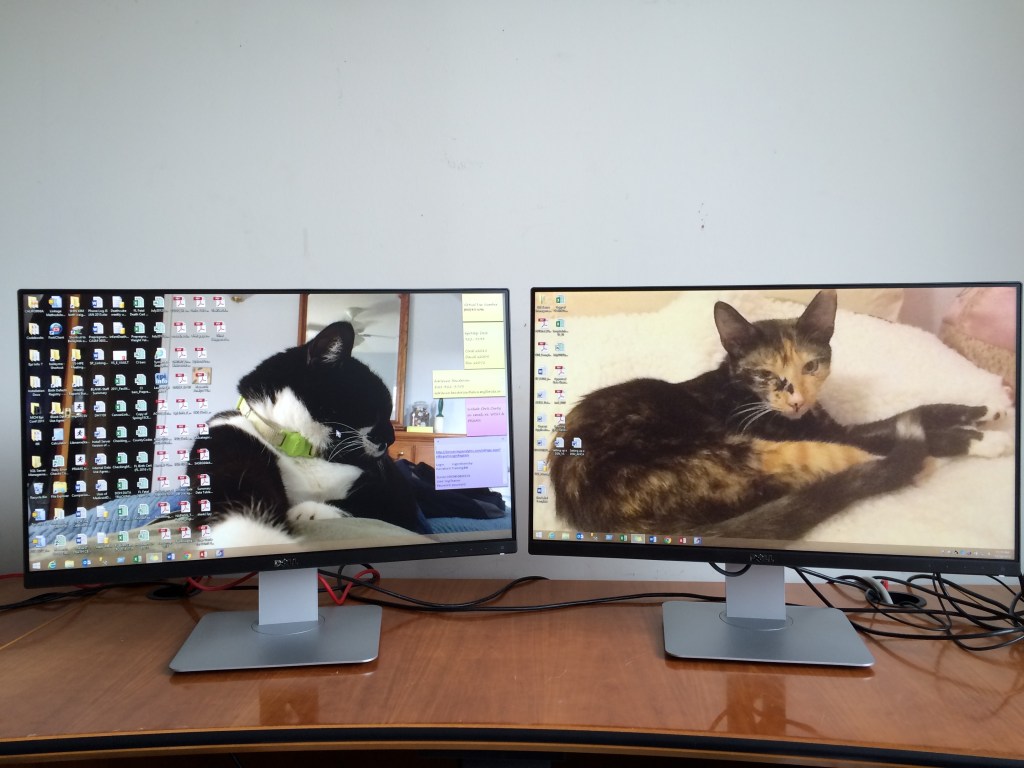
Cats on my computer screens (Maxine on the left, Wendy on the right) 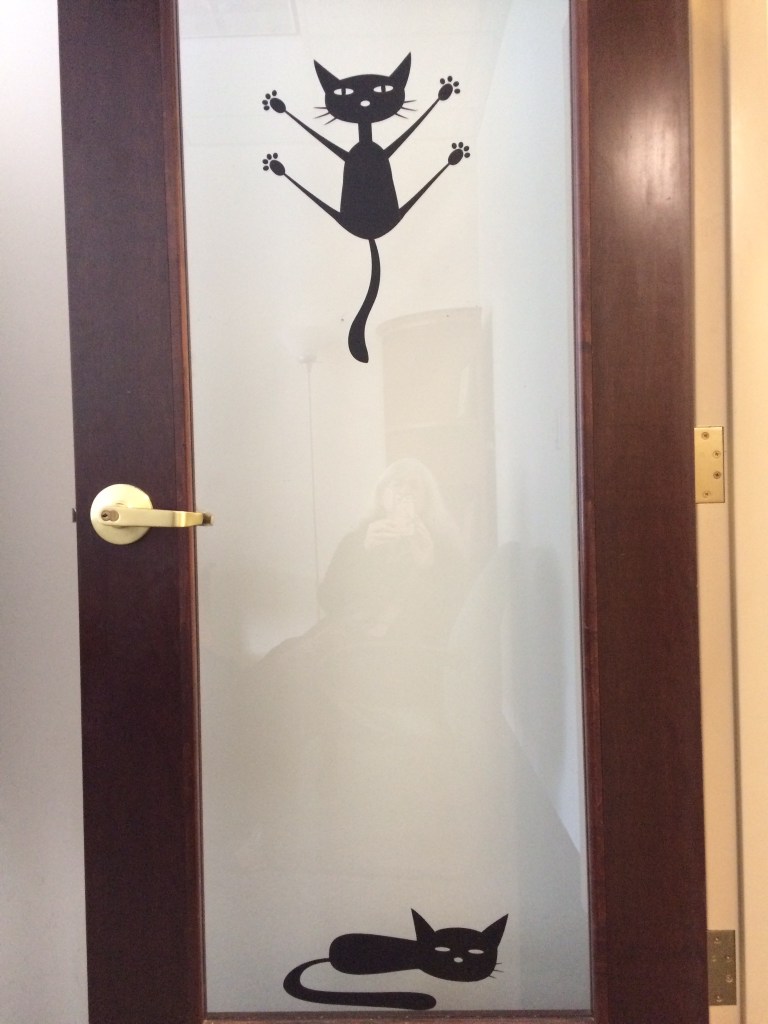
Marking my territory. 
Sitting off to my right, this kitty is ready to pounce on an unwary bird! I had managed to salvage these wall decals and although I’m trying to eschew nesting, I’ll take whatever lifts to my mood I can get. It makes me smile to see the kitties on my door or the silhouette on my window (and I can even see her from the outside at the street level).
I’m happy to say that by the end of this week I feel reconciled to my new office if for no other reason than … well … I’m here ;)
And I’m a roll with the book reviews! A few days ago I finished Such is Life by Jeri Walker. Some of you may already know Jeri from her website, Word Bank Writing & Editing. I actually “met” Jeri through Triberr, yet another social media site that I spent too little time on. Jeri is a freelance writer and author, with a novel in progress and a few small pieces (short stories and essays) available through Amazon.
I loved the stories in Such is Life and, while reading, frequently compared Jeri’s writing (both form and content) to that of Joyce Carol Oates (totally innocent of the fact that other readers had made the same comparison). These are dark slices of life told with a sympathy that keeps you reading even when you know the ending won’t be happy. Go on over to Amazon, read my review, and then pick up a copy of Such is Life.
Finally, I want to direct you to the blog of a friend, a young man I’ve been following for some time and whose weekly updates were often sources of inspiration and validation, as well as some good eye candy. Phillip McCollum is a wonderful writer but also a dad and husband and full-time employee at a very demanding job. So, he’s making choices, thinking hard about what direction his life might/should go in. His musings echo my own. Writing is something I still care about and want to do, but these days it just feels like it has to take a back seat. Life is short. I may be able to carve out a month of crazy writing once a year, but I don’t (yet) have the discipline and focus to put my writing first every day of the year. And that’s okay.
I have plenty of books and blogs to read, yarn to knit up, places to visit, friends to write letters to. Writing is always there in some form or other.
Until next time, I’ll be dancing in my chair …
-
I’m on a roll, dear Reader. Two different kinds of review in two weeks! Amazing what a few days away from the day job can do for a writer. My vacation has not been all writing and reading, as I’ve been fairly absent from social media. We took a brief road trip. More about that later. For now, I want to share a review of Kindness Wins by Galit Breen. This is a very important book for anyone engaged in social media. I don’t have kids, but I loved this book. I hope you enjoy the review.
***

Brittany giggled when she saw the photo Lucy had posted to Instagram. In the photo, the two of them were sitting on an sandy spit in the middle of the creek, their long hair whipped around their shoulders, the sunlight making sparkles on their wet faces. It had been an oppressively hot day, and the two girls had played in the shallow creek like toddlers, splashing each other and getting soaking wet. They were happy, and they were laughing as Lucy took the selfie.
Brittany clicked Like and started to write a comment when something caught her eye. There, from a guy she barely knew, was a comment: “What fatties you both are! How gross!”
Brittany looked at the photo again. Okay, their t-shirts were sticking to them and maybe the way they were sitting made them look like they had rolls of fat, but, really? Why would anyone write something so nasty? She wanted to blast him. She wanted to tell him that he must be a miserable and lonely person to write something so mean. But she stopped herself.
She glanced over at the book that Mary had given her a few days before. It had been a birthday gift from the three widows–Mary, Melissa, and Maggie–along with her first iPhone. She knew the cousins had misgivings about her developing an online presence. They trusted her, but they didn’t trust other people. Not after what Brittany had been through.
But, as Lucy had so well argued, it was time for Brittany to come into the 21st century. She was almost 20 years old, the same age as Lucy, and she needed to reclaim her life, a life almost cut short by a man she once thought of as her father. Lucy would help her. She had read Kindness Wins and, truth be told, she was the one who had recommended it to the widows. Brittany thought she should stop thinking of them that way, but it was too hard. She just needed to make sure she never referred to them as “the widows” online.
Brittany picked up the book and leafed through it again. She had read it in one sitting, and then flipped back and forth, considering the bulleted “takeaways” that the author, Galit Breen, had included at the end of each chapter. She really enjoyed how the book was laid out, each chapter being a “habit” for a child to learn about being online, with reading resources, discussion points, and the takeaways at the end. She knew so little about social media, she was almost embarrassed to admit it. Lucy understood, though. Lucy understood everything about her.
But what to do about the mean comment? Brittany’s fingers itched to retort. She felt that liking the photo and then saying nothing might send the message that she didn’t care, or that she thought the mean comment was okay. Lucy would know better, but other people might not. A sentence from Kindness Wins popped into Brittany’s head: “It doesn’t hurt to be kind.” She didn’t feel she had the guts to take on the bully, but she didn’t have to hide either.
“What a fun day we had! That’s what counts <3” Brittany hit Return.
Well, Brittany thought, the bully will probably roll his eyes at that but no matter. She and Lucy could create a virtual storm of kindness that will drown out the meanest comment. And if they practice what Kindness Wins preaches, maybe eventually the bullies will just go away. Better yet, maybe they will become kind.
***
Dear Reader, this is just a snippet of what you would get out of Kindness Wins. If you’re a parent, grandparent, babysitter, caregiver, teacher, aunt, uncle, cousin, friend of friends with children, you will want to read this book. Breen has an engaging writing style. I really appreciate her honesty in sharing her own experiences and her own mistakes. Kindness Wins will definitely influence how I engage in social media from this point on.
For a great interview with Galit Breen, courtesy of Laura Zera, click here.
Get your copy of Kindness Wins here from Amazon.
-
Hello, dear Reader. I’ve managed to squeeze some time into writing a different kind of book review. This one is for a novel I’ve had for … ahem … well, quite some time. It’s been available since August 2014. Sigh. And I finished reading it back in February. I’m sharing these details to simply illustrate that, yes, I’m rather slow at reading and reviewing. But without further adieu, here’s (finally) my review. Enjoy!
***

Sarah leaned over and dropped the softcover book onto Michael’s lap. He grunted, startled out of his half-dozing state, his eyes still itchy from too little sleep. He picked up the book and for a second conflated the book’s cover with what he had seen through his telescope only a few hours before.
“What’s this?”
“A book.” Sarah turned her attention to her hot coffee, avoiding the sight of Michael rolling his eyes. She waited for him to follow his question and her pathetic sarcasm with “What I mean is … .” But instead he waited as she focused attention on her coffee, by turns sipping and blowing on it. She thought to herself, wasn’t it ironic that on a hot day (almost 80 and not even 9 am), she’d be sitting in her cutoffs and a thin white T-shirt, the humidity creeping up her neck and into her thick hair, with a cup of hot coffee before her.
Michael sighed and looked again at the book. He definitely liked the cover. He leafed through it for a few moments and then looked sharply at Sarah, who now was flipping through the pages of a knitting magazine.
“I didn’t know you liked science fiction.”
“Well, I didn’t know you liked chick-lit.” Sarah smiled as she remembered that evening when she learned that the hard-bodied Marine read novels.
Michael leaned back in his chair, lifted his legs, and rested his feet beside Sarah. He waited. Eventually, Sarah would fill the void. She always did.
“Okay, well, I did like Star Trek, at least the series with Captain Picard, and I liked Firefly … you know, that series that Fox stupidly took off the air … well, I heard about this novel by J.S. Collyer. That it was kind of like Firefly but better since we don’t have to worry about anyone canceling it.”
“So you read this already?”
“Of course! I wouldn’t give you a book that I hadn’t already vetted.” Sarah put her coffee down and leaned toward Michael. “So, this novel has space pirates, and they’re being infiltrated by a government guy. He feels like he’s being punished because he essentially disobeyed orders in order to save some lives, but it’s more complicated than that.”
“Isn’t Life always more complicated than that?” Michael shifted so he could better see how the sunlight brought out the red in Sarah’s hair. Sometimes it looked like she wore a halo of roses.
“Yes, dear, Life is complicated. But that’s one of the many things I enjoyed about Zero. Great character development. Hugo the government guy is sent to captain the Zero. He’s an ass at first, but I think he eventually redeems himself. Webb, his lieutenant, is reckless but smart. Only they don’t trust each other. Hugo thinks he’s always right, and Webb has seen too many captains make too many mistakes. The whole crew reads like a list of misfits who finally found a home: smart, dedicated, but outsiders. And trust is a big, big issue in this novel. Earning it, and losing it.”
“Like in the military where everyone is dependent upon everyone else for survival? Band of brothers and all that?”
“I suppose. I wasn’t in the military.” Sarah took Michael’s left foot and began to massage it, but absently. She had a tendency to be flippant, a characteristic she knew annoyed Michael. She was trying to curb it. Michael was trying to let it slide when she failed.
“Yes, obviously you weren’t. Still, how far does this go?”
“Oh, the trust issues are all over the place. There’s a whole conspiracy that Hugo isn’t even aware of, and the reader is taken along for that ride as well. You don’t know until Hugo knows what the hell is going. It’s a fast-paced novel, too. Collyer really knows how to keep the action going, and the worlds she creates are amazing. They are so familiar, with the industrial ghettos, people living and working under Dickensian conditions while, on other planets, the well-to-do live very well indeed. She integrates futuristic technology with contemporary mechanics: spaceships and motorcycles.”
“She?” Michael was now leaning forward, and Sarah just realized that his feet had slipped to the floor of their deck, her hands massaging air. She dropped her hands and squinted at Michael.
“Yes, she. What? Big tough Marine can’t imagine a woman writing an action-packed, character and plot-driven novel?”
Michael laughed and rubbed the back of his neck. He hoped it would not be too much longer before Sarah would understand he thought more highly of women than of his own sex.
“Of course, I can. But it piques my interest a bit more.” Michael leaned back and brought his right foot up to rest on Sarah’s lap. Without hesitation, she began to knead. He opened the book again, to the first page.
“So, is this part of a series?”
“Yup, she’s coming out with another installment quite soon. Called Haven. You’ll understand the title once you’ve read Zero.”
“Movie rights?”
Sarah laughed. “That would be wonderful, but actually I would prefer Zero as a TV series. Easily, this novel could be one whole season. So much happens, and when you get to the end, you just want it to keep going. You’ll be so entangled in the lives of Hugo, Webb, Rami, Kinjo … you want to know what happens next. It can’t be the end of the story. Like with Firefly. There’s still so much to tell … .”
Sarah’s voice trailed off as she realized Michael was no longer listening. He was reading.
***
The same will happen to you, dear Reader, when you pick up a copy of Zero and start reading. You’ll quickly lose yourself in the fantastic worlds of Zero. And while you’re at it, follow Collyer’s blog at The Path, where she also shares some flash and short fiction as well.
You can find Zero at Goodreads and Amazon. Get your copy NOW!
-
I’m still chugging along with a free online poetry course so here, again, is a traditional book review. And, again, why wait? I’ve posted this review on Amazon and Goodreads, but why not share the review through my blog now instead of waiting for my Muse (i.e., Time) to strike a different kind of book review within me? I say, drum up some interest (and hopefully $$) for the author now! So, here we go …
***
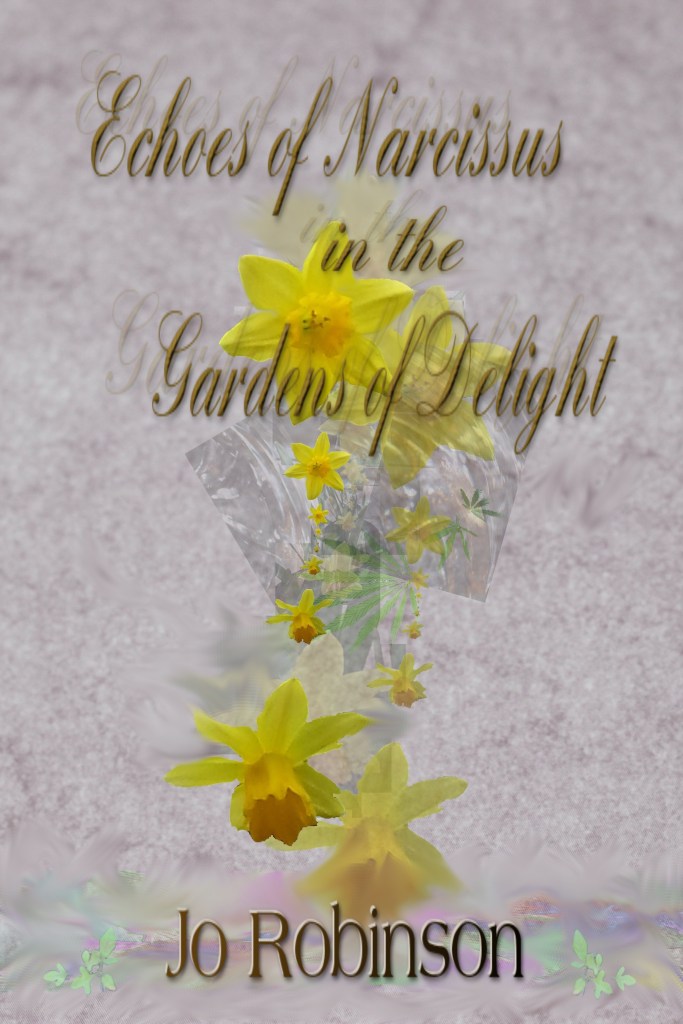
Jo Robinson’s novel is a fascinating study of a psychological disorder, Malignant Narcissistic Personality Disorder, in the framework of a novel. Donna is the wife of Marco, a man used to getting his own way and being in total control. Marco has never physically harmed Donna, but he has emotionally abused and neglected her. Robinson neatly lays out the domestic abuse that is the foundation of Donna’s marriage to Marco as well as Donna’s growing strength and self-determination when she learns, by happenstance, about the madness behind her husband’s actions.
Having worked with victims of domestic abuse, I truly appreciated how well Robinson informs the reader of Donna’s situation without turning her novel into a self-help book. It really isn’t, even though it will no doubt be helpful to any reader who may be a victim to such a creature as Marco. The novel allows you to consider with Donna her options as she tries to free herself from her cruel husband. Along the way she is very fortunate to make friends with a group of charmingly eccentric characters who see through her efforts to hide her shame at being manipulated. And she learns that she has a talent, a skill that few have. A skill that could be her key to freedom.
I liked Donna so much that I wish Robinson had described her a bit more. The reader spends a lot of time in Donna’s head, which works to make her very sympathetic to the reader. But while she considers herself ugly, I suspected that Donna was in fact beautiful. I was frustrated at times to not have a better picture of her drawn for me by the author, but then I wondered if that were on purpose. Without a portrait of lines and color, I had to fill in with my own vision of Donna, and that could be any woman, especially any woman I had counseled in escaping an abusive relationship.
Some things also seemed a little too easy, too convenient for Donna, such as the good luck in finding friends in spite of her near-total isolation. Even her own adult daughter seemed slow to understand what was happening to Donna. And, yet, Robinson doesn’t give Donna too easy a time of it. Extricating herself from someone like Marco won’t be easy, and it could be life threatening to Donna, even her friends and daughter.
I do recommend this book both as an entertaining novel of mystery and as a psychological study that may chill you to the bone.
***
Jo Robinson is the author of several novels, which you can learn about here on her Amazon page. Be sure to follow her blog as well (click here). With Jo’s writing, there’s something for everyone.
-
As I often complain to anyone who will spare me a few minutes (and that usually reduces to a few seconds once they see I’m about to complain): I have a tower of to-be-read and to-be-reviewed books that may as well be called Eiffel for it’s height. It’s my own fault, I know. I buy books at the urging of friends, or because of a fascinating interview with the author, or because I participated in a promotion, or, as in this case, because I am already familiar with the author’s writing and just had to read more.
Many of you I hope already know Katie Sullivan from The D/A Dialogues, an often hilarious blog where Katie spars with a Druid who’s been living in her head for roughly the last 20 years. She is currently working on a series, a young adult historical fantasy novel replete with Druids and Fae, magic and mystery. I’ve read the first novel since published, Changelings: Into the Mist, and wrote a review which you may read here.
When I heard that Katie was publishing a novella, I couldn’t wait until it was available. And while I prefer to write my reviews in the form of stories, well, sometimes there just isn’t time for that. But I did write a traditional review, as would be acceptable on Goodreads and Amazon. So, here it is. I hope you enjoy it and that it makes you want to pick up your own copy of Three Ghosts.
***

Three Ghosts is a fast read not just because it’s only 69 pages. The author pulls you right in with a conflict between two men, Pearse Finnegan and Pat McGuire, and the woman between them, Pearse’s wife Deirdre. Pearse supposedly dies in a conflagration of an abandoned wharf, and Deirdre is gone from Ireland. Fast forward 15 years and Deirdre is back in Ireland on a mysterious assignment. There is much that is mysterious in this well-told tale, and to say too much more would give it all away.
Let’s just say, Deirdre has to come face-to-face with the ghosts of her past, not knowing which of them, if any, she can trust. In many ways, the twists and turns of this story reminded me of some of the Alfred Hitchcock movies of intrigue and betrayal. While I am by no means an expert on Irish history (recent or long past), the author Katie Sullivan appears to be quite astute with historical details as well as creating a sense of place so strong I once felt I was sitting in the table next to Deirdre and Pat as they worried over events yet to unfold.
I’ll admit I was a bit disappointed in the ending, in part because it came too soon. I would have liked to have kept reading, to have had that tell-all scene drawn out some more, to have continued to feel the rising tension as everyone slowly realizes who has been betraying who. As it was, the ending reminded me of the old Perry Mason TV episodes where Mason brings together all the suspects and then neatly points out the murderer.
Perhaps the author thought she needed to wrap things up, but she didn’t. I would have liked to have stayed in the company of Deirdre O’Brien a good while longer. While I’m not sure I would trust Deirdre as far I could throw her, she was still someone I could admire for her wit and her will. I recommend this novella in large part for the pure entertainment value of Deirdre. Perhaps, as subtle hint to the author should she read this review, we haven’t heard the last of Deirdre O’Brien.
***
Now, Dear Reader, get thee to Amazon and purchase your own copy of Three Ghosts!
-
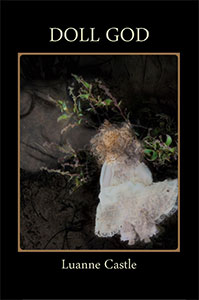
Mary closed the slim volume of poetry and leaned back against the stiff cushions of her couch. She never was one to read much poetry, except occasionally Emily Dickinson and Shakespeare, whose works had stayed with her all these years since high school. What was it Dickinson once wrote in a letter? “If I feel physically as if the top of my head were taken off, I know that is poetry.” And that was how Mary felt after reading Doll God by Luanne Castle.
Mary gazed at the cover, an antique doll, face down amongst some weedy flowers, as if it had been tossed by a child and then forgotten. Maggie, her cousin and a former English major, had given Mary the book that afternoon. “Take your time with these poems,” she had cautioned. “Some of them make you feel like you’re falling. There’s a sadness in them, but like a forlorn kind of sadness. Like missing the childhood you can never get back, or that you never had.”
“Gee, thanks, Maggie.” Mary had watched her cousin let herself out of the house, a knowing smile on her face. And then a wink just before the door closed. It was a dreary day, gray and wet and cold. The perfect day for a pot of hot tea, a woolen lap blanket, and a book. Not necessarily poetry, Mary had thought, but she picked up Doll God anyway. The wonderful thing about poetry collections was that you could just pick up and start reading wherever you wanted, unlike a novel where you tended to start at the first page, not in the middle. So Mary opened the book at a random page and began to read.
Now the room was dark except for the reading lamp. Mary hadn’t even moved to close the drapes and she sat staring at her reflection in the picture window.
Of all the poems she had to read first: “Calculating Loss.” It had given her chills at the realization, the recognition of the presence of loss. A missing chair. One less car in the garage. A half-empty jar of pebbles that, to the poet, seemed overflowing. Things missing should imply a vacuum, empty space. But Mary thought about those first few horrible months after Christopher was killed. How long it took her to remove his clothes from their walk-in closet. And how she couldn’t bring herself to hang anything there for she felt there was no room. The closet was full with her loss.
And then “Marriage Doll” and that exquisite image of the Hakate marriage doll with it’s hand upraised but empty, juxtaposed to a husband, flesh-and-bone, in the same pose but not empty-handed. Marriage Doll: 1 of 2, the poet wrote.
And so many other poems that evoked feelings in Mary that she couldn’t quite articulate. She didn’t feel sad after reading Doll God, but she felt changed somehow. Like someone pointing out the homeless guy huddled in a doorway on a dark, cold, rainy night, and then telling her a story of the man’s childhood (“Vagrant”). Like reading notes from someone’s diary about a day in October in the southwest and the shift in the habits of both wild and domestic creatures (“Sonoran October”). She is changed. She knows something, feels something new. The words are in the poetry so she really doesn’t need to find her own.
From “Repetition”:
Daylight burns brighter, scrape
deteriorates into amputation until day
is here and there is no yesterday.
From “Calculating Loss”:
Every day the world subtracts from itself and nothing
is immune.
From “American Girl”:
I am the wait.
By the time Mary finished reading the poems, she did feel as if the top of her head had been taken off. But, as if she were in a Frida Kahlo painting, she also felt images and words tumble from the half-empty but overflowing cup that was once her head. She gazed at her reflection in the black glass of the picture window and saw dolls and children and feral cats staring back at her. She felt cold and knew that no fire or freshly brewed pot of tea would warm her. She had just read poetry.
***
And now, dear Reader, if you would like to have that Dickinsonian experience of reading poetry, do go now and purchase a copy of Luanne Castle’s poetry collection, Doll God. And, while you’re at it, visit her blog at Writer Site where Luanne writes about poetry but also about memoir. She is writing her own memoir, which I can’t wait to read once it’s published, and her blog often features book reviews and guest bloggers. It’s never half-empty, but always overflowing. She also has a beautiful website to showcase her writing: http://www.luannecastle.com/
I know you will enjoy her works as much as I do.


 Marie at 1 Write Way