
Note: I received this novel for free through a giveaway. Free or not, I always post honest reviews. Just saying.
In Deborah J. Brasket’s novel When Things Go Missing, Franny, a wife and mother of two adult children, leaves her family without warning or explanation. Franny isn’t really missing. The reader knows that, but in the beginning her family doesn’t. They are only aware that she still exists when she chooses to make them aware.
With her daughter Kay, it’s phone messages always left when Kay is asleep or out of her apartment. With her son Cal, it’s through strange and provocative photos that she mails to him. With her husband Walter, it’s the charges to his credit card that lets him know where she might have last been seen.
This idea of a woman, who has just turned fifty, leaving her family without warning and without explanation is intriguing. Franny starts with a “shedding process, opening closets and cupboards, ridding herself of everything she no longer needs, stripping away all that’s not essential.” That’s in the Prologue, before we even get to the expected reactions of horror, anger and angst from her family. On its surface, we all could possibly relate to a “shedding process.” Some might call it spring cleaning or even death cleaning. But what does it mean when one’s own family is stripped away, deemed “not essential”?
After the Prologue, Franny recedes into the background, and we experience Kay’s, Cal’s and Walter’s reactions in turn, each viewpoint moving the novel forward. We experience their frustration and anger and fears.
Kay is a headstrong, yet somewhat needy young woman, working toward a career in archaeology. She often annoyed me. Of the three, she seemed to be the one who didn’t want her mother to be anything but a Mother. As a soon-to-be-ex-boyfriend says, “You don’t see her. You just see Mom.” A bit ironic given Kay’s own fierce sense of independence, her determination to not let herself get bogged down by a man and marriage. Franny who kept the family together. Franny managed Cal so Kay didn’t have to. Franny was always there when Kay needed her. Until she wasn’t.
Cal is a drug addict who in turn uses and abuses his family. He’s older than Kay but just as immature in his own way. Yet, his immaturity stems not from being spoiled, but from being misunderstood and believing he’s always been unwanted: “Like from the day he was born, they were all waiting for him to move out again.”
Walter is a quiet husband and father, seemingly uninterested in his children and his wife. He has a temper, one that has scared all of them, including him, on occasion, which might be why he keeps to himself. At least until he too starts the shedding process.
How these family dynamics play out through the novel is truly fascinating and deeply insightful. I saw Kay, Cal, and Walter as people in arrested development, people who basically depended on Franny to do whatever was needed so they wouldn’t have to, so they wouldn’t have to grow up and figure out on their own how to become fully actualized human beings.
I believe that was what Franny was trying to do for herself, find out what she was really meant to be in the world, beyond being a mother. She could only do that for herself, just like Walter, Cal, and Kay had to do that for themselves, separately and by themselves.
While the novel ends a bit neatly, it also left me feeling uneasy at first. Then I felt relieved, sad, and, finally, satisfied. We learn through Walter, Cal, and Kay that Franny was a good mom and a good wife, and so the ending fits, even if at first you think it doesn’t.
When Things Go Missing is a story is that has lingered with me long after I put the book down. It left me wondering about the role we play in each other’s lives, the relationships we build, the relationships we might later wish we hadn’t started. It left me wondering about the degree to which we use each other and call it Love. It left me wondering about how co-dependence is often mistaken for Love. It left me thinking about how liking each other, respecting each other might be just as important in a family as loving each other.
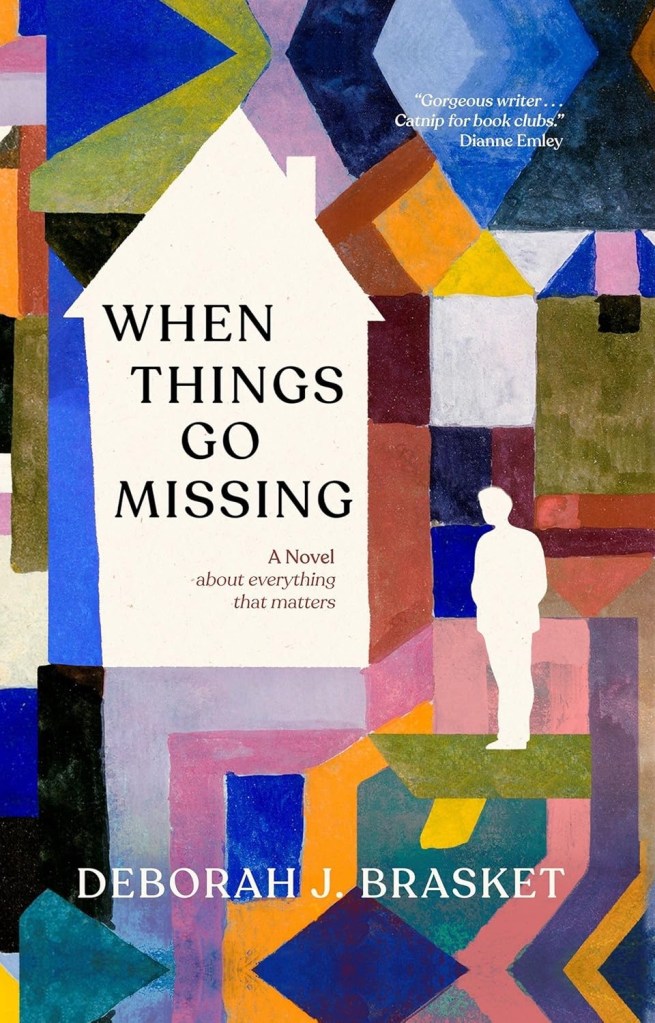
I do strongly recommend When Things Go Missing by Deborah J. Brasket. Click on your preferred store to get your copy from Amazon, Bookshop or Barnes and Noble. While you’re at it, check out Deborah’s blog at https://deborahjbrasket.com/blog/
Thank you for reading! Here’s my free gift to you: Raji snuggled under the shawl/scarf I’m (still) knitting.

 Marie at 1 Write Way
31 responses to “When Things Go Missing by Deborah J. Brasket: Book Review”
An excellent review, Marie. Congratulations to Deborah
LikeLiked by 2 people
Thank you, John!
LikeLiked by 2 people
😊
LikeLiked by 1 person
Thank you, John!
LikeLiked by 1 person
😊
LikeLiked by 1 person
I appreciate this honest review, Marie. It sounds like an intriguing book. Congratulations to Deborah!
(I can see her award-winning cover better here than I’ve seen it elsewhere. )
LikeLiked by 2 people
Thank you, Merrill!
LikeLiked by 2 people
You’re welcome, Deborah!
LikeLiked by 1 person
Thanks, Merril! You know, I just lifted the book cover from Amazon … lol. Sometimes that works, sometimes it doesn’t.
LikeLiked by 1 person
You’re welcome, Marie! 👍🏼
LikeLiked by 1 person
Thank you so much, Marie, for your insightful interview. You touched on elements I don’t think I’ve seen before in reviews. It’s so interesting to see my characters through other’s eyes. I’m so happy the novel left you, in the end, feeling satisfied. Many, many thanks!
LikeLiked by 1 person
Deborah, I’m glad you enjoyed the review. I think the fact that I don’t have children makes me view children, especially adult children, a bit differently from parents. I have to pull from observations of dynamics within my family and, believe me, I’ve observed a lot of co-dependence disguised as love ;-) I do like and prefer endings, such as the one in your novel, that provoke a series of reactions. Seems so much more true to life.
LikeLike
VERY TIMELY, Marie! As I
LikeLiked by 1 person
Oops, Leo, your comment got cut off :-(
LikeLike
Right…It became a tome. I will send you another copy in an email.
LikeLiked by 1 person
A huge congratulations to Deborah for the stellar review! When Things Go Missing is waiting for me on my Kindle. Sharing to help spread the word!
LikeLiked by 2 people
Thank you, Liz!
LikeLiked by 2 people
You’re welcome, Deborah!
LikeLiked by 1 person
Awesome, Liz! I know you’ll enjoy it :-)
LikeLiked by 1 person
Thank you, Marie!
LikeLiked by 1 person
“…how liking each other, respecting each other might be just as important in a family as loving each other.” From experience, I think I might go one further and say liking and respecting one another may be more important in the family dynamic of getting along.
I enjoyed your review, Marie. It sounds like a fascinating read. Thanks for the recommendation.
LikeLiked by 3 people
Thank you, Jennifer. I believe you are right that liking and respecting each other is more important for getting along. It’s a challenge :-)
LikeLiked by 1 person
True enough. Some families seem to have few problems in that area, while others have many.
LikeLiked by 1 person
Deborah’s book is surely getting a great following! YaY! Wonderful review, Marie.
LikeLiked by 2 people
Thank you, Laura!
LikeLiked by 1 person
Thank you, Laura! It’s been so lovely having so many people read and enjoy my novel. Can’t thank everyone enough.
LikeLiked by 2 people
Raji is such a sweetheart. When I think back to his early days with you!
Deborah’s book is freaking amazing IMO. So well written and such a careful depiction of a family under pressure and of addiction and how it affects everyone in the family.
LikeLiked by 2 people
Aw, Luanne, that really makes my day. Thank you!
LikeLiked by 2 people
Great review! It sounds very intriguing. I think a lot of women can relate to this story.
LikeLiked by 1 person
Indeed! Thank you, L. Marie!
LikeLike
[…] Review by Marie A. Bailey […]
LikeLike