It’s one thing to write a first draft of anything — short story, novel, essay — and save it to a hard drive or to iCloud or to Dropbox or to Goggle Docs or to a thumb drive. That’s one document saved somewhere. But when you have several short stories and a few drafts of each one, or perhaps a few versions of one novel, how do you organize your writing?
Currently, I’m using Dropbox which was fine until I needed to find some stories I had written years ago. I thought I had saved everything to Dropbox but … of course, I hadn’t. In searching for these old nuggets of gold on my hard drive, I found duplicates galore. The same story saved in multiple locations, but not the version I was looking for. I eventually found what I wanted but it was a nail-biting experience.
Over the years, I’ve had to adjust how I organize my files, and I know I’ve lost some in the process. Going from floppy disks (I’m that old) to 3.5 hard disks to various iterations of the Cloud. It’s appealing to use the Cloud and believe that I can access my work from any computer anywhere as long as there’s an internet connection. Of course, when you have an internet connection but the vendor’s server goes down, you’re screwed.
So my challenge is two-fold: (1) organize my writing so I can find what I want when I want it; and (2) find a reliable location to store my work.
I would really love to know what you do to store and organize your writing. I know I could learn from you. Please share in the comments section.
I’m popping out of my self-imposed bubble long enough to share this essay by Anita Gill in BREVITY. So much of this short essay resonated with me and my perpetual struggle with my inner critic, and, of course, it prompted a comment from me. Please read the essay (and my comment below) and let me know: How do you handle your inner critic?
By Anita Gill On a chilly winter day in Oregon, Laura Hendrie, an award-winning fiction writer, gave a craft talk to a room full of graduate students on the topic of crafting the beginning lines of a story. She looked around the room and asked, “What is it about an opening that pulls me in […]
“And this would apply to fiction as well. Even when I’m purposely making things up, my inner critic argues against my authority to do so. The thing about memories–and why the inner critic can often win the battle against writing down memories–is that they are subjective. Your memory of a particular event may differ from every other person who witnessed that event. I’ve often gotten blank looks from family members when I recall an experience that I know we share, but they no longer remember … or choose not to remember. When I write down memories, my inner critic often takes on the voice of my mother or brother or sister, arguing against my version of events and whether I have the “right” to tell it as I remember it. If I go public, I risk being called a liar or of hanging out the family’s dirty laundry. So I write fiction, but my inner critic still knows what I’m up to. This essay is validating and makes it clear that the only way to silence my inner critic is to simply keep writing until my words drown her out.”
My Facebook page recently reminded me that no one has heard from me in a while. Funny how those prompts make me feel just guilty enough to start thinking about writing a blog post, but not guilty enough to write one right away. I’ve been cruising through Life lately, musing on how busy I feel even though I’m not as busy as I used to be.
I’ve been writing … which some of you might be pleased to hear. Still, it’s hit-and-miss. I’ve never been terribly organized and, at 60, I probably won’t start now.
Several months ago I was diagnosed with cervical osteoarthritis. Also known as chronic pain in the neck. Well, the pain is not constant and is mostly due to the stiffness that seizes my neck when it’s been immobile for a while … like when I’m typing … on my computer … for my blog. My arthritis can even be a pain in the neck when I knit–adding insult to injury. My husband wants me to have an MRI to make sure it really is arthritis, that the physical therapy I went through really is what I need to be doing.
My husband is a case study of how x-rays can deliver an incorrect or incomplete diagnosis. The short story is after several months of physical therapy for his back (during which he got little to no relief for his pain), he finally got an MRI and found that he has, among other things, severe spinal stenosis. The kicker: the physical therapy he had been prescribed was contraindicated for his type of back problem. Before I continue, let me reassure you all that he’s fine. He’s retired which allows him to spend as much time as he needs to exercise and take care of his back. He’s actually doing quite well compared to a year ago.
So, given his experience, he’s somewhat adamant that I consult my doctor about getting an MRI. Have I mentioned that I’m claustrophobic?
Besides doing a bit of writing here and there, complaining about my neck, and knitting … and let’s not forget my day job–although I try to, I really try to–I’m living in the moment. About 75 moments were spent walking around Lake Overstreet this Saturday.
It’s a nice walk, about 3.5 miles from the parking lot and back. It’s one of the few places in Tallahassee–aside from our house–that gives me a respite from the workaday world.
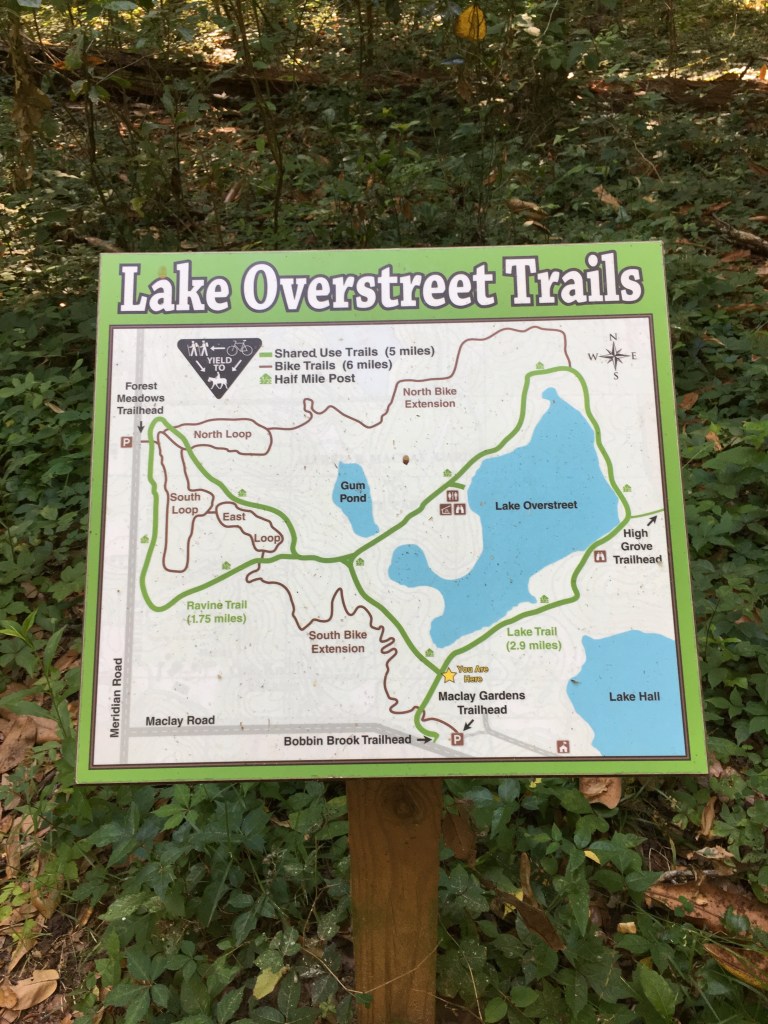
Start of the trail
Sometimes we’re lucky and we see some wildlife.
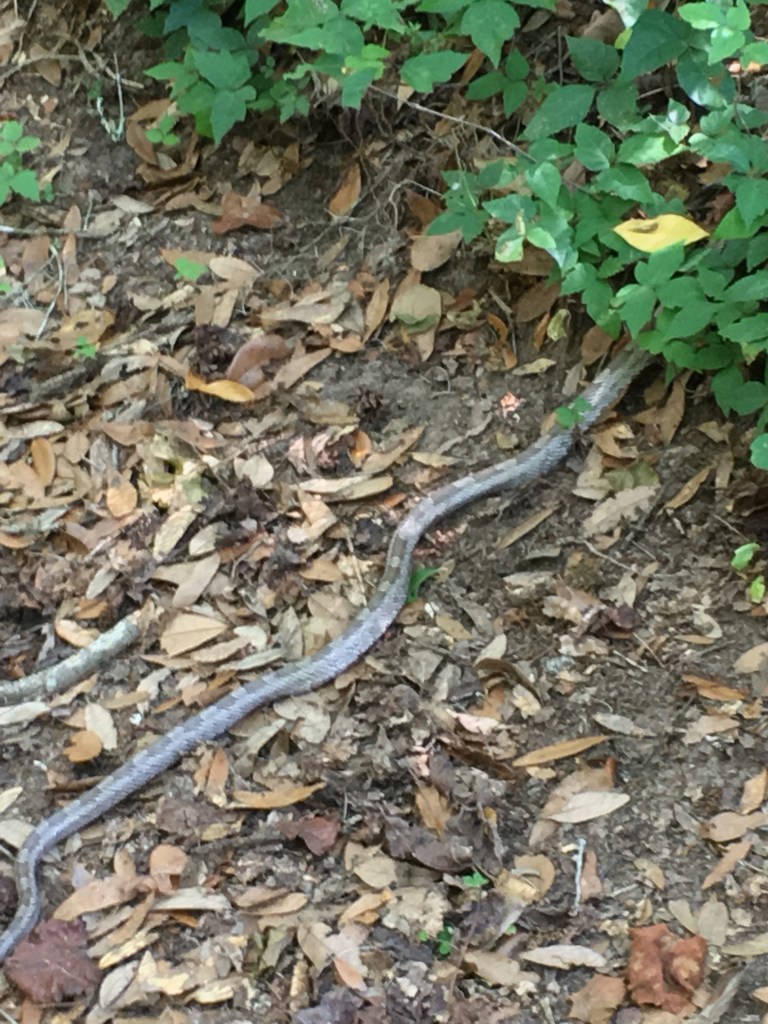
Gray rat snake. Harmless and very pretty.
Unfortunately, as I was just starting to take a picture of Mr. Snakey, a bicyclist came barreling down the path. Mr. Snakey was startled and slithered away, his head hidden in the bush before I could snap. Still, he was a treat to see, and I’m glad we were there otherwise the bicyclist probably would have ridden over him.
The trail has a few places where walkers, runners and bicyclists can stop and admire the lake. I’m always looking for alligators, of course.
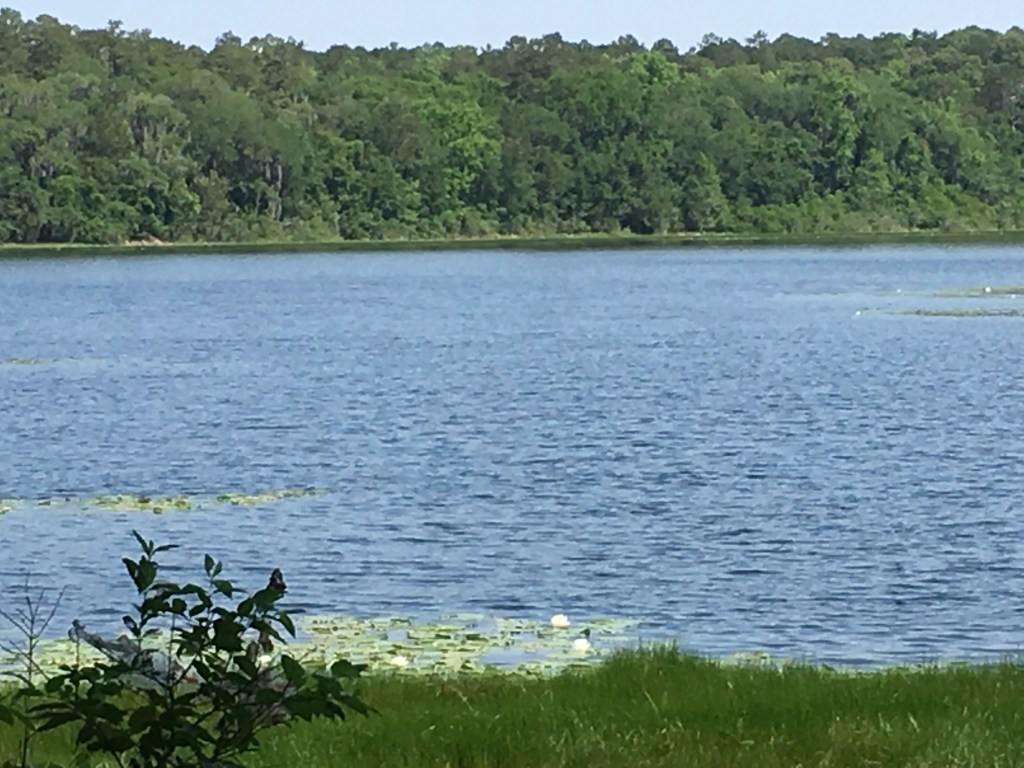
Lake Overstreet
I know they’re out there. The view in the photo above is from a rest area built away from the water. Too far away for me to see whether there’s any lurking about.
Another nice spot with a picnic table even. And no barrier to the water. So I strolled up to the water line, looking for alligator trails among the tall grasses. Nothing.
Nothing but the moment and the being there. Turn up the volume.
Hope you’re all doing well and living in as many moments as makes you happy.
I’m reblogging this essay from The Disappointed Housewife not only because I want to promote The Disappointed Housewife, but also because this essay by Krista McCarthy is spot-on when it comes to social media. I am not quitting social media, but McCarthy’s essay captures the tension I have with social media … especially Facebook. Sorry, Zuckerberg, but connecting with people through Facebook has not always been a happy, positive, three-dimensional experience. Even with family, sometimes it’s painfully one-dimensional. I’m not quitting Facebook. I’m in too deep. But I’m going to Google Krista McCarthy.
So I’m off social media. I did it. I went in too deep, and now I’m just out. Because it flattened me.
It started with Facebook. It’s like only Zuckerberg really understood what was going to be happening, and had to happen, and that is that people would start connecting. But he might not have thought through the dynamics of that kind of connecting, which allows the subject – the “person” depicted on the Facebook page – to show herself to the world in any way she likes.
I didn’t need to connect to “friends and family” because I was already close enough to them and we all talked. On the phone. Instead I wanted to connect with other people. People I didn’t know yet and who didn’t know me. I was going to be (I thought) a monologist, though I think monology was already getting a little bit…
The title of my post is a riff on the fleetingly popular #SorryNotSorry. I’m writing but not really writing. I mean, I haven’t been writing but I’ve been thinking about it a lot. As usual.
What I have been doing is … knitting.
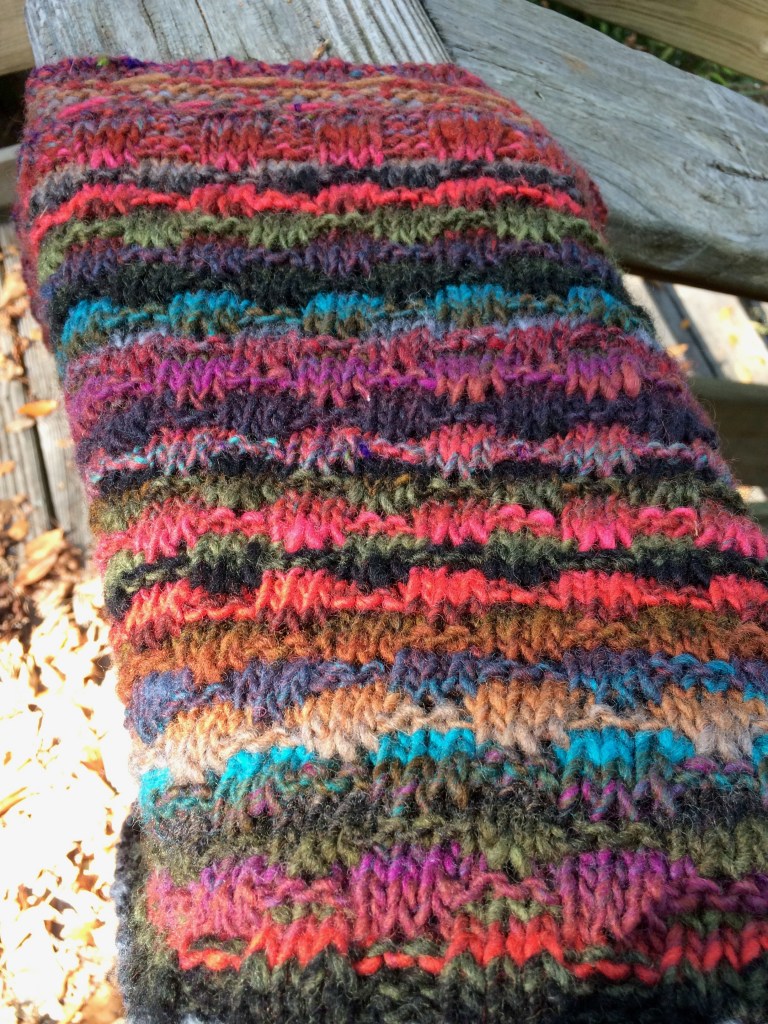
This purple and gray wrap will soon be wrapped up and sent to a friend who has cooler temperatures this time of year than I do.
Just finished this cowl in time for a friend’s birthday.
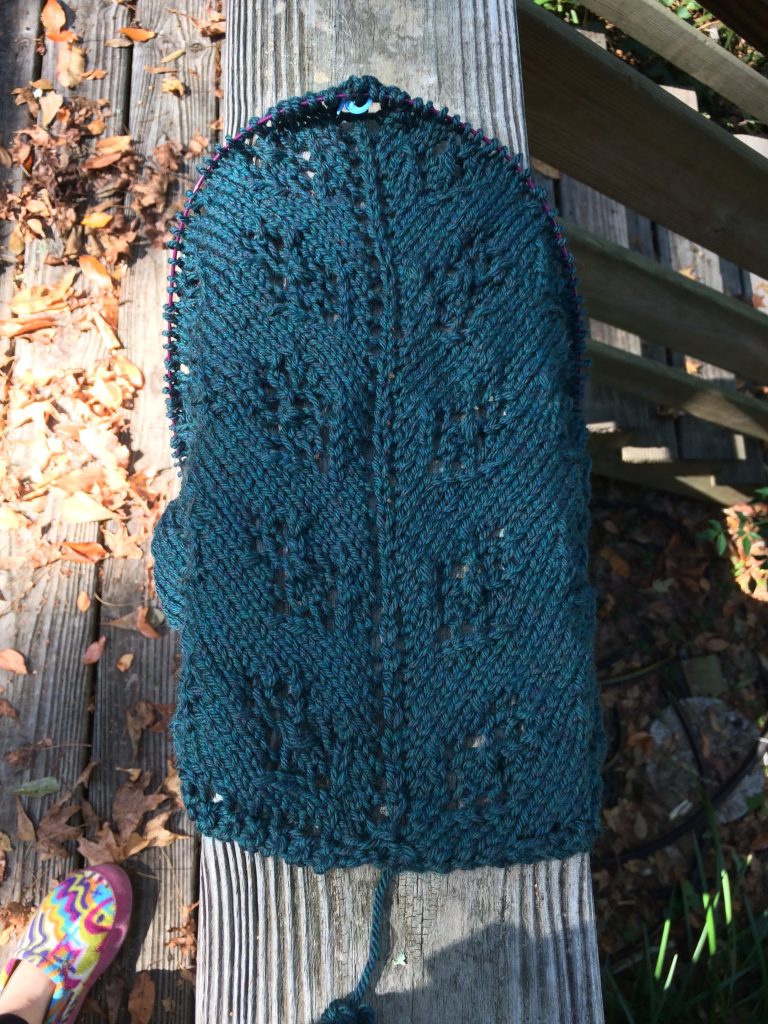
The beginnings of a shawl for a relative who lives in a cooler clime than I do. And off to the lower left … my foot.
When in doubt, I knit. Not only is knitting a meditative practice, it is also quantifiable. It moves linearly (for the most part anyway). There’s a definite beginning, middle, and end to my knitting. I don’t (often) feel that way about writing.
I have also been studying Spanish, for the nth time since I was in high school. I’ve become a bit obsessive, loading countless learning apps onto my iPhone, logging hours on Duolingo and Rosetta Stone, and downloading videos on learning Spanish from The Great Courses.
And, yet, my fluency leaves something to be desired. Yo tengo tres gatos y un marido.
And, yet … with both knitting and studying Spanish I persevere. I make a knitting error? I just rip it out and start over. I stumble over my grammar in Spanish? I can retake the lessons as often as needed. But writing is different. When I hit a wall in my writing, everything stops and it feels near impossible to get going again.
Quality of writing seems so subjective. I can quantify the number of words I write, but I can’t speak to their quality. With knitting and Spanish, I can see a steady progression of quality as a beautiful pattern takes shape or my review lessons become easier.
The subjective appreciation of writing trips me up every time. And I’ve been working at it as long as I’ve knitting and studying Spanish.
Now, this post will continue on to a rant I wrote almost a year ago. I’m sharing it now because it speaks to my frustration with literary and popular criticism. I had just finished listening to The Goldfinch by Donna Tartt and needed to get a few things about the novel off my chest. If you haven’t read The Goldfinch and plan to, you might want to stop here since my rant includes some spoilers. If you have read The Goldfinch and loved it, you might want to stop here because I didn’t. The rest of you may proceed as you wish.
***
I’m a pretty sensitive individual. I internalize everything. Let’s say I wrote a novel titled The Goldfinch and not only was it published, but it was awarded a Pulitzer Prize. Sure, I’d be happy for the publicity and the money and probably both would be enough to keep me in a bubble, safe from the knowledge that most buyers of my novel couldn’t finish it, the awareness that some of those who could were not just disappointed but dismayed by it. All the hype, the publicity, the Pulitzer for a novel that is too long and too uneven and too clever. Near the end of the novel, one character complains about “relentless tedium.” That pretty much describes the pace of The Goldfinch for me. At another point Theo, the narrator, says to a character, “It’s a long story. I’ll try to keep it short.” I laughed out loud at that line. Was Tartt poking fun at her own book? The novel is full of “relentless” litanies and extended dialogues that sound like something out of soap operas. You know the kind. Where the characters keep talking around each other and asking but not answering the same questions over and over until you want to scream, “Oh, just answer the bloody question!”
Only at the end does the reader learn that Theo has been keeping a journal all this time, since his “childhood”; yet, there’s never a mention of him doing so in the earlier parts. I found that so odd given how much this young man moved from one place to another, never once losing a journal apparently but also never mentioning his journals and what might happen if they fell into the wrong hands.
And The Goldfinch itself? I never really felt Theo’s connection with the painting that he claimed to have. Too often it seemed as if he had actually forgotten about it. He’d have all kinds of adventures with his Ukrainian friend Boris, never once mentioning the painting. Then, suddenly, briefly, he’d describe how he thought about it all the time. And oddly, those descriptions always seemed to occur about the same time I had almost forgotten about the painting myself. Did Tartt have to remind herself that the painting was supposed to be pivotal to the story?
At one point, the reader gets the idea that Theo and Boris might be in love with each other, not an unimportant realization for two teen-aged boys. Yet, the idea goes nowhere. Theo has no problem taking up with women when he returns to NYC and eventually he forgets Boris until they have their odd reunion.
The pace picks up when Boris admits that he stole the painting which has now been stolen from him and he needs Theo to help get it back. But the plot is convoluted and the miracle of it progressing at all is simply because Theo has access to money. I know it’s a given in some genres, like romance novels, where the reader wants to escape into a world where money is not a problem, only love and lust. But this is literary fiction (I think). Maybe I’m being a “reversed snob” but it’s a pet peeve of mine when a character who heretofore has been nearly destitute comes into a large inheritance and suddenly, money is no longer a problem. He can hop a jet to anywhere, stay in a luxury hotel for days on end, and never worry about the bill. Boring.
And that’s another thing: Theo seems to suffer illnesses that go on for days, yet he doesn’t die. Somehow he always comes through, but these “relentless” illnesses were part of what pushed me to lose patience with the character. He is unsympathetic, perhaps even a sociopath, incapable of understanding anyone’s feelings but his own. Often, there didn’t seem to be any there there with Theo.
Now, I actually listened to an audio version of The Goldfinch and I think that’s one reason why I stuck with it. The narrator was quite good and his rendition of Boris was wonderful. And I was listening as a writer, trying to hear how the story ebbed and flowed. I did enjoy many of the other characters, but overall the novel sounded to me as one in a series of drafts, not the first, crude draft but not the final, polished draft either. There was so much that could have been edited out of the novel without doing a whit of harm and, more importantly, doing it much good. Theo’s journal writing would have been a nice thread to have had throughout the novel.
There was a surreal aspect to the novel, which made me cast about for comparisons. Dickens did not come to mind as anything more than Tartt “borrowing” some of Dickens’s characterizations. What I kept thinking about was Dreiser’s An American Tragedy. In both novels, two naïve young men go astray, one is spurred by his desire to be among the better classes, the other by survivor’s guilt and his desire to numb it. Both commit crimes without seeming to have the full sense of their consequences, and both seem naïve to the point of being led about by the “wrong” people. But whereas I was struck by the timeless quality of An American Tragedy, with The Goldfinch I was only struck by how long it took me to suffer through it. Oh, and that it got an effing Pulitzer.
I don’t like complaining … in public, anyway. And I don’t like making excuses. Unfortunately, complaining and excuses seem to go hand-in-hand for me. The thing about complaining is that there is always someone worse off than me, which should give some perspective. And the thing about excuses is, nobody cares. We all have excuses. We all have reasons why we haven’t done this and why we’ll be late in doing that.
Lately, all I’ve been doing is complaining and making excuses: to my husband, my coworkers, my cats. Because of that, I haven’t been writing for my blog. I want to, but when I’m being tormented by the demons of Angst, well, I don’t think my writing is very entertaining or fun to do.
You see, I have very little to complain about. […]
In fact, I just deleted two whole paragraphs where I complain about … something. This is my desire for privacy kicking in. My deep-seated belief that some things just should not be shared publicly. Not that anything awful has happened. No, no, no. It’s just the usual issue of balance and I’m not talking about yoga.
So let’s be positive. Or, rather, let me in this blog post try to retake control of my life. The thing is, I’m getting too old for this, among other things. I want to slow down. Everyone seems to want to speed up. I want to simplify my life. Everyone seems to want more and more things, more bells, more whistles, more distraction. I want to minimize the distractions in my life. And I write this after having sent out a slough (for me, anyway) of tweets.
Maybe I want others to feel my pain. Maybe my use of Twitter and Facebook isn’t so much because I want to “connect.” Maybe I just want to assault people with the same brain-numbing bombardment of tweets, pokes, comments, Likes, and Mentions that I experience after one of my WP posts goes live. But that’s not true. For one thing, I don’t receive that many tweets, pokes, comments, Likes, and Mentions after any of my WP posts. And I can choose when I respond, should I choose to respond. So what’s the problem?
You see, there really isn’t any problem. When I write down my angst, it suddenly seems so trivial.
A couple of decades ago when I was a doctoral student, I fell into a depression. A mental one. I once literally fell into a depression and sprained my left ankle. It occurred about the same time. Anyway, I digress. I was seeing a counselor at the university, a wonderful woman recommended by another student. During one session, she asked me what was the worst thing that would happen if I dropped out of the doctoral program. How would it ruin my life? I thought about it and realized that my life would not be ruined if I left the program. I would be fine. Although the program was a big part of my life, it didn’t contribute to my happiness … like my husband did, or my knitting, or my friends, or my cats, or my writing, or my walks in the neighborhood. That one question changed my whole perspective. I had control. I could decide to stay, or to go. I didn’t have to let the program rule me.
Eventually I secured a “real” job (that is, one with better wages than that of the lowly student research assistant), finished my coursework, and simply drifted away. I admit I toyed with returning to the doctoral program on occasion. But deciding not to return is a decision I’ve never regretted.
So, what is this about? Just that I do have control. I have some control over how things run my life, or, perhaps I should say, whether things do run my life.
I think of my counselor and that pivotal moment in her office, and I ask myself, what is the worst that can come of this? What are my priorities? If writing a blog post is not in the top five of my priorities for the day or even the week, what bad will come of that? If I choose a morning yoga practice, reading The Hypothetical Girl by Elizabeth Cohen, grooming my cats (alas, they have fleas even with Revolution), going to the gym with my husband, and (finally) knitting while watching a movie with my husband, all of that ahead of writing a blog post, who is there to fault me? Do you think I’m spending too much time with my husband?
Yes, there is so much writing I want to do. I started working on a revision of Clemency a few weeks ago. And I’m writing book reviews in my head. But there’s time, isn’t there? Does everything have to be done now? Taking control means that I believe I have all the time in the world. It means that I don’t live as if this day may be my last. It means that as long as I enjoy what I am doing when I am doing it, then I am having a good day. And if that means I don’t get to my novel that day, well, you know, I think I’ll live.
And what about you, dear Reader and dear Friend? Have you found a balance between living your life and writing? Share any and all secrets :)
It’s been so long since I’ve been on my blog, I almost forgot my password. WordPress recently “congratulated” me for having first registered with WP eight years ago. My, my, how times flies. Except … I have posts going as far back as November 2007. Oh, I don’t want to be snippy, but my head is so full of computer code right now, it’s hard not to try and make mincemeat out of WP.
Yes, sadly, my absence (or, at best my filmy, flimsy presence) is due in large part to my workplace. It’s been a hellacious time with projects being delayed and then coming due all at the same time; with little nonsense fires that takes several people (including moi) to put out because, you know, leadership (or the lack thereof) don’t have a clue; with regular duties that get put off because of the projects and then the thousand mea culpas that I feel obliged to give because it’s “Nobody’s Fault But Mine.” Okay, that is just the title of a song I like, as sung by Joan Osborne.
I’ve been surfacing here and there in the blogosphere, trying to keep up with friends and failing (as usual) but … I can’t stop trying because there’s just so much good stuff being written and shared.
Unlike this post.
But there is light at the end of my workaday tunnel and I expect to (eventually) be back up and writing and reading and commenting … eventually, as I say. I may never regain the energy or even the will to be a daily blogger as I once was or even a weekly one. It’s not that I don’t want to write. I do. I do. I do. I just don’t feel compelled to engage with you all on only my platform when visiting you on yours is so much more fun.
More importantly for me right now, I’m trying to get some balance in my daily life by engaging in mindfulness (and I do hope you all aren’t sick of hearing about mindfulness yet). Spring has come to my corner of the US and I make a daily effort to get out and walk about, even if it’s just around my building. The sun is warm but the air is cool in the shade and often I pick up my pace and make my way (with determination even) to a large pond uphill from the complex where I work. Often my efforts are rewarded with sightings of hawks, red-winged blackbirds, egrets, blue herons, squirrels, rabbits, pond sliders, and lazy cats gazing out windows. Recently, I was fortunate in coming upon a wood stork feeding in a clump of tall grass that bordered the pond. I approached slowly, quietly, but the nervous large bird took exception to my presence and flew off. And I was fortunate that for once I thought to use the video function on my iPhone. Please enjoy and see you all around and about again.
My mother once said I was predictably unpredictable. I would argue that I’m simply consistently inconsistent. Some of you may have noticed that I’ve “rebooted” my LinkedIn account. Those who know me well aren’t the least bit surprised. This seems to my M.O.: I’ll think long and hard about taking an action, consider all the pros and cons, and after considerable debates with me, myself, and I, make a decision and announce it to the world. Then, within a short period of time, I will flipflop. I will discover some reason, some argument that I had somehow overlooked, and come to regret what now seems to be an ill-informed decision.
Well. So it goes.
I try to simplify my life, but life simply isn’t simple.
And I really can’t complain about that. As an older yogi friend of mine said, after asking him how he was feeling: “Well, I’m still vertical and sucking air.” True dat. Still, I get annoyed with myself for being what I perceive as inconsistent. That said, while filling in all my employment and education history (I had deleted my previous account and obviously all the data that went with it), I saw a lot of consistency.
I’ve been working for the same state government for 15 years and have progressively gained more experience in working with, what we in the biz call, “large administrative data sets.” Your birth certificate data sets, your hospital discharge data sets. These files of millions of records that were never designed for research, never meant to “communicate” with each other. But I make them talk, in a manner of speaking. Don’t misunderstand me. I’m no magician or even expert when it comes to this kind of work. I was (and still am to a degree) part of a team of highly skilled epidemiologists and public health experts. Working with data like this is like working on a massive jigsaw puzzle that was designed by different people for different reasons. Not all the pieces are going to fit. Some may even be missing. The fun is in finding those pieces that will fit, and the reward is in knowing that the completed puzzle, even with its missing pieces, will be used to understand health behaviors and, ideally, improve health outcomes.
The true benefit of deleting and then resurrecting my LinkedIn account is my realization that this part of my life is still pretty important to me. Of course, if I could afford to live off my writing, I would. I’m not a fool. But since I have to have a day job, I’m glad it’s in a field that seeks to make a positive difference in the world. A colleague recently said to me, “I just want to be where I can do the most good.” I know some if not many people think government employees are slackers at best, parasites at worst.
Well, hello there, dear Reader. My name is Marie and I am a state government employee. What motivates me in my work is not my salary, not even my benefits (although I truly appreciate having them). My motivation is in being “where I can do the most good.” And I know, in this case, I am very, very lucky.
And now for something different.
A tree!
Yes, a tree and not a cat! This photo was taken a few years ago when I was visiting my childhood home. There’s a wonderful footpath through the woods and past the cornfields near my old house. The photo doesn’t do justice to the wonderful late afternoon light which made the leaves of this tree glow. Soon, I’ll be making another trip to this area. I’ve plan for a couple of posts while I’m gone, but comments will be off since my access to the internet will be intermittent at best.
But you know, dear Reader, I’m always with you in spirit.
Nothing. Yes, dear Reader, I got almost nothing for this post today. I have been fairly productive of late, but not with writing or blogging. Again, it’s the knitting.
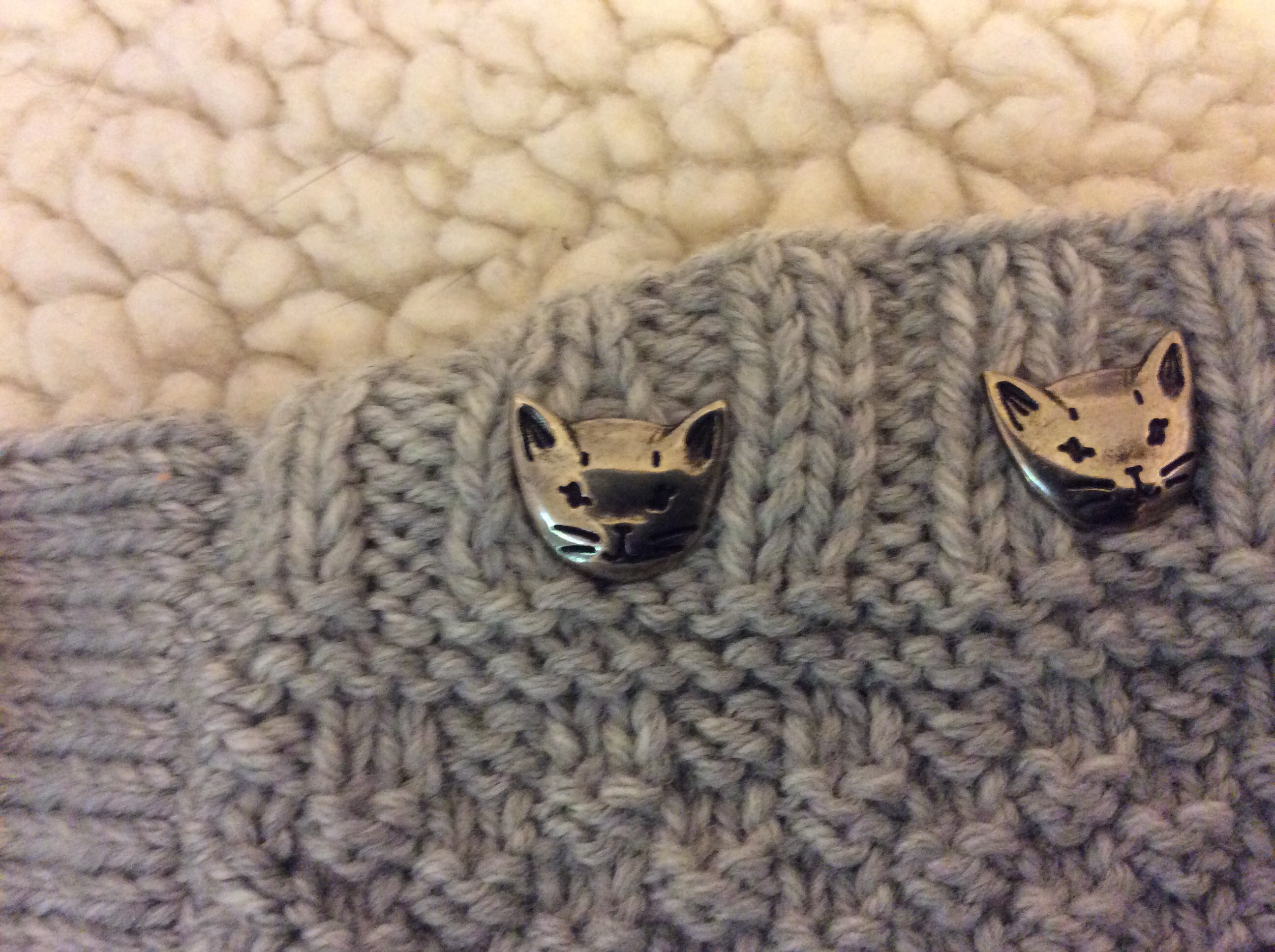
A friend noted that the buttons on the baby sweater I knitted for a baby-to-be might not be appropriate for a baby.
Yes, they are cute cat heads but the ears are rather pointy, not too sharp against my rough old skin, but I don’t want to the buttons to be the cause of baby’s first injury. So I swap them out for these.
And, to be honest, I think these buttons are better suited. They are pretty without drawing the eye entirely away from the sweater pattern.
I hope to present the parents-to-be with the sweater and hat tonight. I’m sure they will be pleased that at least the outfit can be machine washed and dried, and yet it is wool. Merino wool, in fact, which is very soft.
Well, that’s it for now. I’m thinking (again) of changing my blogging schedule. If I aim for Fridays, then I can have all week to write and revise my posts instead of doing them half-off as I am now. We’ll see.
Oh, and what about the classes I’m taking? Well, the Modern Poetry class is a no-go for me. It’s too fragmented: too many links to follow, an audio here, a video there. Each week brings an email (or two) with several embedded links. In contrast, a class I started a long while ago (on a lark), through the same platform (Coursera) has a very simple syllabus, with all content accessible through my iPad app. The course is historical fiction and very interesting so far. I can (and have) happily watched a video lecture while knitting. I’ll say more about that class in a later post. I’m still looking forward (with eagerness and dread) to the Fiction Workshop that will be offered free through the International Writing Program. That will start on Thursday, September 24. And, no doubt, you’ll hear all about that as well.
Until then a little eye candy for all you cat lovers: my green-eyed boy Junior. Why buy a fancy cat bed when an old basket and a couple of magazines make him happy?







 Marie at 1 Write Way