In a New Yorker article (September 13, 2021), author Amia Srinivasan made this observation: “[…] the Internet, […] has simultaneously given us too much to read and corroded our capacity to read it.” The context was feminism and what we think we know about it, but her description of how the Internet has impacted reading applies far beyond her subject.
It’s something I struggle with every day. So much to read, especially online, but also on my Kindle and my bookshelves, the dining room table and the living room desk where magazines pile high. And yet I’m supposed to be writing.
I know I’ve been going through a stressful time. Which requires a couple of updates:
- My sister’s cast was removed last week and she was fitted with a walking boot. She’s still at the facility, but she’s been having more good days lately than bad days. The facility change was definitely a good move. Still, the uncertainty as to when she’ll come home and what kind of help my brother-in-law will given as he continues care for her subdues my efforts to be positive. We all just keep saying, “One day at a time.”
- Maxine, our feline dowager, has been more her old self lately. Spunky, willful, and talkative. She’s been handling our handling of the twice daily antibiotic injections and every-three-days subcutaneous fluids quite well. My husband has even been able to give her the antibiotic injection by himself, that is, without me having to hold her still. Unfortunately, she has “good” days and “bad” days: good days are when she limits her pee and poop output to a litter box or a potty training pad; bad days are when she and Junior get in a tussle and, in her excitement, she poops on the kitchen floor (this morning) or when she sits on the potty training pad but still pees on the floor (also this morning).
I’ve been working through my stress not by writing, but by gardening (healthy activity) and binging on a podcast call Casefile (maybe, maybe not healthy). If you enjoy true crime stories (is enjoy the right word?), check out Casefile by clicking here. A few things I like about the podcast:
- The narrator is anonymous. He wants the audience to stay focused on the survivors and victims in these stories; however, his fans call him Casey.
- The podcast has no dramatic reenactments, no roleplaying, no editorializing, no aimless, mindless banter. Casey narrates in a steady, calm voice. Occasionally he narrates dialogue, which can sometimes be humorous with his Australian accent.
- I say no editorializing, but Casey’s empathy toward survivors and victims is real. At the beginning of each podcast, he cautions the listener in case the crime is of a particularly disturbing nature, such as crimes against children. For example, I chose to not listen to the episodes on The Moors Murders because Casey admitted he had to stop recording a couple of times because he was so disturbed by the abuse done to the children.
- He has, on occasion, expressed frustration with law enforcement responses (or lack thereof) to violence against women. But he doesn’t rant, he doesn’t rail. He just points out when injustice is being served.
- The episodes do not focus gratuitously on details of crimes. Casefile only shares what is necessary to understand the seriousness of a crime, which doesn’t require a second-by-second account of an assault or a murder.
- The podcast often includes interviews, audio clips and other materials, providing a deeper context of the crime.
- The effort Casey and his team put into their research and production is impressive. Links to their sources are provided with each episode.
My most recent binge from Casefile was several episodes on crimes committed by the The East Area Rapist, the Original Night Stalker, and the Golden State Killer in the late 70s to mid-80s who happen to all be one man–Joseph DeAngelo. The best episode was the last one where Casey read or played clips of survivors’ impact statements at DeAngelo’s sentencing hearing. It was the best episode because too often, justice is not found. In this case, it was. A little late, but that was due to the limitations of forensic testing at the time, the fact that DeAngelo was a former cop and knew how to avoid capture and identification, and lack of communication among the various law enforcement agencies involved.
Finally, if you write crime fiction, this podcast will teach you a lot about crime, the justice systems in the U.S. as well as other countries, and how law enforcement, even with truly dedicated officers, can be hampered in their efforts to find and bring the perpetrators to justice.
Now, what about my novel, which is about a murder?
I don’t consider myself a gardener really, but I might allow myself to wear the label of amateur gardener. I am thrilled when one of my plants starts to bloom. Why, hello there, Georgia Aster! I’m so grateful to have a fall-blooming plant.

My red penta is still going strong, and I’ve planted a lavender penta and a red-yellow lantana in the front yard. Fingers crossed that I can keep them safe during the winter. The following Ruellia or Mexican petunia was an impulse buy.
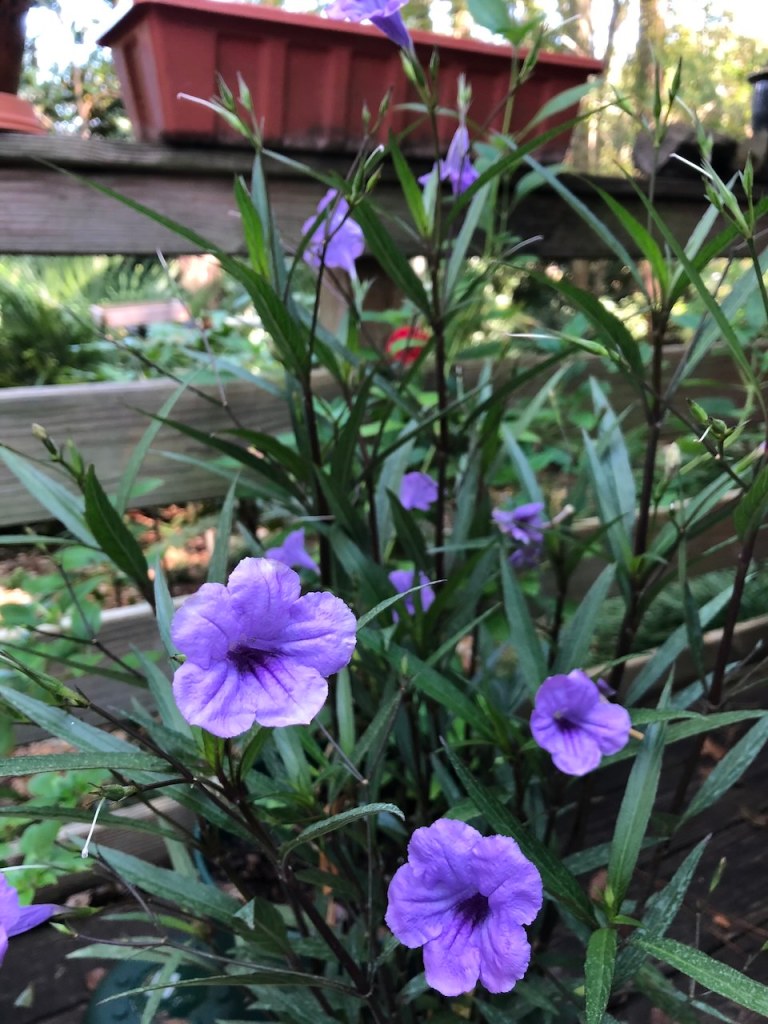
We had gone to Home Depot to order a new dishwasher (a whole other story, but let me just say that we’re never buying GE appliances again). I needed a couple of pots so we went to the gardening section. This lovely purple plant caught my eye. We’ve seen it around our city so, hey, let’s get a pot and see what happens.
What happened was I did some research since the pot only said the plant was Ruellia. Well, according to the iSeek app, this is Ruellia simplex, a highly invasive plant.
WTF.
Through my research (and panic … what does one do with an invasive plant and why was it being sold at Home Depot????), I found the distributor (Costa Farms) who claims: “We sell sterile Mexican petunia varieties that don’t spread by seed. However, these are often vigorous plants and can colonize quickly in gardens and landscaping beds and borders — especially when grown in rich soil.” Okay, fine. The Ruellia I see around town seem well-controlled, but I’ll have to think long and hard about this. It’s so tempting to plant just this one in the front yard, yet perhaps I should keep it in a container.
Meanwhile, there’s that novel I should be working on.
One of the joys of gardening is discovering critters who like to eat my plants. I have three Black Swallowtail larvae on my Rue which is fine because that’s what Rue is for.


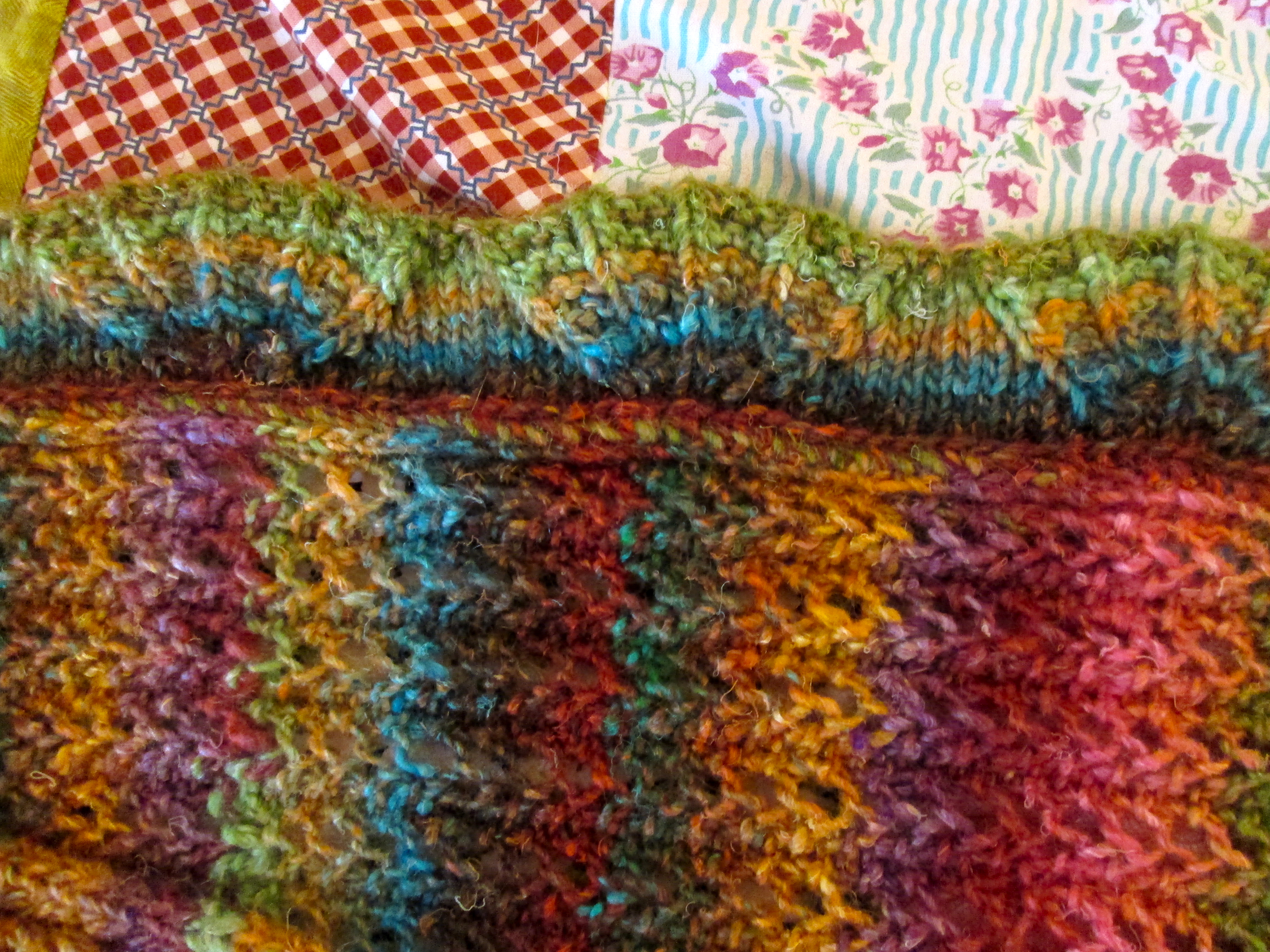
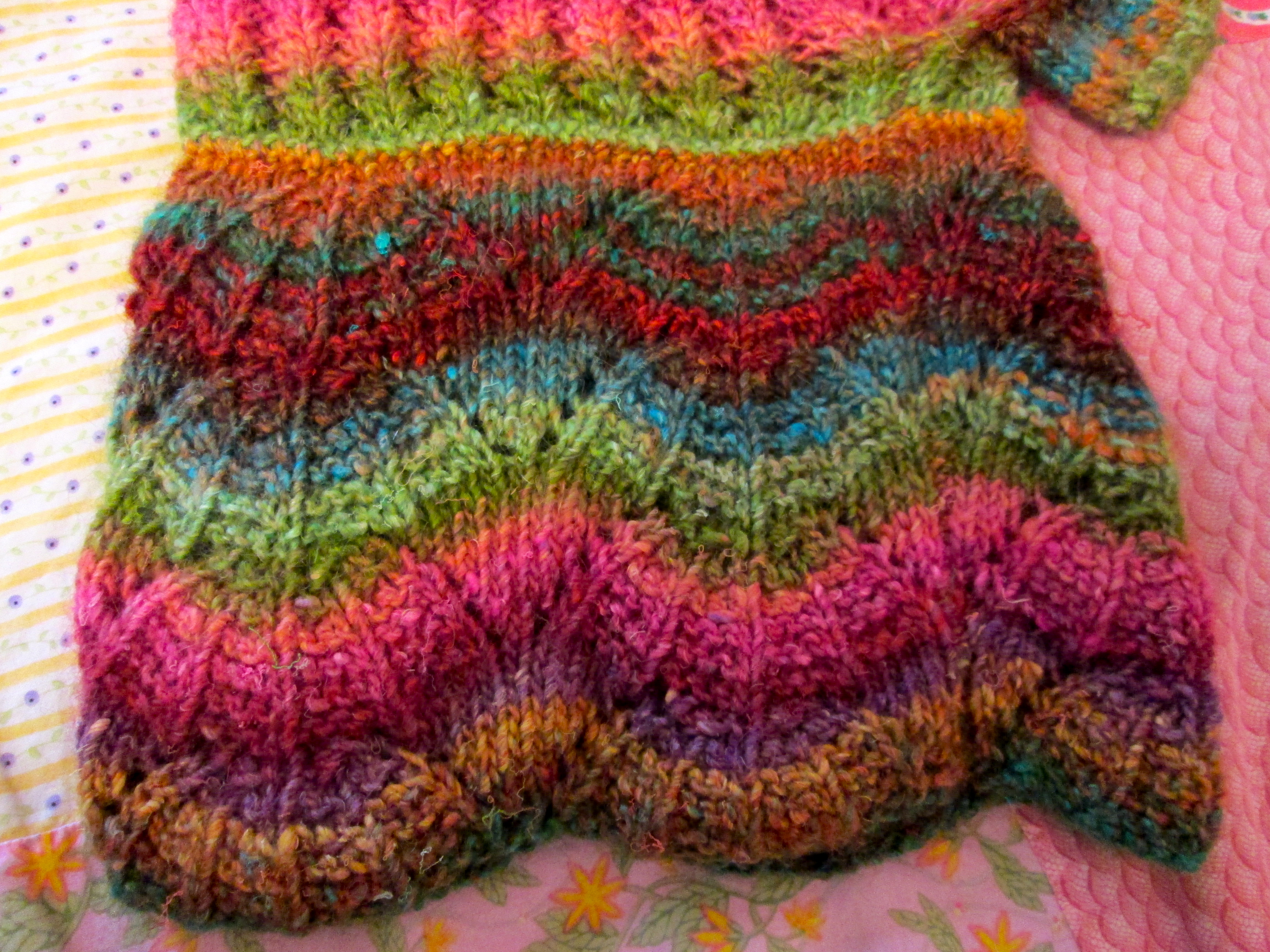
I’ve also been knitting. Finally finished this wool lap blanket so I can put it away in my cedar chest since cold temperatures won’t be arriving down here anytime soon.

I’ve started crocheting granny squares for a larger blanket in a desperate effort to use up my stash.
I have a punch needle kit and a cross-stitch kit as well as three knitting projects waiting for my attention. And sewing? Did I mention sewing?
And then there’s my novel. Oh, boy. You see what I’m doing here?
I’m avoiding my novel because I’m intimidated by the idea of writing from the POV of three narrators. My instinct (these days anyway) says to stick with one, that it will be enough of a challenge to write in first person. I’m trying to work through that. I’m trying to get my writing groove back. But I’m a bit overwhelmed.
Going back to the quote at the beginning of my post, I am realizing that I’m my own worst enemy when it comes to being distracted and drowning. I need to develop some discipline if I’m ever going to finish my novel.
So what do you all do? You publishing writers out there: How do you organize your time? I see a lot of you engage in social media. How do you manage to do that AND work on your writing? Is it just a trick of the Internet that you all seem to be out and about on social media all the time? How do you manage to stay engaged and yet productive?
Thank you for reading, and thanks in advance for any advice you wish to share.
Bonus cat photo: Junior, the green-eyed bully who harasses Maxine until she poops.


 Marie at 1 Write Way