Two nights ago I finally did what I had been avoiding for months: I looked for a blogging friend’s obituary. The sad news is I found it. Some of you might know Nancy Jo Anderson aka Zazamataz on WordPress. Her blog is still up at zazamataz.wordpress.com, but she has not posted since December 11, 2024.
According to her obituary, Nancy died on March 14, 2025. She was only 62. Nancy was open about her illness. In her post of April 24, 2024 (“I’m back. Again.”), she explained that she had both COPD (chronic obstructive pulmonary disease) and CHF (chronic heart failure). My oldest sister Charlotte had both of these conditions, and it was the COPD that killed her. I imagine it was the same with Nancy.
I hadn’t known Nancy for long. I “met” her through Ally Bean’s blog The Spectacled Bean, and quickly came to cherish her friendship, her stories, her humor, her openness. She didn’t shy away from writing about being sad and depressed, her struggles to get proper care, and her many “visits” to the hospital.
Her humor was a gift. She would write about her hospital stays with such comedy that I’d often laugh out loud, forgetting for those moments the fear and pain she most likely felt while it was happening.
And she was generous. In May 2023, she organized the “the great moose giveaway.” It was a clever way to clear out her house and send out a little love to the world. I was game for anything that involved yarn (naturally). But what I got from Nancy was so spot-on, I was speechless when I saw it.
This ceramic bluebird is more precious to me than anything else Nancy could have sent me. I have it sitting on a desk next to the loveseat where I usually have my morning tea. Seeing the bluebird, remembering Nancy, is a nice way to start my day.
I could have “looked for” Nancy long before Saturday night. I thought of it often, but sometimes you don’t want to confirm what you already know.
Although she’s physically gone, I hope some of you might visit her blog. Her spirit lives on in her writing and in each of us whose lives she touched.
In her Author’s Note, Casey Mulligan Walsh begins her tough, bittersweet and unflinching memoir with this quote from Barbara Kingsolver.
Memory is a complicated thing, a relative to truth, but not its twin.
Casey notes that The Full Catastrophe is “a true story to the best of my recollection.” And a reader cannot expect better than that. Some writers of memoir will ask family members or friends to fact-check their memories, but I’ve often thought of memoir as a window into one person’s perception of their life and take it as such. It’s not autobiography. It’s that person’s truth, the essence, of what they remember.
What impressed me more than anything while reading this book was Casey’s seeming determination to not whitewash her story, to not spare herself any blame criticism in how her life turned out.
I started to use the word blame but that wouldn’t have been fair. Casey turns a critical eye on herself, but in such a way that allows her to rise above where she feels she might have gone wrong. Hers is a story of how the best of intentions can lead one astray and how being honest with oneself can save a life (hers) and a family.
Determination, I see now, is not always a positive quality. It can spur you to great things. It can also make you blind, unable to see when enough is simply enough.
When still a young girl, both of Casey’s parents died. Several years later, her only sibling–a beloved brother–also died, leaving Casey alone and adrift in an unfriendly world. She was placed with relatives who weren’t shy about showing her their displeasure in having to be responsible for her.
In such an environment, it’s easy to imagine any young woman jumping at the first chance to leave. In this case, that chance was an ill-fated marriage.
All Casey wanted was to feel safe in the world and to shower love on a family of her making. She really wasn’t asking for much, not considering how hard she was willing to work for what she believed in. Unfortunately, she and her husband were a “mismatched pair.” Later Casey also learns that his parents (who she had believed accepted her as much as they would their own daughter) were perhaps her greatest enemies, siding with her husband during their separation and subsequent divorce, and coming between Casey and her children.
It’s not enough that Casey struggles to keep together the family she always wanted. Two of her three children, her first-born son and then her daughter, are born with a genetic condition, a form of high cholesterol called familial hypercholesterolemia (FH). Can you imagine the worry, the fear for your children, knowing they have a condition that can lead to a premature death?
As Casey’s marriage deteriorates, she becomes more controlling of her children and her husband. She admits this. In the context of her children’s health, it makes sense. In the context of all her losses, the deaths of her parents, her brother, other family members and friends, it makes sense. In the context of her husband’s drinking and combativeness, it makes sense. Her world was falling apart, and she was desperate to keep it together. As anyone would be.
And then her oldest son dies. Not from FH as Casey feared, but from something so random and so common as a car accident. Casey holds it together until she can’t. She finds comfort and strength in the outpouring of love and support she and her family receive, but then dissolves in tears at the end of TV news story about Eric.
The Full Catastrophe is a story of love and loss, the devastating grief of losing a child, the determination to make a family, to make a home. All along I was taken with Casey’s resolve to do the right thing by her children, sometimes to the point of seeming to turn them against her. Tough love, you might call it, but love nonetheless.
I often thought of my mother as I read Casey’s memoir, recalling how my mom tried to protect me from the big, bad world, how her efforts to protect me drove me away from her. I wondered if at times she too blamed herself for her children’s failures. I can only hope that, like Casey, she came to realize that she had done the best she could have done given her circumstances and that her love would ultimately bring me back to her.
The following quote from The Full Catastrophe is one that I keep nearby, a reminder that while death is inevitable, love never dies:
Just in time, I understood our connection to those we love doesn’t end with death, that nothing can separate us unless we choose to walk away. That it will all be over so soon for all of us, and what’s important is what we do while we’re here.
I highly recommend The Full Catastrophe for all readers, but especially those interested in memoir and who may be experiencing their own never-ending grief.
All orders placed at Battenkill Books will be fulfilled with a signed copy.
To further entice you into preordering, Casey has some bonuses for you! After you’ve ordered, head over to her website at https://caseymulliganwalsh.com/preorder-the-full-catastrophe-now/. Scroll down to the preorder form and provide your name, email, order number, and supplier. Hit submit and you’ll receive the link to three preorder bonuses:
Five Ways to Support Those Who Grieve, a concise sheet with advice about ways to support grievers when you struggle, as we all do, with ideas of what to do or say, and a list of supportive podcasts, books, and websites
The Full Catastrophe Spotify playlist—hours of music that became the soundtrack for the life Casey lived, then captured in her memoir
Finally, a link to an ask-Casey-anything zoom call/celebration on launch day, February 18, 2025 (time TBD).
(If you plan to order from Amazon on launch date, just enter “00000” in the order # space on the form, and you’ll receive these bonuses as well.)
I don’t know where you are right now. I don’t believe in Heaven or Hell, but if there’s a Heaven, then I imagine …
You sitting at a picture window, in front of a card table where a spread of 1,000 puzzle pieces wait for your attention which is distracted by the Baltimore Orioles and Cardinals and Bluebirds also vying for your attention outside your window.
Your oldest daughter Charlotte is watching TV which is permanently set to daytime soaps, the ones you and she would discuss on the phone when she lived in Florida and you in New York. She sits in her blue leather recliner, offering running commentary that you only half listen to.
Your other daughter Shirley is flipping through Amway receipts while she recites the latest accolades of her grandchildren. During commercial breaks she’ll pick up a James Patterson novel and read a bit. She sits in her chair, a facsimile of the recliner she left behind, the shawl I knitted for her draped over the back.
You watch your birds, piece together your puzzle, and maybe listen to your daughters. You don’t have to hear every word. It’s enough to have them near you.
Maybe you’re waiting for one of your siblings to drop by. Maybe Beatrice who was the first to go, or Alice who was the last before you. Maybe your brothers Virgil, Ed, Bob, or Leon will show up, or Mildred, Edith, or Leona. It’s been so long since you had seen your siblings. And you wonder about the last two–Howard and Orvetta. You want them to be well until it’s their time and then … no pain, no pain.
You miss berry picking and going to the casino, but then your daughters might take you when you’re in the mood. In this version of Heaven, Shirley does not have Parkinson’s and Charlotte can breathe easily on her own.
After your daughters–your girls–died, you missed them so much that you were relieved to miss your 100th birthday. You got close, very close. But the pull of your girls was too strong, the loss of them too much to continue to bear.
People ask me why your last two children–me and your son–weren’t enough to keep you going. Why did you openly lament the loss of your girls as if they were the only children you had?
They were the only children you had for eight years. You were in your twenties then. By the time your son and I came along, unexpectedly, you were nearly middle-aged with a sick husband and decades of hard and poorly paid work ahead of you.
I want to believe that those first eight years, when it was just you, my dad and your girls, were happy years. Maybe, when your girls died, that was the loss you felt most keenly. They were no longer around to remind you of that time.
No child should die before their parents. No parent should experience the death of their child.
I know you loved me as best as you could. I loved you as best as I could. Yes, I could have been a better daughter. My efforts paled compared to my sisters. Yes, you could have been a better mother. Hindsight is 20-20. There’s regret on both sides, but no point in it.
You were never one for regrets. You didn’t like to look back, and you didn’t pay much mind to the future. From you, I’m learning to live in the moment. That may be your greatest gift to me.
This is my first Mother’s Day without my mom. I don’t grieve my loss of her as much as I first did, but I miss her. She was 99, just over a month shy of turning 100, and she was done with life. She wanted to go, and it would be cruel of me to wish that she hadn’t. Instead, I’m grateful that she lived long enough for us to finally get along with each other.
I am my mom’s youngest, and I was unexpected. I often felt unwanted as well, being that my birth and childhood seemed to coincide with my father’s decline into mental illness. When I was quite young, I was intimdated by my mother. She had a strong personality, and she didn’t seem to care how deeply her words might cut.
When I became a teenager and then a young adult, we were like oil and water. She’d argue that she just wanted to be friends with me, protect me from the dangers of the world. I’d argue that I needed to make mistakes. I needed to be on my own.
But there were other times. I confided in her when my boyfriend stood me up again, or when I found out that a different boyfriend had been cheating on me. When she couldn’t talk me out of moving to California, she took me with her to AAA and got me all the maps I’d need to find my way.
There were times in my life when I thought I wouldn’t miss her once she was gone. It was easy to feel that way while she was alive, and we spent most of our time arguing.
After her second husband died, and she was living on her own for the first time in her life, she changed. She mellowed. Live and let live. Other than the occasional admonishment to remember my brother’s birthday, we got along. She’d talk about birds mostly, or playing the slot machines at the casino, or getting her hair done, or going berry picking, or going to lunch with my sister and a few nieces. She’d talk about my sisters or the grandkids or her remaining siblings. Mostly she’d talk about herself.
As the years went by, we had more frequent but brief conversations. She tired easily. And after her daughters had died, she cried a lot.
In the spring of 1992, I wrote the first draft of a short story for a writing workshop led by Jerome Stern. I have spent the better part of my writing life trying to sort out my parents’ relationship and to see my parents as individuals, separate from me.
My mom and dad when they were so young.
I wasn’t privy to their intimate moments, their lives before I showed up, and even after I was born, I was shielded from knowing too many details. So I had to turn to fiction to help myself understand what their lives might have been like.
The result is “Love Me Tender.” My story is available through BookFunnel. You can download your preferred reading format through this link: Love Me Tender.
Here’s a brief description:
Sometimes we love someone we can’t help, beyond loving them. Irene Newkirk loves her husband but his mental illness continues to worsen despite hospital stays and treatments and Irene’s desperate efforts to keep her family whole. Love Me Tender tells the story of a few hours in Irene’s life as she comes to grips with the fact that her husband won’t be coming home again.
Again, this story is free to read, unless you want a print copy which is available at Lulu.
My story is not available through Amazon or any other outlet but BookFunnel and Lulu.
My oldest sister Charlotte would have been 79 today, October 7, if she had lived. She died on November 26, 2022.
Charlotte was my mother’s first baby.
My mom and Charlotte in December 1944
The first-born child of Florence.
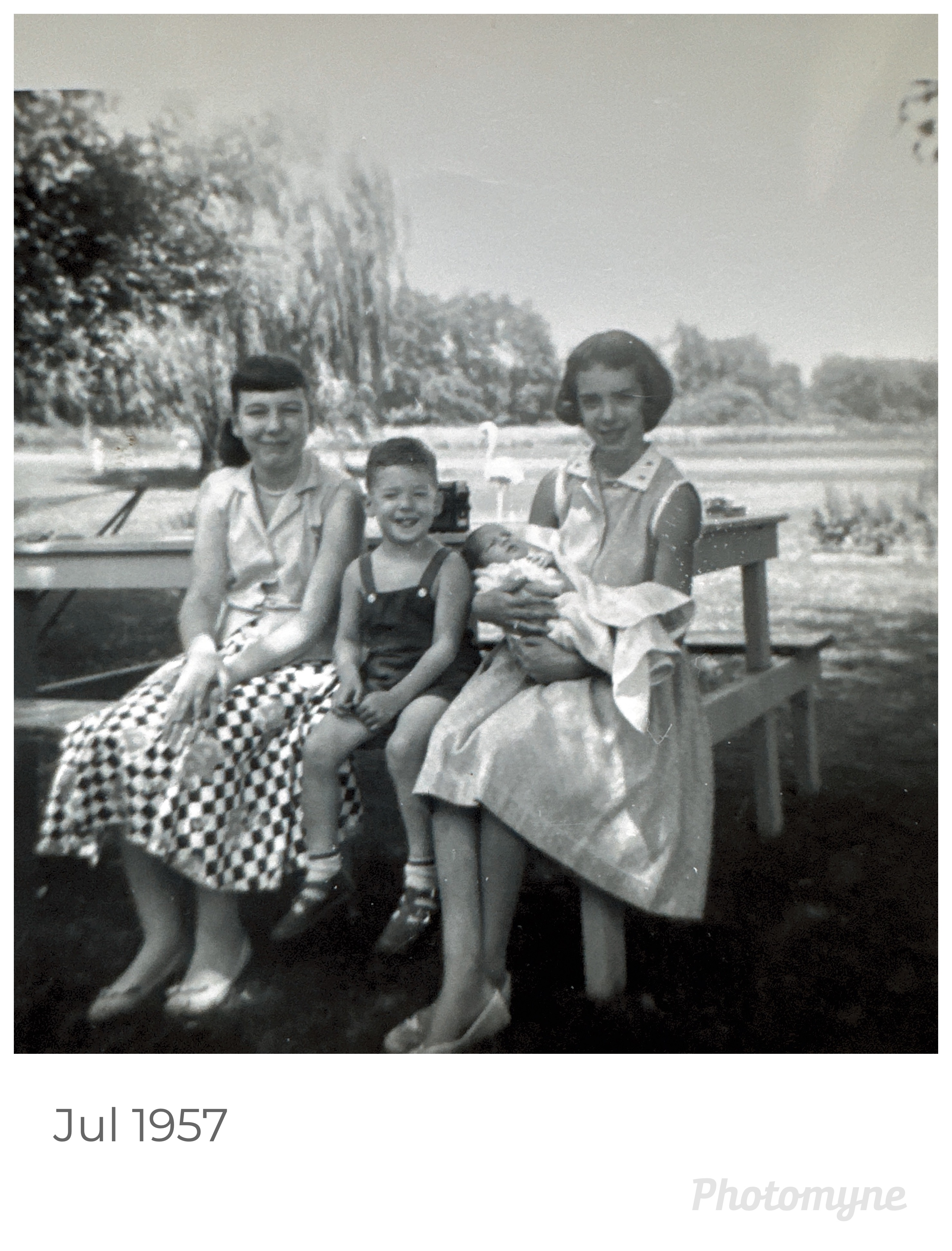
She was a few months shy of 13 when I was born. Here she is with my brother sitting between her and our sister Shirley. I am, of course, the baby in the photo.
The four of us: Charlotte, my brother, Shirley and me.
Over the years, Charlotte blossomed into a beautiful young woman. I was often gobsmacked by her beauty. None of these photos have dates so the order is possibly random.
This slideshow requires JavaScript.
My sisters Charlotte and Shirley took radically different paths from each other. Shirley married the man she first met when she was 16 and stayed happily content with him and their growing family until her last breath. Charlotte suffered through two failed marriages and then became a widow after six short years into her third marriage to a man who possibly loved her more than all the others that came before him. He also loved to sing as did she.
Charlotte being serenaded.
Charlotte had rheumatic fever when she was a young adult, leaving her with a weak heart. She was cautioned against having children because of it. According to one of my cousins, Charlotte had the fever during her first marriage, and it was our mother, not Charlotte’s husband, who got her medical care.
I often viewed Charlotte as a tragic figure, looking for love in the wrong places, struggling to support herself, pining for the children she could not have. She eventually found happiness in St. Petersburg, FL, which too quickly turned to grief, but through it all, she had friends who made her feel loved.
I failed at that. During the last several years, Charlotte and I shared a mutual dislike, due in no small part to our political differences. When my mother started spending winters with her, we would drive down from Tallahassee and visit, trying to be as pleasant as one could be with someone who didn’t welcome our presence. It hurts to remember those tense visits, the TV so loud that we could hardly converse, my sister quick to argue if I said something she didn’t like. I came away from one visit, the last one we had, feeling that my sister actually hated me.
We had had some good times together, times when we’d go out for a few drinks, long phone calls where she’d tell me stories about coworkers, the two-and-a-half weeks I stayed with her while she underwent heart valve replacement surgery. There was something about my sister that made you want to help her. I might have gone a bit overboard with that back then, helping her when she didn’t want or need it, and then feeling resentment it when she didn’t seem appreciative. That wasn’t fair of me.
Eventually our phone calls became shorter and farther between. I felt that the harder I tried to find common ground with Charlotte, the more I realized what little in common we had. It hurt. It hurt to call her and not be able to say something as simple as “How are you doing?” without her snapping back, “I’m fine. Of course, I’m fine. Why wouldn’t I be fine?” It hurt to think that the sound of my voice was enough to twist her mood into something ugly.
It hurt, but what hurts even more is that the last time we did talk on the phone, when she was in hospital because she couldn’t breathe on her own anymore, that last time I was so close to telling her I love her. The words were in my mouth, but I couldn’t say them. We had been so angry with each other for so long. Somehow I knew that by saying I love you, I’d be saying Good-bye. And I just couldn’t do that. I couldn’t admit that she was dying.
Today, April 2, is the anniversary of my sister Shirley’s wedding. Several days after she died last July, my brother-in-law shared the story of how they came to be together.
Imagine the year 1962, in a rural town in north-central New York. Three houses keep company with each other, hugged by cornfields and the main road.
Imagine the middle house, a two-story with peeling pink paint and a septic tank buried in the backyard next to the well. Inside the house are four siblings: the youngest (me) at about 5, the boy at 9, the middle sister at 16, and the oldest sister at 19.
Imagine a tall, dark, lanky lad of 19: Alfred, the son of a dairy farmer. He’s come to the pink house to see the oldest sister Char, his date for the evening.
Char is beautiful in a dark, smoldering way. Her face is round and her eyes are dark slits. She’s somehow restless and indolent at the same time. Alfred comes to the door and is greeted by Shirl, the middle sister. It’s the first time he has seen her. Shirl is cute in a perky kind of way. Her face is thin, her eyes bright and shiny.
“She opened the door and smiled. She was so bubbly.” Alfred went out with Char that evening, but he couldn’t stop thinking about Shirl and how she had smiled at him.
“Then later I called the house and she answered. She said, Oh, you want to talk to Char. I said, no, I want to talk to you.”
And so the love story begins when Shirley was just 16.
I asked my brother-in-law whether my oldest sister was miffed that he chose Shirley over her.
“Oh, no. She had lots of boyfriends.”
I’m sure she did. Char was beautiful and liked to walk the edge of the wild side. Shirley was pretty and liked to follow convention. Alfred was most likely her first and only boyfriend.
I think this is Shirley showing off her engagement ring. The best part of the photo is how happy both of my sisters look.
Alfred and Shirley married when she was 19 and he was 21. Char was her maid of honor. Alfred’s older brother was his best man. Shirley quickly settled into the life of a dairy farmer’s wife, welcoming two sons within the first couple of years of the marriage and then another son several years later.
With the nursing diploma she earned between high school graduation and her wedding day, Shirley took a job working nights in the maternity ward of a local hospital. She loved babies. She loved to write. Many of those nights, while the babies slept, she wrote letters.
I still have a lot of those letters. Well, actually, now I have scanned copies of them. I sent the originals to Alfred, to read and to keep as long as he wants them.
A few weeks before Shirley died, she pulled out her high school yearbook. She made Alfred read what he had written on the back page: “I’m so glad you’re my girl.” He tells me that he didn’t remember writing that until she showed it to him.
I wish I had known their love story, that I could have been more part of it. I was only five or six when they started to date, completely oblivious to anyone’s needs but my own. I don’t remember Alfred taking my sister out. I don’t remember him being in the picture at all until the day of their wedding, that day when I wanted to scream “Don’t go! Don’t leave me!” as she recited her vows.
And then she was gone, but only to another house, just a few miles away. A two-family house they shared with Alfred’s older brother until he divorced, got cancer and died. Some years later, the farm was sold. Alfred couldn’t run it without his older brother, but it’s still in the family and Alfred spends a lot of time there, helping the current owner with upkeep.
Alfred and Shirley kept a few acres of the farm for themselves and built a new one-story house. Ever the handyman and carpenter, Al quietly and steadily worked on their home, adding a front porch where they could sit and watch the occasional car pass by and a screened-in back porch where they could eat when the weather was mild.
Alfred worries that he didn’t hug Shirley enough, or tell her he loved her enough. While she was in the hospital those last few weeks, he visited as often as allowed. He talked to her and hugged her. Sometimes she responded and returned his hug. Sometimes she didn’t. He could never really tell if she understood anything he said.
I try to tell him that none of it would have been enough, no number of hugs or I-love-yous would ease the pain of losing her. That he has to have faith that she knew, she always knew, how deeply he loved her. He has to have faith that her love for him was just as deep as his love for her. They had 59 years together on this earth and were rarely apart from each other. They built so many happy memories together that he can’t remember them all.
Sometimes the deepest love is unspoken. The deepest love resides in the heart. It will never leave and it will never end.
I always feel apprehensive when reviewing poetry, maybe more so than when I’m writing the poetry myself. Some time ago, I took an online writing course, and the instructor mentioned in passing that she liked writing poetry because you didn’t need to explain poetry like you would explain a story or an essay. While that idea frees me to write poetry, it definitely makes it more difficult to review poetry.
Poetry is like music, like art. You can admire the technique, the skill in putting words (or notes or paints) together in a pleasing way. But the poetry I’m attracted to does more than please me. It lifts me out of myself and sets me to ponder ideas and feelings I either hadn’t considered or had been afraid to acknowledge. So ends my long introduction to this review of Merril D. Smith’s book, River Ghosts.
Cover art by Jay Smith
But before I begin my review: Just look at that cover! River Ghosts is published by Nightingale & Sparrow, and what a gorgeous book to hold in my hands. When I first saw the cover on Smith’s blog, I knew I had to have a printed copy. I have not been disappointed. In fact, when I wasn’t reading Smith’s lovely poetry, I had her book displayed on a bookshelf so I could enjoy seeing the cover.
The first poem in this collection–“River Ghosts”–sets up the reader for a journey into the past and present, into if and when, with “echoes / over the river.” The reader is invited to “Observe again.” but also to “Now solve the problem.” And that’s just in the first two poems. Smith might not intend for the reader to “solve the problem” presented in all the poems, but she definitely intends (in my humble opinion) for the reader to observe again and again, whether she is observing “a train to hell,” a first love or dark matter. Like a river, these poems meander–at turns edging toward grief (“our mother stopped eating before she died, / now I hear her ghost-laugh in my dreams”), then sisterly fun (“we rubbed the laughing Buddha’s belly for good luck”), but always listing toward the mysteries of the universe, encompassing life and death:
Once some brilliant star breathed time
in the after-wake of explosion and danced across a universe
exploring eternity
The poems were compiled after Smith’s mother died of COVID-19 in April 2020, and so a number of the poems feature her mother in her youth and old age. She (and others long-deceased) also features as a ghost; not a scary, haunted ghost, but:
Not living,
no longer here,
yet not completely gone.
In her poem “Family Ghosts,” Smith makes clear her calling and intent:
Subsisting, existing
their ghost voices sing to me
I hear them
I feel them–ancestors calling me,
this is what we do, generate, create the songs of our hearts forever.
These are poems I will be turning to often as I seek comfort when my own family members become “not living, / no longer here.” I will find comfort in knowing that they are “not completely gone.” Smith demonstrates how a writer could (and, perhaps, should) allow ancestors to speak through her, echoing through the years, so we always remember not just when but if.
It’s been so long since our last hike at Big Basin Redwood State Park in California. But it isn’t that last hike that comes to mind; it’s the first one we made one winter. My not-yet-husband Greg and I had been living together for about 18 months when we decided to spend a couple of winter nights at Big Basin. At the time (the late 80s), it was an easy two-hour drive from our San Francisco apartment. We spent the previous night packing our sleeping bags and other gear, preparing food while The Talking Heads’ movie Stop Making Sense played out on our TV.
It was a cold winter. We practically had the park to ourselves; it was so cold no sane person would think about spending the night in a tent. We were sane, but also young. That first night we set up camp and walked around a bit, returning to eat and retire early.
I wanted to read. I don’t remember what novel I was reading at the time, but it was a paperback. I remember that because turning the pages while wearing thick wool gloves took as long as actually reading a page. I reclined in one of our Nifty chairs, a two-piece chair of slotted wood and dark blue cotton panels. It sat low to the ground. I wore a wool cap, wool sweater, long underwear, a hooded storm blue parka, thick wool socks, jeans, and hiking boots. I draped scarves around my face. Greg cocooned me in blue, green and red patterned wool blankets that he had bought in Ecuador.
We were slotted in among tall trees and deep green bushes, a thick border between us and our neighbors, except we didn’t have neighbors. Instead, we had uninvited guests, an unwelcoming party of five young raccoons who, at the first scent of our roasting hot dogs, decided to crash our little party of two. They came out of the bushes, advancing on us, their bandit eyes fearless and curious. It was cold. They were hungry.
“Shoo, shoo!” We waved them away, normally not afraid of raccoons, but we were outnumbered. Finally, Greg took a big stick, a fallen branch, and pounded the ground in front of them. They looked at him, shrugged, and went away reluctantly.
That night I bundled into my sleeping bag and lay listening to a barred owl hoot as it flew from one tree to the next. I was warm except for my nose which felt like an ice cube. The raccoons came back and tried to jimmy open the cabinet where we had stored our food. I smiled knowing they could never break in.
The next day we went on our hike, starting off with three layers of clothing. That morning I had had to chop through a layer of ice to get to the water in our bucket. The seven-mile trail we took was flagged as “strenuous” by the park. Seven miles of drops and climbs, from the bottom of waterfalls with dark green ferns and moss, up to chaparrals with manzanita shrubs dotting the stony, bare hillside.
We lunched on a platform overlooking one of the falls, taking in as much with our senses as we city people could: the tang of muddy earth, the lull of rushing water, the slipperiness of moss-coated stones. Our calves were cramped with the strain of hiking this roller-coaster of a trail. This trip, this vacation, was a pilgrimage to a place on earth we knew we had to enjoy now while we could still walk.
The air was fresh and wet and cold, the temperature rising to the forties, maybe the fifties. By the end of the hike, my left knee gave out and I had to walk sideways for the last half-mile. We had warmed enough to strip down to one layer — long-sleeve t-shirts and jeans — stowing all the rest into our too-small backpacks.
At the end of the hike, the temperature was dropping and the light was fading. We bee-lined for the showers. Have you ever taken a hot shower in an ice-cold stall? Any bit of your skin that isn’t covered by hot water feels the knife-edge of freezing air. I always thought I would linger during my shower, but I never could last long, the cold air and hot water battling over my body. By the time I toweled off, I was starting to shiver. I couldn’t get my clothes on fast enough.
Back to camp and a fire and some brandy. More hot dogs. More raccoons. They kept their distance this time and all was well until I reached for the bag of pistachio nuts that I had left on the picnic table. It was gone. Panicked, because I loved pistachio nuts and had only eaten a few, I searched under and around the picnic table. Then I heard it. The familiar crunch and crack of the nuts being broken open and then devoured. The raccoons had stolen the bag.
I glared at the bushes where they were hidden, unseen but not unheard. Outwitted by raccoons.
As we stood around the fire, sipping the pint of brandy, I wondered out loud whether Greg’s former girlfriend — the one just before me, the one who left him and then tried to come back — would have been a better camping companion, more experienced and fun. He laughed out loud and said, “No, she’d be lying in the tent right now if she came at all.” She was not, never had been, a good camping companion. “You’re a superior woman,” he said before he kissed me.
As we packed up the next morning, making sure we weren’t leaving any crumbs for the felonious raccoons, a doe and her fawn sauntered into our campsite. They paused when they spotted us, and the four of us stood staring for a minute or two. We were in awe by their proximity; they were waiting for us to leave so they could forage. I poured some trail mix — peanuts and raisins — into my hand and held it out. The doe leaned her head forward, taking only as many steps as she needed. Her soft muzzle tickled my palm. She never took her eyes off me and kept her body between me and her fawn.
We dropped the rest of the mix on the ground so the fawn could eat too.
This wasn’t my last winter hike at Big Basin, but it was the last one where I looked deep into the eyes of a doe as she ate out of my hand. It was the one where I learned that I had won the heart of the man I loved.
***
Hello, everyone, and thank you for reading. This story was written in response to a February flash challenge hosted by Mom Egg Review. No worries. I’m not going to post daily, but since it took me ALL day to write this, I just thought I’d go ahead and share. Here’s your reward for sticking with me this far.
Raji in a somewhat drugged state before his annual checkup with the vet.
You know I had to read my last post to see where I left off. Lol.
Apologies for my absence from the blogosphere, not so much for not writing as for not reading. Whoa, I am so behind that I might not bother to try and catch up.
Update on my sister: Last week she was moved to a new, better and closer-to-home facility. She even has a private room. She is still on schedule to see the surgeon and (hopefully) get her cast removed on October 7. Still, we’re all taking things one day at a time. She has good days and bad days which means her husband and sons have good days and bad days. My brother-in-law met with a doctor at the facility who explained that given the trauma my sister experienced (breaking her leg) as well the subsequent surgery, anesthesia, changes in environment, etc., it’s expected that she would have good days and bad days. Maybe her Parkinson’s is getting worse, but maybe also she is still recovering from her fall. Right now we’re all just grateful that she’s in a better facility getting better attention and that her husband, sons, extended family and friends can visit more often. Everyone is staying positive.
Update on Maxine: Two weeks of twice daily injections of antibiotics have cleared her UTI (good news!), but our vet wants us to do another two-week round (ugh!) and then a recheck to be sure. Her kidney enzyme values (creatine) have decreased by one point (from 6.9 to 5.9 for those well-versed in feline kidney disease) (also good news). We will continue to give her subcutaneous fluids every three days which is a nerve-wracking experience for both of us (more for Greg because he has to insert the needle while I hold onto Max and close my eyes) … but it helps her so it’s worth it. Plus, today we tried out a “harness” for the first time, and Maxine just relaxed on the couch while she got the fluids. I didn’t have to hold her. The harness is simply a velcro belt that fits around her hips and keeps the IV line in place so she can move around if she wants. Today she just laid on the couch and enjoyed having her head scratched while Greg administered the fluids. Max isn’t “out of the woods.” Previously our vet had said that if the antibiotics worked and the fluids helped, we’d be looking at another several months to a year with Max. I’m inclined to think that’s optimistic, but I’ve been rather pessimistic of late. I hope to be proved wrong.
So the beat goes on. You know, I loved the Sonny and Cher show way back when. Good times.
Here’s recent photo of Max, looking wide-eyed and alert and as willful as ever, living up to her nickname, “She Who Must Be Obeyed.”
Comments are closed because I am SO far behind in writing and reading. I’m retired but there’s still not enough hours in the day. Go figure.
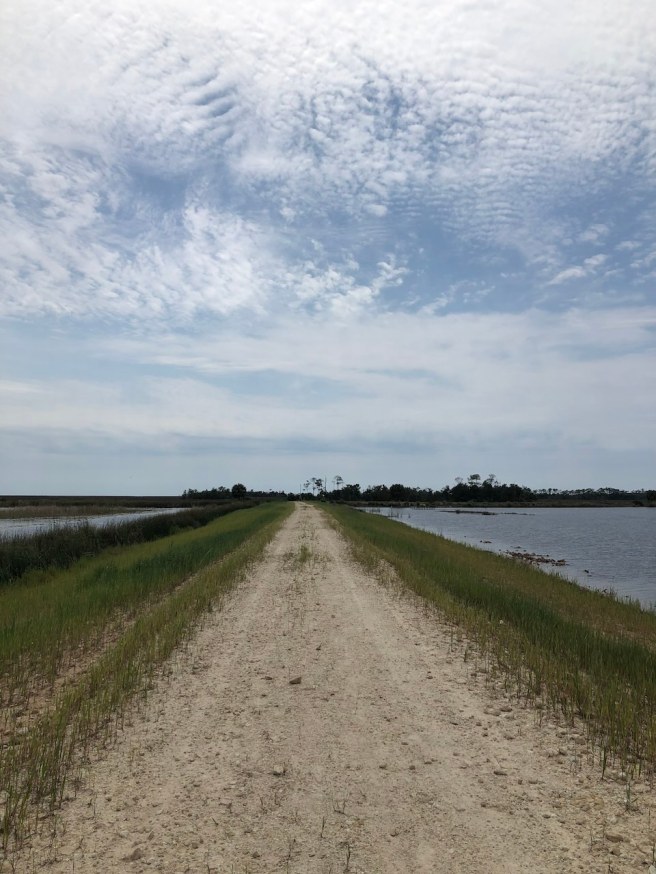
St. Marks National Wildlife Refuge, Stony Bayou, March 29, 2021
I’ve been down this dike before with you. I often veer off our path gaping at clouds in the wide blue sky, shuttering a desire to leave my bike and explore the bayous. It’s why we’re here, to feel the expanse of nature, the filling of our souls. Often ordinary but glorious cumulus clouds fill the sky.
There are clouds today but these clouds are clearly foreign, such an exotic clutter against the blue cloth of the sky. Thin cotton rolls layer above our heads. Is this what they call a “mackerel sky,” I wonder but don’t ask out loud. You wouldn’t hear me anyway. You’re too far ahead. I always fall behind when we travel this dike. I want to stretch my arms, embrace the whole of the sky. I fall in love with these clouds like I fell in love with you.
***
I’m participating in Merril’s prompt for dVerse Prosery Monday. Click here if you want to join in. Frankly, I have no idea what I’m doing, but I seem to be attracted to challenges where I’m limited to 144 words or less. I suspect it’s because I’m working on a novel … lol.








 Marie at 1 Write Way