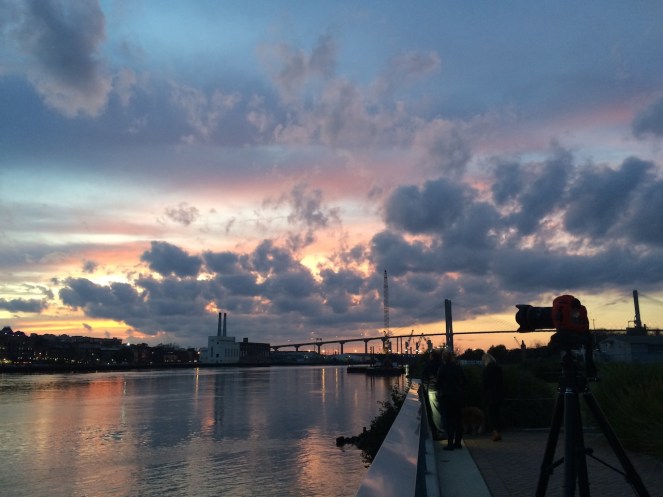
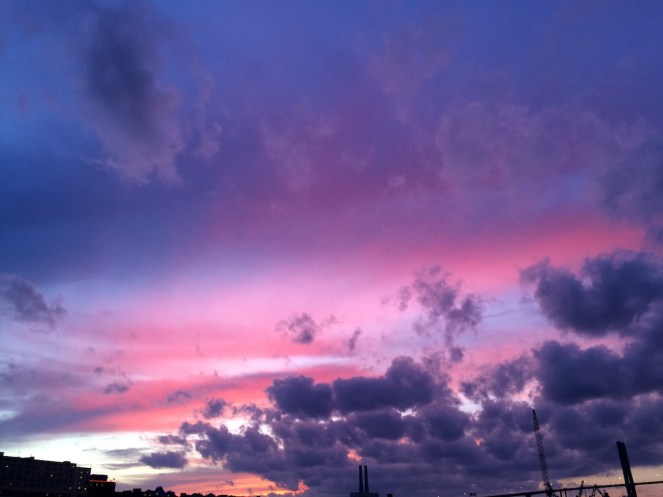
This week’s challenge comes from Amy of The World is A Book. She asks us to share our “cloudscapes over land, sea, or cities, or just clouds.” I love clouds and am often looking up to see what they’re doing, and just as often I trip over my feet trying to take photos of them. I knew I had a lot of photos of clouds stashed on my computer so I was up for this challenge. I slogged through, selecting this one and that one when I came to my collection of sunset photos taken when we were in Savannah, Georgia. They still take my breath away, although my photos don’t do true justice to what we saw that evening. The photos were taken in January 2016 with an iPhone 5S. No filters. Seriously, the colors you’ll see here are the colors I saw with my naked eyes.
I started “snapping” photos at about 4:23 PM and finished close to 6:00 PM. The scenery will change because I took photos at different angles along the Savannah River. Enjoy.
I hope you enjoyed this series. If you want to join in, make a link to Amy’s original post (click here) and tag Lens-Artists so you can be found through the WP Reader.
This week, Anne leads the photo challenge with “Wildlife Close to Home”: “Stop. Look. Listen. Doing those three things will help you discover the abundance of wildlife you have nearby.” I stop, look, and listen a lot on my walks in the hood and even in my own backyard.
You might recall that my husband gave loaned me his Lumix GX85. So far I’ve been pretty pleased with the quality of photos I’m getting. As always, my favorite subject: the humble bumblebee.
We’re making an effort to attract bees, butterflies, and hummingbirds to our little slice of suburbia. The following photo shows a shrimp plant that, on any given day, will have two or three bees slipping in and around its flowers. I am utterly amazed by this plant. It wasn’t blooming at all the first couple of months. I transplanted it during that time, but still no blooms. Finally, I moved it to a much bigger pot and now I have 20-30 blooms on it!
Shrimp plant. Looks good enough to eat!
There are wilder places than our backyard. One of my favorites is St. Marks National Wildlife Refuge. We went out there this past Monday (a gorgeous, cool, sunny day) on our bicycles. We took a break at one of the two concrete bridges that we cross over. We delighted in the spectacle of a number of insects enjoying the yellow centers of the Climbing Aster.
This here is a type of bee making hay with a Climbing Aster. Taken with my iPhone 8 Plus.
I really struggled to get a good shot of the bees (they were moving too fast). Here’s a photo with just the flower so you can see how pretty they are.
Climbing Aster. This one I took with the Lumix GX85.
The refuge would not be a refuge without an alligator. We found this one “dozing” at the first concrete bridge we crossed. When we came back this way a few hours later, he/she/they were still there. The day wasn’t too cold, but cool enough for the alligator to go into a kind of stupor. Still, I was more than happy to stay on the bridge and just admire it.
Alligator doing what alligators do when they’re on the chilly side. (Taken with my iPhone 8 Plus)
Now for a change of pace. Several months ago we went to Mashes Sands Beach, a funky strip of sand along an estuary. I love going there because there’s always something interesting to see. On this day, I was playing with my old Canon T3i and a telescopic lens. This is an osprey on the hunt.
Osprey on the hunt. Taken with a Canon T3i and telescopic lens.
Last, but never least, one of my favorites from springtime at the St. Marks National Wildlife Refuge: the bum of a bumblebee as it tears through a thistle.
Bum of a bumblebee on a thistle.
Thank you for visiting!
If you care to join in the fun, remember to tag your post with Lens-Artists and make a link to Anne’s post.
Anne Sandler from Slow Shutter Speed leads this week’s photography challenge with “what’s your photographic groove?” What a great question!
At heart, I’m a minimalist … although if you saw my bedroom/workroom, such a thought would have you laughing your arse off. By minimalist, I mean I don’t like having a lot of gear, which is why I really regret attending the going-out-of-business sales of a local quilting shop several years ago. I still have a lot of that stuff! But back to photography …
I still play around with a Canon Rebel T3i that I bought over ten years ago. My husband (who does love gear) provides me with nice macro and zoom lenses, and I can neatly fit the camera with the two lenses in a small case … which then weighs a ton. I fantasize about taking the camera and lenses with me on my morning walks, but I always have an excuse not to. One excuse is that it might be picking-up-litter morning, in which case I’ll also be carrying my gripper and a 13-gallon bag, which, in all likelihood, will be full by the time I get home. Another excuse–the more common one–is that I have my phone if I feel compelled to take photos. Besides, isn’t it more important to enjoy the sights and sounds of nature without always trying to “capture” it?
I try to do both.
Here’s where we get to my groove. My iPhone 8 Plus suits my minimalist nature. While I might have gotten better photos with my Canon, I feel satisfied for now with what my iPhone can capture. Case in point: the Pleated Inkcap (Parasola plicatilis), a fungus I found on a recent morning walk.
For scale, here’s my left index finger pointing to a Pleated Inkcap.
Dainty little things, aren’t they? One of the things I enjoy about photography in general and macro photography, in particular, is that I “see” more. These fungi sit close to the ground, and there was just one bunch of them. Still, to my delight, my eye caught them.
Don’t they look like dainty little flowers or parasols?My iPhone was almost flat on the ground in order to get this photo.This should give you some perspective on how low to the ground these fungi are.
So I guess my photographic groove is macro with an iPhone 8 Plus. For now, anyway. I’ve heard that the iPhone 14 is supposed to break new ground in iPhone photography. We’ll see …
If you want to participate in this challenge, please link to Anne’s original post (click here) and use the Lens Artists tag. As the LAPC team resumes rotation, Patti will present next week’s challenge. Be looking for her post. In the meantime have fun and stay safe.
Almost down to the wire with this week’s Lens-Artists Photo Challenge. The lovely Ana has the lead on this week’s prompt: Postcards.
I would like to encourage you to participate, in any way you want. You can show us some of your pictures that you would send as postcards to someone you love. Or you can simply share with us images of your favorite places.
If you have a garden full of flowers, show us a beautiful and colorful collection of floral postcards. It doesn’t need to be your garden, It can also be your neighbour’s. 😉
If you have some real postcards it would be great if you would like to share them with us, I’m sure they have a nice story behind them.
I love postcards. Even today with my iPhone as a camera and the ability to share photos in real time, I still look for the best postcards when I travel. Some I keep for myself, some I send to others. Here’s a few I kept from our trip to Bridgeport, California where we married on August 21, 1989.
First, you need to know that back in the late 80s, we were living in San Francisco. In August 1988, I and my not-yet husband went on a car-camping trip through Nevada, returning to San Francisco via Bridgeport and Mono Lake. I fell in love with Mono Lake and its surreal tufa, or limestone, formations. We found a place for the night, and the next morning had breakfast in Bridgeport across from the county courthouse. Fast forward to the summer of 1989 where we are discussing where to go for our August vacation.
“Let’s get married,” he said in his matter-of-fact way. (I admit, we had been talking about getting married, but the plan was to wait until December.)
“Okay,” I said, trying to sound as matter-of-fact as he did. “Where?”
“In Bridgeport, at the county courthouse. It’s a beautiful building.”
Swoon. Unbeknownst to him, my soon-to-be husband was revealing his romantic side. So we did, we married in Bridgeport and went car-camping in the White Mountains for our honeymoon. Here are some postcards from our trip. You can tell that I took photos of my postcards. They are pretty much stuck in the photo album we were given as a wedding gift.
The county courthouse is at the right in the uppermost postcard above and at the bottom in the postcard below. Some of these postcards also have photos of the tufa formations at Mono Lake.
Since it was a warm, sunny day, we chose to be married outside.
This last postcard is my favorite and captures well what Mono Lake looks like on an overcast day.
One of the things I had to do on our trip was “swim” in Mono Lake. I had read that because of the lake’s salinity, one would simply float on the water. I waded in only as far as my calves and couldn’t get out of the water fast enough. I had made the critical mistake of shaving my legs that morning. Talk about putting salt on wounds! Ha! I’ve never attempted it again although we’ve visited Mono Lake several times since.
I hope you enjoyed this little excursion into the past. If you want to participate in this photography prompt (and there’s still time), please remember to link Ana’s post and use the Lens Artists tag. On Saturday, August 7, Patti will host LAPC #160 Your inspiration, which can be a place, a subject, a person, a book–just about anything that inspires you.
This week, Patti has us thinking about size–from large to small. Her instructions (or suggestions, depending on how compliant you aim to be … (smile)): For this challenge, pick a color and select several photos that feature that color. Start with a photo of a big subject in that color (for example, a wall) and move all the way down to a small subject in that same color (for example, an earring).
I was initially stumped until I started looking at how others were meeting the challenge. The dim bulb in my head got a little brighter.
The color I choose is pink. When I was in my late 50s, I had an obsession with the color pink. I was buying pink clothes, pink laptop covers, pink yarn, pink fabric. I drank pink lemonade. My desire for pink ran amok. I think it was because I actually hated pink when I was a little girl. Blue was my color then. So maybe my obsession was just making up for lost time.
Tina asks us to go from large to small, here goes …
Here’s a variety of pink in a light quilt that I made many years ago. In the photo, I am under the quilt. Wendy is cradled by my legs, her nightly routine.
Smaller than my quilt is one of my favorite shirts, which is mostly pink. It’s made of quick-dry fabric making it a great travel shirt, and the color has not faded at all in the many years I’ve had it. Whenever I need a visual pick-me-up, this shirt does it for me.
Smaller than my shirt is … wait! What’s Maxine doing here? No, she’s not pink-colored, but she does have a connection to the color pink.
Maxine’s story
Maxine showed up on our back porch in January 2009 and refused to leave (she knows a sucker when she sees one … or two). We made the usual effort to try and find her original staff. After a few days of no response to our inquiries, we took her to our vet to see if she was chipped. Yes, she was! We learned then that Maxine hailed from Miami (only about 400 miles south of Tallahassee), that she had been adopted in 2004 (making her five whole years old), and … wait for it …
her original name was Pink.
However, she’s forever Maxine (or Max or Maxie) to us.
Smaller than a cat–! I bet you all were wondering when I was going to sneak flowers into this challenge. I recently purchased this Gerbera daisy (aka Barberton Daisy). I could look at it all day and every day … which, actually, I do since it’s on my deck.
The flowers of my Madagascar Periwinkle are definitely smaller than the Gerbera Daisy.
Lastly, smaller than them all, one of my favorite earrings in pinkish glass.
I hope you enjoyed my answer to this week’s challenge. Remember, if you wish to participate in the From Large to Small, be sure to link to Patti’s original post and include the “Lens-Artists” tag.
Personal note: I’ve closed comments on this post. My husband is scheduled for back surgery on Friday. Although it is outpatient surgery and a relatively simple procedure, I need and want to give him undivided attention now and through his recovery. I know you all understand.
Stay safe, well, and happy. Be sure to tell the important people in your life that you love them.
For this week’s photography challenge, Diane of the Rambling Ranger is “talking about Mother Nature untouched and untrammeled, allowed to get on with her work without human help or hindrance.” Now that’s a real challenge, especially here in Florida where evidence of human help or hindrance is in overwhelming abundance. But Diane further notes that, “Even if your only access to the natural world is the local park, you will certainly find something wild in your world.” Okay, well, I do have some parks and forests around, and human help that I just can’t help but show.
In early April, my husband and I drove to a segment of the Apalachicola National Forest, expecting to find a field of pitcher plants, or more correctly, a Savannah wetland of pitcher plants. What we found instead were charred remains.
Above is my husband on the search for bugs and pitcher plants.
What we didn’t know was that the U.S. Forest Service had conducted a prescribed burn in the area back in late February. Prescribed burns are necessary to reduce the risk of wildfires and to maintain a unique ecosystem such as the Savannah wetland. Even though we were disappointed, I found good subjects to photograph.
Life on the rebound, especially among the pines.
Above are remnants of a hunting party, or maybe just a party. I actually did some trash pick-up while we were out, although I didn’t have enough bags to pick up this assortment of burned-out bottles. But see the green shoots … nothing can keep Mother Nature down for long.
A few weeks later, we returned.
What a difference six weeks can make! We were thrilled to find green everywhere and pitcher plants in abundance!
Pitcher plants are carnivorous, needing to get their nutrients from the insects that crawl into the pitcher part of the plant where they drown and are slowly digested. (It takes all kinds.) You can learn more about them here.
Looks like a moth is becoming food for this pitcher plant.
Tuberous grasspink
Including my hand for scale
Snakemouth or rose pogonia
Flowers were everywhere as well, such as these tiny orchids (above).
Mimosa pudica
Orange milkwort (?)
Coreopsis nudata–Georgia tickseed
This last (but not least) flower, I call “Jill’s Flower” because I think of her whenever I see a pretty combination of purple and yellow. (Y’all know I mean Jill Weatherholt.)
So, this is as wild as I get, folks. Given my achy-breaky knees, it was hard enough to squat down to get close and personal with the orchids, and then get back up.
I hope you enjoyed this walk on Marie’s wild side and will visit other photographers participating in this challenge.
If you care to join in, please remember to use the Lens-Artist tag and link to Diane’s original post (here). And heads up, next week’s challenge will be hosted by Patti and the “rules” are as follows: “From Large to Small. Here are the details: Pick a color and take several photos that feature that color. Start with a photo of a big subject in that color (for example, a wall) and move all the way down to a small subject in that same color (for example, an earring).“
This week, the challenge is from Tina at Travels and Trifles: “we are returning to the color wheel and its cooler members, which include blue (primary) green (secondary) and blue-green or blue-violet aka purple (tertiary). A visit to the web on the subject will take you deep into the emotions said to result from exposure to these and other colors. For this week’s purposes, let’s simply explore the many ways the cooler colors appear in our world.”
Let’s hear it for green and blue!
Hydrangeas are in full bloom in my neighborhood. The top two photos are from a corner bush on one street, the bottom from across my house. One of the many things I love about hydrangeas is how you can have different colors–from true blue to bluish purple to light purple–in the same bush.
This sign (above photo) has been up for the past year. You know why. I love seeing it.
This treasure (above photo) was spotted on our walk at the Timberlane Ravine where I had seen an assortment of figurines. (Story about that is here.) Some of the figurines are there, some have been taken, some have been added. It’s a thing, apparently, and I might participate by leaving one of my figurines there someday.
Here’s one of my own lovelies, a pot of Lobelia which we bought not just because it’s so pretty, but it’s supposed to attract hummingbirds. I haven’t seen the two hummingbirds that visit us seek out the Lobelia, but we also put out sugar water for them. Why go for a sip when you can have a big gulp?
I hope you enjoyed my contribution to the challenge. If you wish to participate, please remember to link your response to Tina’s original post and to use the Lens-Artists Tag. Next week’s challenge will be hosted by Dianne Millard of Rambling Ranger. Be sure to check out her blog and watch for her post next week.
I like this quote that Leya cites in kicking off this week’s Lens-Artists Photo Challenge:
In one sentence, I’d describe myself as indescribable. But, I wouldn’t end it with a period. I’d end it with three dots. – Jason Schwartzman
I like the quote because, as anyone who’s read a lot of my comments should know, I use ellipses (…) a lot. I use them often incorrectly, but I persist because, well, …
This week’s theme is Spots and Dots, and Leya wants us to have fun with it. I cannot resist fun.
First up, a spotted and dotted leaf on spotted and dotted ground.
I know! I’ve clinched the challenge! I could stop right here, but I have more.
This is one of my favorite photos and some of you have already seen it featured on my blog: A morning glory with raindrops.
I’ve also shared this photo before: Sawfly larvae. I believe it was last spring when we came upon a small pine tree that was covered with these larvae. We were fascinated by them, having never seen them before. Unfortunately, they are known to decimate trees, particularly young pines.
This critter may well be a White-Marked Tussock Moth caterpillar of the “look but don’t touch” variety. Apparently their fur is covered with chemicals that can cause allergic reactions. Good thing I instinctively do not try to pet anything that is not a cat or dog. Still, I think this caterpillar is lovely with its orange dots and white spots. Occasionally I see them among my potted plants. I was chauffeuring this one to a tree in our yard.
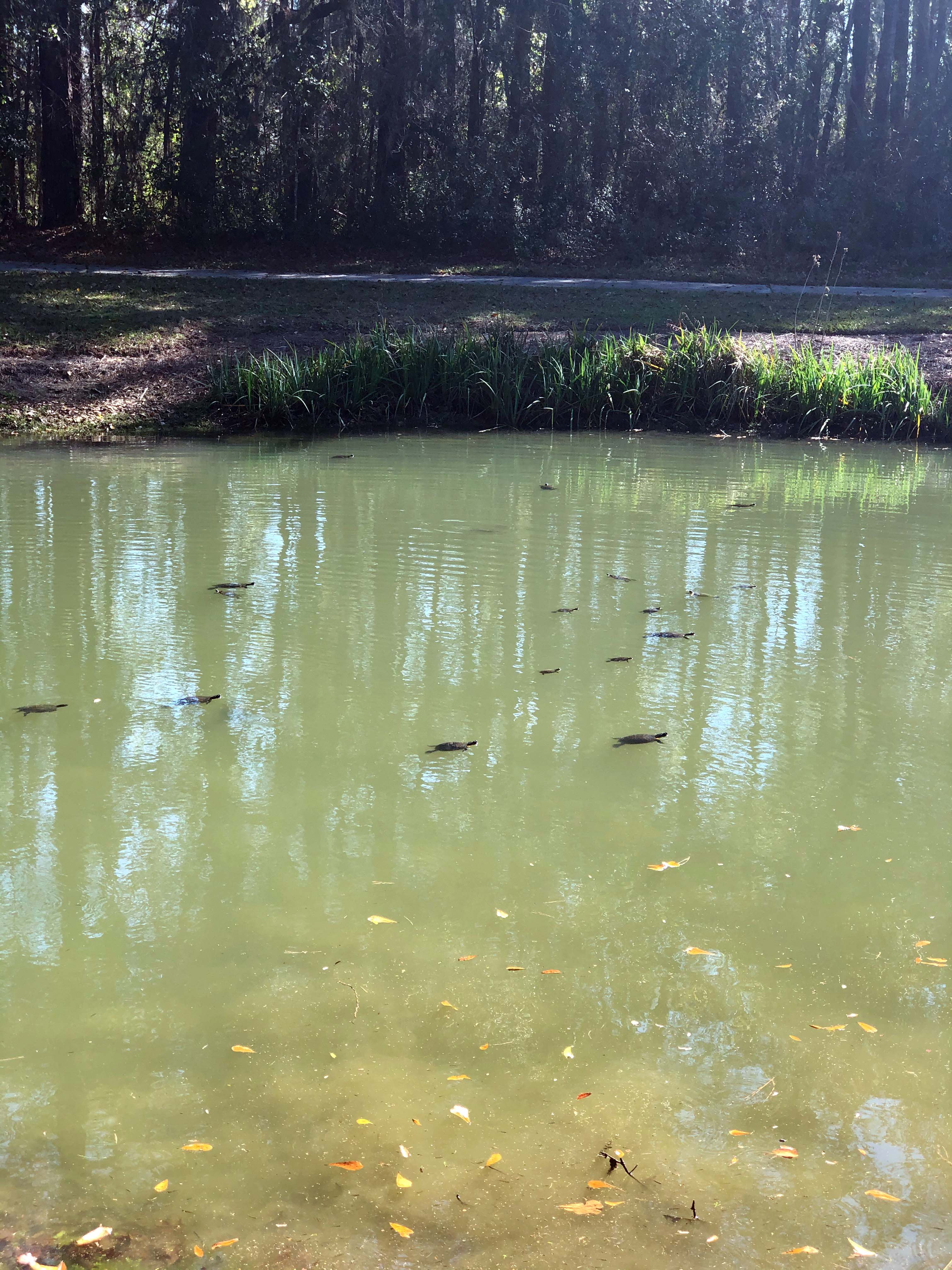
Okay, these are not really dots or spots unless you want to say you spot some turtles in the water. In the years of B.C.B.R. (Before COVID, Before Retirement), I used to frequent this pond near my former office building. These bathing beauties (as I love to call them) would often be sunbathing at the pond’s edge. As soon as I came into their view, plop, plop, plop! One by one they would plop into the water and linger there until I had gone around the bend and out of sight.
Thank you, Leya, for this week’s fun challenge! If you, my Dear Readers, wish to participate in this challenge, don’t forget to link to Leya’s original post and include the Lens-Artists tag.
This week’s LAPC challenge is to share the beauty of gardens, whether your own garden, another’s garden, or the experience of gardening. I don’t have a garden, unless you consider 15 potted plants to be a garden, which I suppose they could be but maybe that can be a blog post for another day.
For this challenge, I’m going to define the word garden rather loosely. A couple of blocks from my house sits a stormwater facility. (I keep calling it a pond and my engineer husband keeps correcting me … which is funny because the city thinks it’s a lake hence the name Lake Le Marc (major eye-roll here)). I digress (which I often do …).
As I was saying, there’s a stormwater pond a couple of blocks from my house. I often visit it on my walks, checking for litter (of which there’s often quite a bit) but also checking for new or strange flora. I am rarely disappointed.
Firstly, the setting.
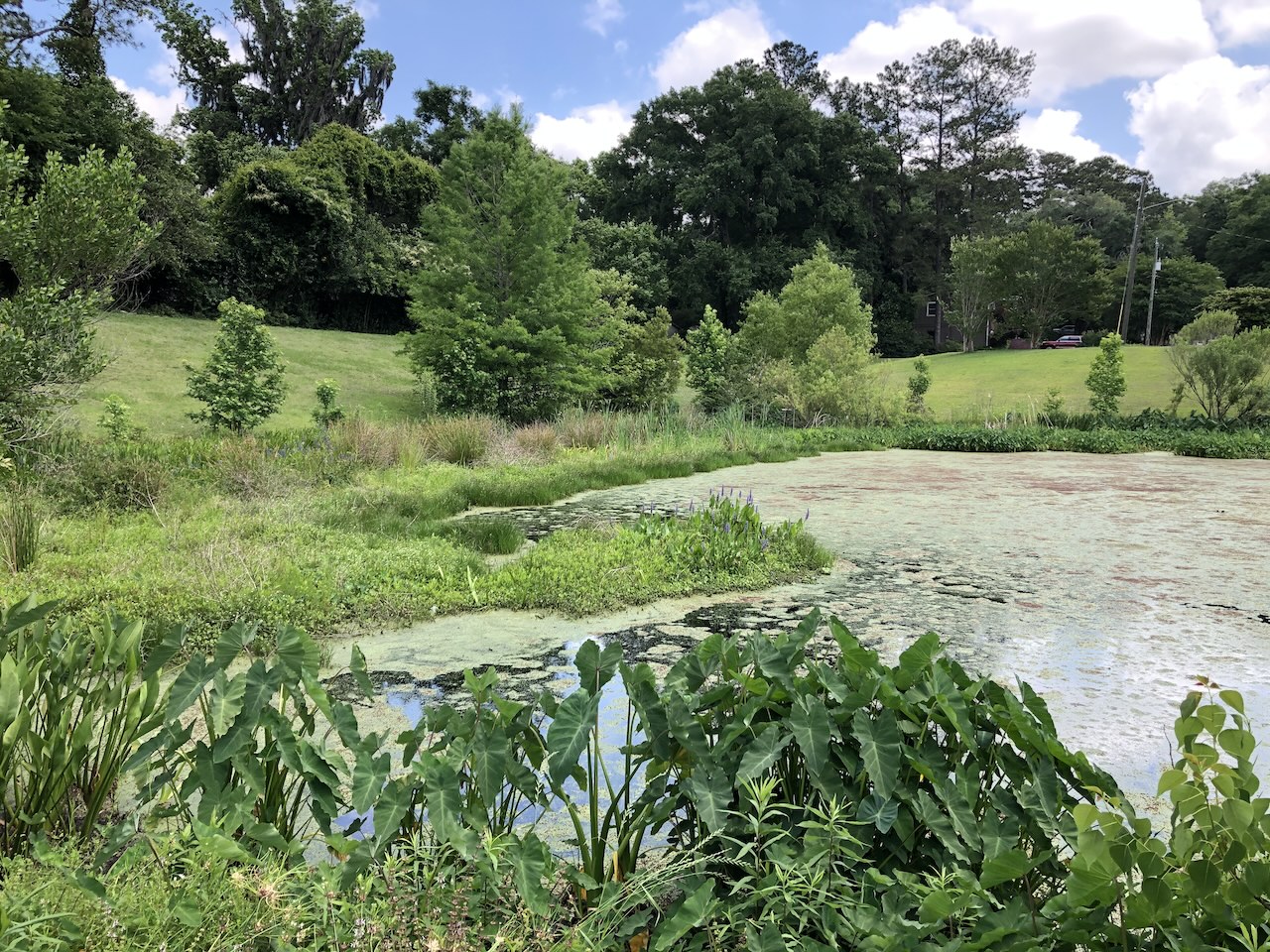
Here’s a long view of the pond, at least one-half of it. The water is low but all about the pond are lovely green hues with some strikes of purple if you look closely enough.
Nice, but let’s get a little closer.
And here we are! Pickerel Weed (Pontederia cordata), an aquatic plant native to Florida. They are in delightful abundance at the pond.
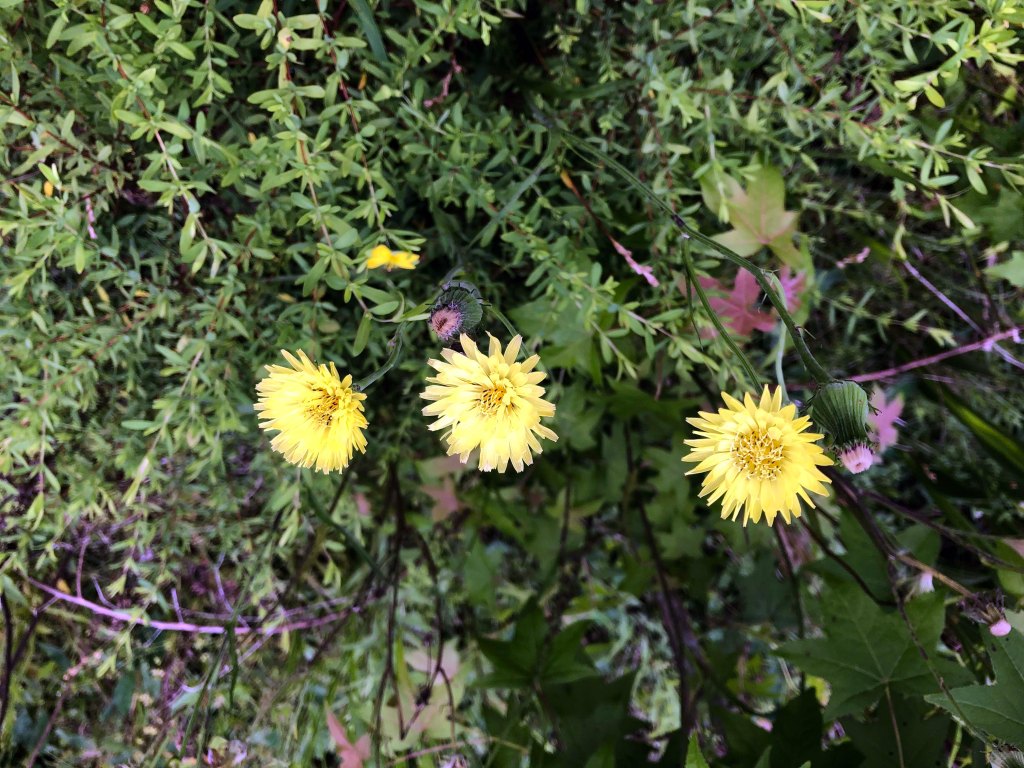
Also in abundance are dandelions. I guess you could say these are before and after photos (grin).
This delicate flower is either a Broadleaf or Lance-leaved arrowhead. Google Photos says it’s a Broadleaf but my Audubon Florida guide says it’s Lance-leaved. Even though we’re not talking a huge difference here (Sagittaria latifolia vs Sagittaria lancifolia), I’m going with Audubon.
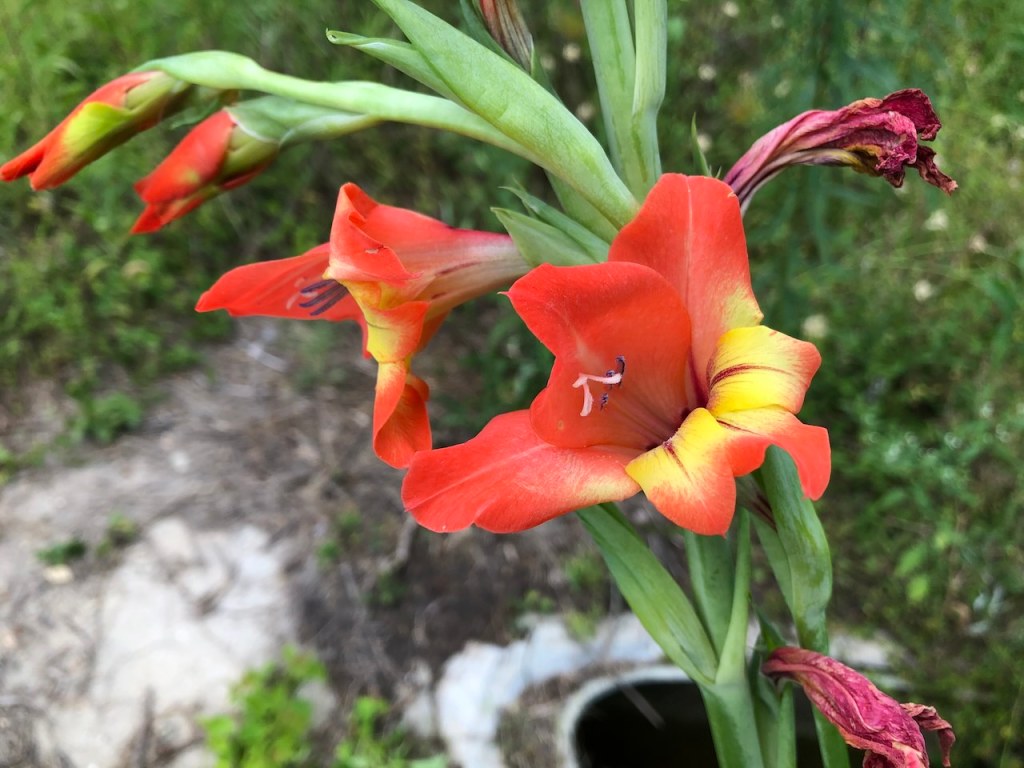
This gladiolus was a true surprise for me. All the years I’ve been visiting the pond, I’ve never seen it before this weekend. The stalk is taller than me (5’3″) and is so top heavy that it’ll probably wind up buried under the bushes. I had to hold the stalk with my thighs in order to get the two close-ups. Fun.
The Florida Native Plant Society tags this plant as meadow garlic (Alliaceae). Initially I thought I had not seen meadow garlic before, but, in fact, I have seen their delicate white flowers around the pond. I always wondered what they were and could rarely get a good enough photo for identification. (I still struggle with getting good shots of white anything.)
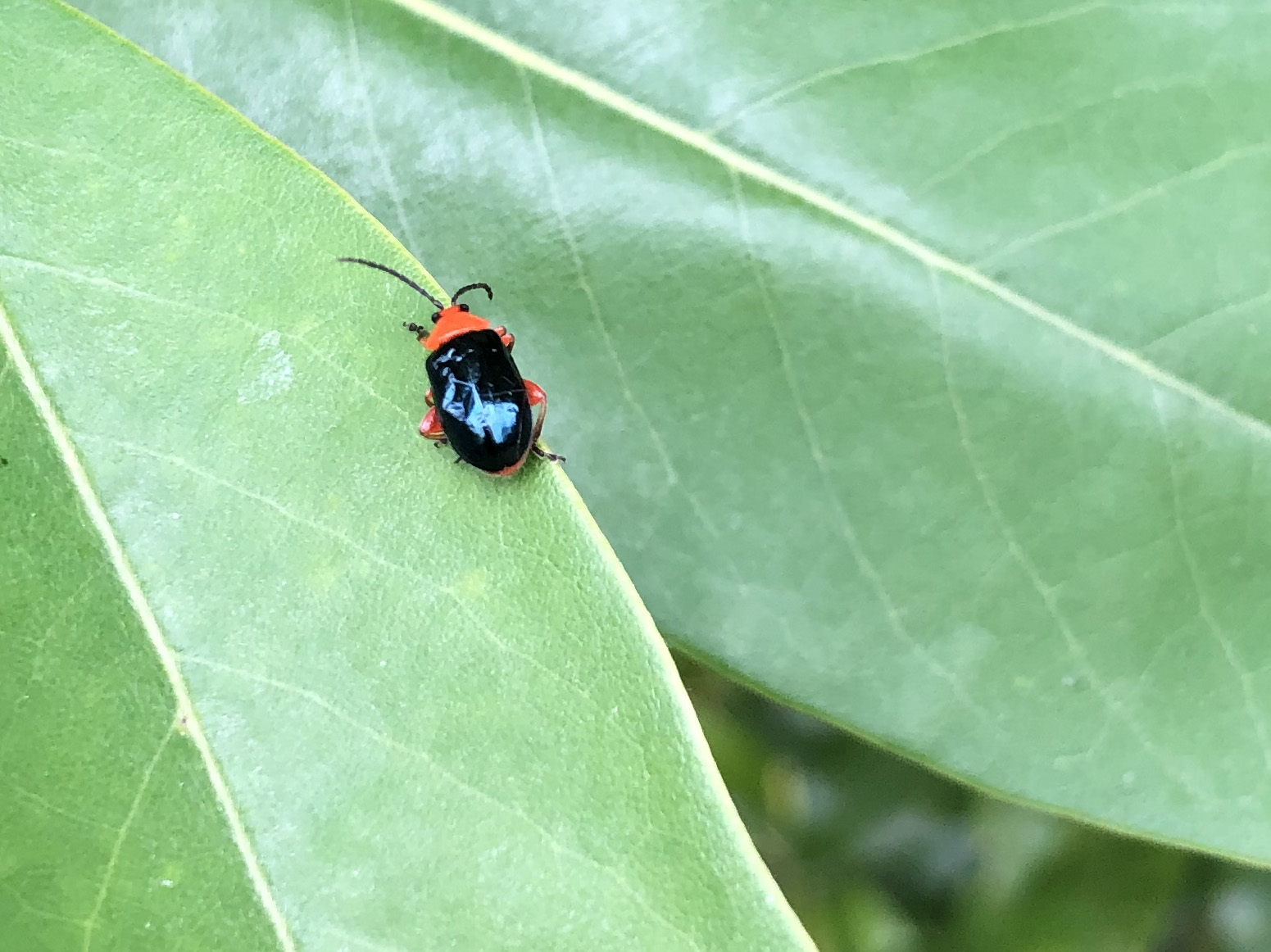
And last but never least, a bug! What’s a garden without bugs … even if they are the kind to mess up your garden. This critter is a blue and red flea beetle. From what I’ve read, it’s a pest for home vegetable gardens, but here I always get a bit of a thrill when I see one. They are very accommodating for photo shoots.
I hope you consider sharing photos of the gardens you have visited, your own garden, your experience of gardening, or anything to do with the idea of gardens. Please include a link to Amy’s original post here and use the Lens-Artists tag so that everyone can find your post in the WP Reader.
As many of you know, I’m rather challenged when it comes to challenges. Since I retired, I no longer have a calendar on my wall. I’ve been using my cat Maxine’s pill dispenser to tell me what day it is. Such is the life of a procrastinator.
But after coming across a couple of Lens-Artists photography challenges, I’ve decided to turn up the heat on myself. Seems all I need to do is post within the proper week, note the proper references, and show off my photos. For this week, I’m responding to Patti Moed’s “Focus on the Details” photography challenge.
When I think of details, I think of macro photography. Currently I use an iPhone 8 Plus which has some macro capability but not a lot. Most of the following photos were cropped so you could best see the detail that caught my eye.
My husband is a macro photographer, focusing primarily on flies. He’s developed a keen eye and I can count on him to find interesting insects. He pointed out this long-legged fly (Dolichopodidae, dolis for short) for me to photograph. Green on green on green rather blend in together, and the fly itself is only the size of my littlest fingernail.
I lose some detail with cropping, but in the above photo you can still see clearly the green of the fly and its delicate wings.
This handsome insect is a lightening bug or firefly, depending on what part of the U.S. you reside in. He’s hanging out on the leaf of a Georgia Aster I have on my deck. Currently I have 15 potted plants on my deck. Not only do I enjoy watching them grow and bloom, I love inspecting them and seeing what new visitors we have.
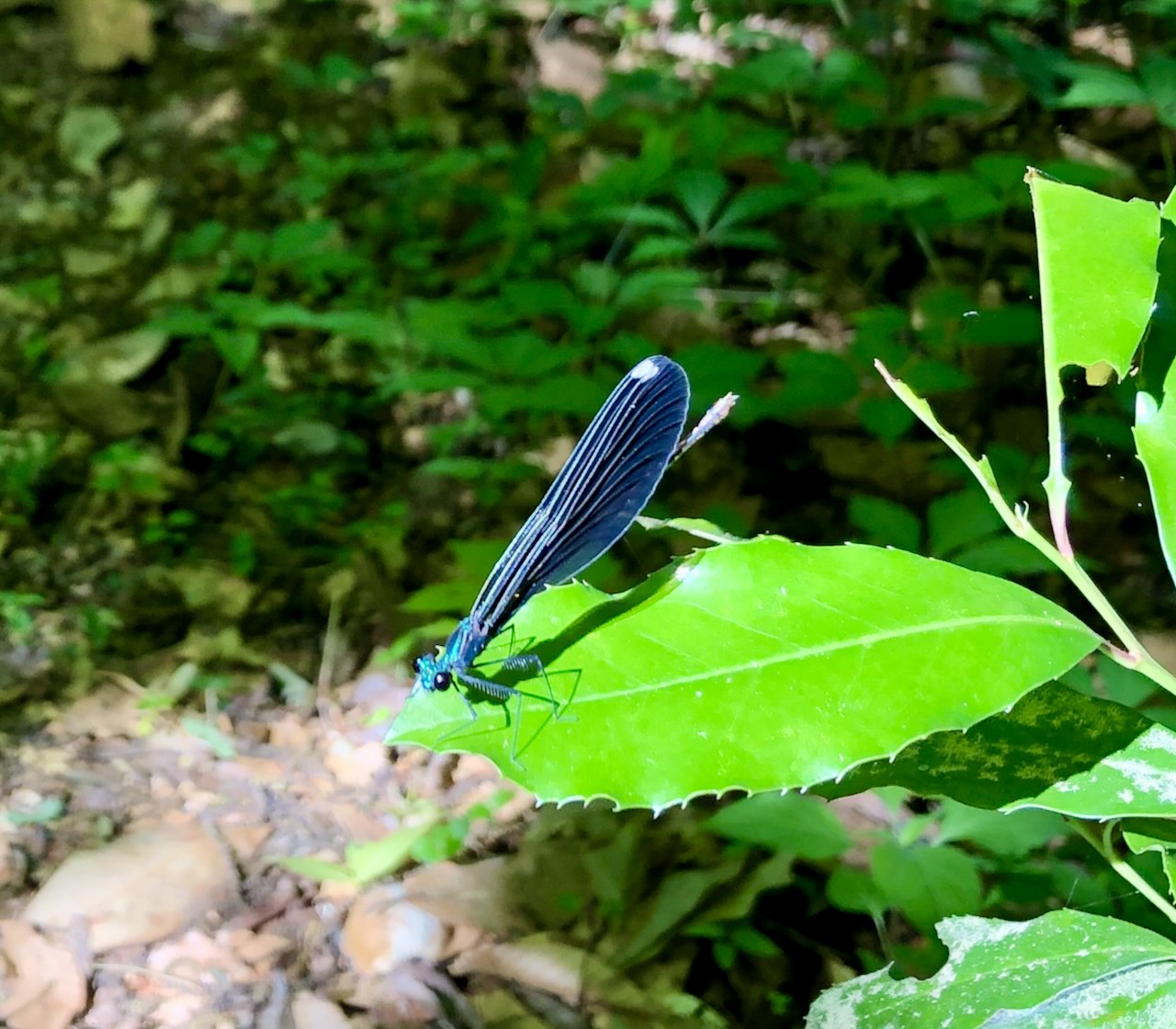
On a visit to one of our favorite trails, we were entertained by two damselflies that followed us, dancing around our heads and landing on leaves as if ready for their photo op. Again, the photo above is seriously cropped so it’s a bit fuzzy, but you can see the beauty of this damselfly with its turquoise and dark blue colors, and what appears to be white spots on its wings. Frankly, I did not even notice these spots until I cropped the photo. The second damselfly, which managed to evade my camera, was black with white spots on its wings. Maybe they’re siblings.
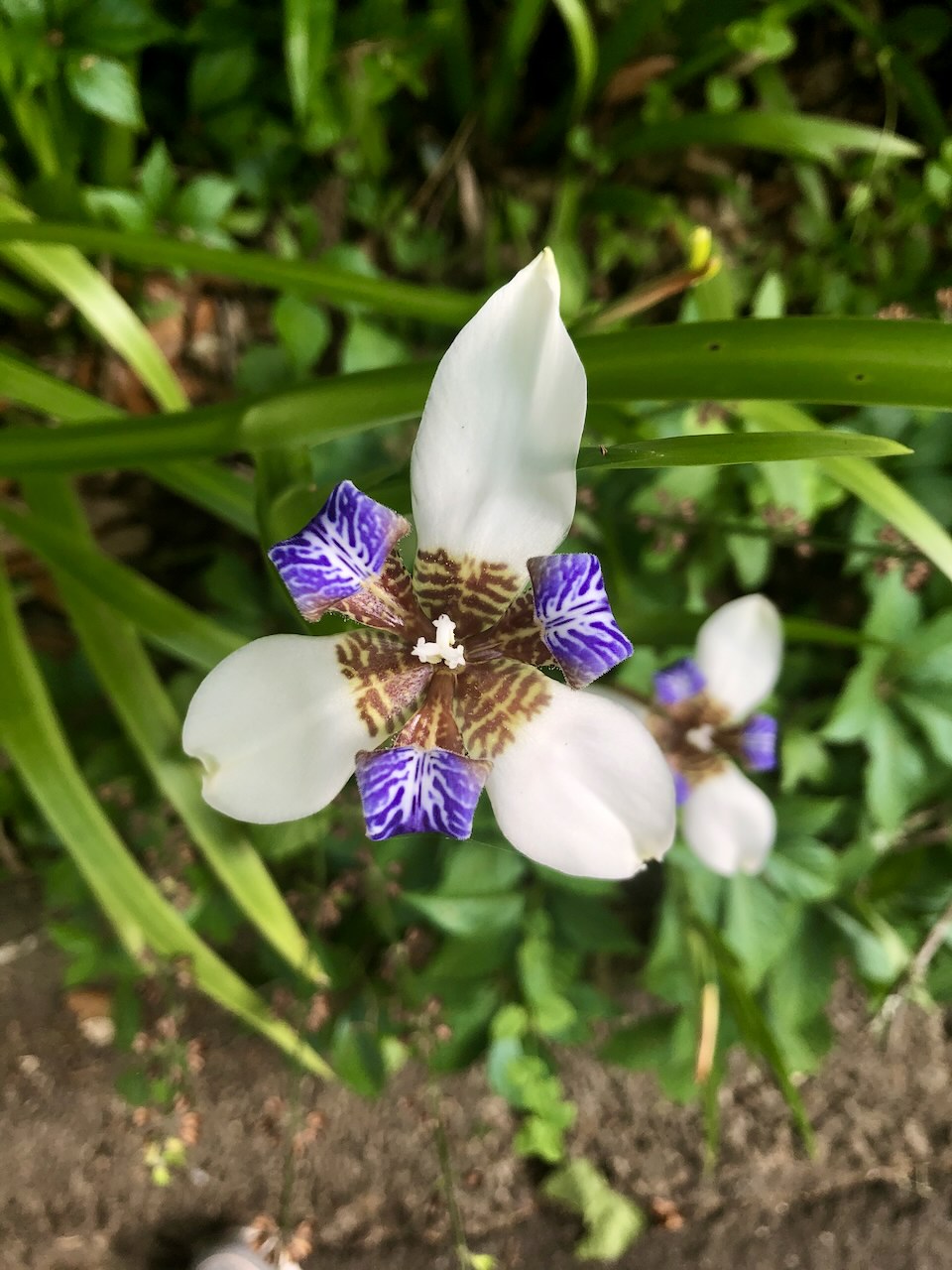
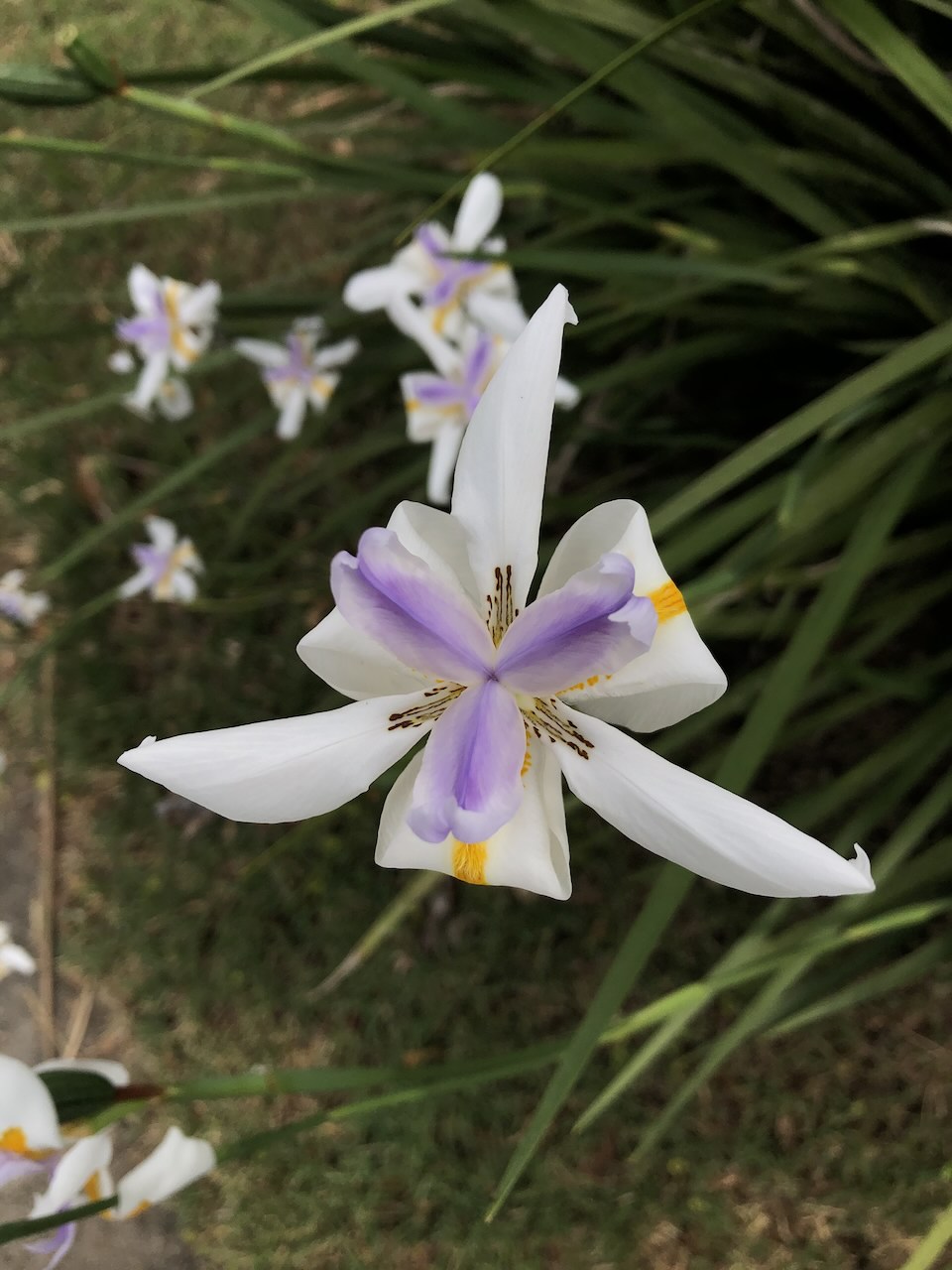
Flowers were my first focus when I started photography, and I hardly miss an opportunity to get up close and personal with them. Above and below are photographs of irises, the above being a Walking iris (indeed!) and the below being a African Iris (Dietes vegeta), per my limited knowledge. (I’m hesitant to name plants if I can only rely on Google and not my field guides.) You can tell right away that they are both irises, but they have intriguing differences in their colors and markings. I’m fortunate that both of these irises reside in my neighborhood.
I hope you enjoyed this photo gallery. If you care to participate in the challenge, please include a link to Patti’s original post, and use the Lens-Artists Tag so others can find you in the Reader.












 Marie at 1 Write Way