Two nights ago I finally did what I had been avoiding for months: I looked for a blogging friend’s obituary. The sad news is I found it. Some of you might know Nancy Jo Anderson aka Zazamataz on WordPress. Her blog is still up at zazamataz.wordpress.com, but she has not posted since December 11, 2024.
According to her obituary, Nancy died on March 14, 2025. She was only 62. Nancy was open about her illness. In her post of April 24, 2024 (“I’m back. Again.”), she explained that she had both COPD (chronic obstructive pulmonary disease) and CHF (chronic heart failure). My oldest sister Charlotte had both of these conditions, and it was the COPD that killed her. I imagine it was the same with Nancy.
I hadn’t known Nancy for long. I “met” her through Ally Bean’s blog The Spectacled Bean, and quickly came to cherish her friendship, her stories, her humor, her openness. She didn’t shy away from writing about being sad and depressed, her struggles to get proper care, and her many “visits” to the hospital.
Her humor was a gift. She would write about her hospital stays with such comedy that I’d often laugh out loud, forgetting for those moments the fear and pain she most likely felt while it was happening.
And she was generous. In May 2023, she organized the “the great moose giveaway.” It was a clever way to clear out her house and send out a little love to the world. I was game for anything that involved yarn (naturally). But what I got from Nancy was so spot-on, I was speechless when I saw it.
This ceramic bluebird is more precious to me than anything else Nancy could have sent me. I have it sitting on a desk next to the loveseat where I usually have my morning tea. Seeing the bluebird, remembering Nancy, is a nice way to start my day.
I could have “looked for” Nancy long before Saturday night. I thought of it often, but sometimes you don’t want to confirm what you already know.
Although she’s physically gone, I hope some of you might visit her blog. Her spirit lives on in her writing and in each of us whose lives she touched.
In her Author’s Note, Casey Mulligan Walsh begins her tough, bittersweet and unflinching memoir with this quote from Barbara Kingsolver.
Memory is a complicated thing, a relative to truth, but not its twin.
Casey notes that The Full Catastrophe is “a true story to the best of my recollection.” And a reader cannot expect better than that. Some writers of memoir will ask family members or friends to fact-check their memories, but I’ve often thought of memoir as a window into one person’s perception of their life and take it as such. It’s not autobiography. It’s that person’s truth, the essence, of what they remember.
What impressed me more than anything while reading this book was Casey’s seeming determination to not whitewash her story, to not spare herself any blame criticism in how her life turned out.
I started to use the word blame but that wouldn’t have been fair. Casey turns a critical eye on herself, but in such a way that allows her to rise above where she feels she might have gone wrong. Hers is a story of how the best of intentions can lead one astray and how being honest with oneself can save a life (hers) and a family.
Determination, I see now, is not always a positive quality. It can spur you to great things. It can also make you blind, unable to see when enough is simply enough.
When still a young girl, both of Casey’s parents died. Several years later, her only sibling–a beloved brother–also died, leaving Casey alone and adrift in an unfriendly world. She was placed with relatives who weren’t shy about showing her their displeasure in having to be responsible for her.
In such an environment, it’s easy to imagine any young woman jumping at the first chance to leave. In this case, that chance was an ill-fated marriage.
All Casey wanted was to feel safe in the world and to shower love on a family of her making. She really wasn’t asking for much, not considering how hard she was willing to work for what she believed in. Unfortunately, she and her husband were a “mismatched pair.” Later Casey also learns that his parents (who she had believed accepted her as much as they would their own daughter) were perhaps her greatest enemies, siding with her husband during their separation and subsequent divorce, and coming between Casey and her children.
It’s not enough that Casey struggles to keep together the family she always wanted. Two of her three children, her first-born son and then her daughter, are born with a genetic condition, a form of high cholesterol called familial hypercholesterolemia (FH). Can you imagine the worry, the fear for your children, knowing they have a condition that can lead to a premature death?
As Casey’s marriage deteriorates, she becomes more controlling of her children and her husband. She admits this. In the context of her children’s health, it makes sense. In the context of all her losses, the deaths of her parents, her brother, other family members and friends, it makes sense. In the context of her husband’s drinking and combativeness, it makes sense. Her world was falling apart, and she was desperate to keep it together. As anyone would be.
And then her oldest son dies. Not from FH as Casey feared, but from something so random and so common as a car accident. Casey holds it together until she can’t. She finds comfort and strength in the outpouring of love and support she and her family receive, but then dissolves in tears at the end of TV news story about Eric.
The Full Catastrophe is a story of love and loss, the devastating grief of losing a child, the determination to make a family, to make a home. All along I was taken with Casey’s resolve to do the right thing by her children, sometimes to the point of seeming to turn them against her. Tough love, you might call it, but love nonetheless.
I often thought of my mother as I read Casey’s memoir, recalling how my mom tried to protect me from the big, bad world, how her efforts to protect me drove me away from her. I wondered if at times she too blamed herself for her children’s failures. I can only hope that, like Casey, she came to realize that she had done the best she could have done given her circumstances and that her love would ultimately bring me back to her.
The following quote from The Full Catastrophe is one that I keep nearby, a reminder that while death is inevitable, love never dies:
Just in time, I understood our connection to those we love doesn’t end with death, that nothing can separate us unless we choose to walk away. That it will all be over so soon for all of us, and what’s important is what we do while we’re here.
I highly recommend The Full Catastrophe for all readers, but especially those interested in memoir and who may be experiencing their own never-ending grief.
All orders placed at Battenkill Books will be fulfilled with a signed copy.
To further entice you into preordering, Casey has some bonuses for you! After you’ve ordered, head over to her website at https://caseymulliganwalsh.com/preorder-the-full-catastrophe-now/. Scroll down to the preorder form and provide your name, email, order number, and supplier. Hit submit and you’ll receive the link to three preorder bonuses:
Five Ways to Support Those Who Grieve, a concise sheet with advice about ways to support grievers when you struggle, as we all do, with ideas of what to do or say, and a list of supportive podcasts, books, and websites
The Full Catastrophe Spotify playlist—hours of music that became the soundtrack for the life Casey lived, then captured in her memoir
Finally, a link to an ask-Casey-anything zoom call/celebration on launch day, February 18, 2025 (time TBD).
(If you plan to order from Amazon on launch date, just enter “00000” in the order # space on the form, and you’ll receive these bonuses as well.)
I don’t know where you are right now. I don’t believe in Heaven or Hell, but if there’s a Heaven, then I imagine …
You sitting at a picture window, in front of a card table where a spread of 1,000 puzzle pieces wait for your attention which is distracted by the Baltimore Orioles and Cardinals and Bluebirds also vying for your attention outside your window.
Your oldest daughter Charlotte is watching TV which is permanently set to daytime soaps, the ones you and she would discuss on the phone when she lived in Florida and you in New York. She sits in her blue leather recliner, offering running commentary that you only half listen to.
Your other daughter Shirley is flipping through Amway receipts while she recites the latest accolades of her grandchildren. During commercial breaks she’ll pick up a James Patterson novel and read a bit. She sits in her chair, a facsimile of the recliner she left behind, the shawl I knitted for her draped over the back.
You watch your birds, piece together your puzzle, and maybe listen to your daughters. You don’t have to hear every word. It’s enough to have them near you.
Maybe you’re waiting for one of your siblings to drop by. Maybe Beatrice who was the first to go, or Alice who was the last before you. Maybe your brothers Virgil, Ed, Bob, or Leon will show up, or Mildred, Edith, or Leona. It’s been so long since you had seen your siblings. And you wonder about the last two–Howard and Orvetta. You want them to be well until it’s their time and then … no pain, no pain.
You miss berry picking and going to the casino, but then your daughters might take you when you’re in the mood. In this version of Heaven, Shirley does not have Parkinson’s and Charlotte can breathe easily on her own.
After your daughters–your girls–died, you missed them so much that you were relieved to miss your 100th birthday. You got close, very close. But the pull of your girls was too strong, the loss of them too much to continue to bear.
People ask me why your last two children–me and your son–weren’t enough to keep you going. Why did you openly lament the loss of your girls as if they were the only children you had?
They were the only children you had for eight years. You were in your twenties then. By the time your son and I came along, unexpectedly, you were nearly middle-aged with a sick husband and decades of hard and poorly paid work ahead of you.
I want to believe that those first eight years, when it was just you, my dad and your girls, were happy years. Maybe, when your girls died, that was the loss you felt most keenly. They were no longer around to remind you of that time.
No child should die before their parents. No parent should experience the death of their child.
I know you loved me as best as you could. I loved you as best as I could. Yes, I could have been a better daughter. My efforts paled compared to my sisters. Yes, you could have been a better mother. Hindsight is 20-20. There’s regret on both sides, but no point in it.
You were never one for regrets. You didn’t like to look back, and you didn’t pay much mind to the future. From you, I’m learning to live in the moment. That may be your greatest gift to me.
Yesterday, October 7, would have been my sister Charlotte’s 80th birthday. I meant to write a blog post celebrating her birthday. I felt that weird sort of self-consciousness that social media provokes: if I don’t publicly share what I’m doing, did I do it? By not writing a public post on my sister’s birthday, I can’t prove I thought about her that day. Trust me, I did.
Hurricanes
It wasn’t just her birthday that prompted me to think about Charlotte. It was also the hurricanes—one past, another on its way. Charlotte had lived in St. Petersburg, FL, in a mobile home park. If she were still alive, she’d be evacuating right now, trying to get as far away from Hurricane Milton as possible. Maybe.
When she was alive, and hurricanes had the Tampa Bay Area in their sights, I’d worry about Charlotte. I’d call her, ask if she had someplace to go. She’d get impatient with me, arguing that I didn’t need to worry. She’d argue that she didn’t have to evacuate, but then she would wind up staying with friends. I’d feel relieved but also guilty.
We didn’t have the kind of relationship where I’d drive almost 300 miles to pick her up and whisk her away. We didn’t have the kind of relationship where we were willing to risk being stuck with each other.
Health
It wasn’t always like that. Twenty-some years ago I spent a couple of weeks with her while she recovered from heart surgery. We had fun. We watched old movies, ordered pizza, ate Kentucky Fried Chicken. It was like a two-week slumber party.
While she was in hospital, I cleaned her tiny trailer, shampooing the worn carpet, replacing old appliances. And I cried. She was widowed by then, and she didn’t seem to have many friends. At least, not many that she could count on. I didn’t know yet that when she was very drunk, she wasn’t very nice. I cried because I saw how she was living on the edge. I wanted to fix things for her. I paid off her credit card that was several months past due. I told a bartender at the establishment she frequented that she had had heart surgery and should limit how much she drinks. I left her cash so she could pay her bills. I treated her like a child, much like our mother did.
History
Charlotte was almost 13 when I was born. Growing up, she was sometimes my favorite sister, sometimes not. I always saw her as tragic, fragile, fatalistic. Our mother infantilized Charlotte. Really, there’s no other word for it. My sister Shirley didn’t give our mother a chance. She went to nursing school and then married at 19, putting herself on the same playing field as our mother.
Charlotte, well, she was unlucky in love. She first married a guy who dealt in antiques and taught me how to pick the strings of a guitar. He was quiet and patient with me so I liked him.
Until Charlotte acknowledged that, yes, rape does occur in marriage. I was 12, a budding feminist, and I felt a chill when she responded affirmatively to what I had just read in a book. She didn’t look at me, and I had a fleeting image of her in a dark bedroom pleading No.
During that first marriage, Charlotte came down with scarlet fever. I didn’t know until years later that it was our mother who insisted that Charlotte go to the hospital. Her husband, apparently, was content to let her lie in bed. The fever weakened her heart, and she was told that she should never have children. All she ever wanted.
Sisters
A desire for children was something I never shared with either of my sisters. Maybe because I was the youngest. By the time babies entered my life—through my sister Shirley—I had turned inward, wanting to just be left alone. My family was crumbling. I was old enough to see that something was wrong with my dad, but too young to understand what it was. I was afraid of my mother and her cold temper. My brother was a boy.
Occasionally, I’d spent a night or two with Charlotte and her first husband. I guess it was my mother’s way of getting me out of the house. I remember Charlotte going with me to a quarry for clay and then making a mess of her kitchen trying to make little pots. I remember her being patient with me and quiet. And sad.
It’s taken me 67 years to realize that Charlotte and I were not destined to be friends. We were too alike in the wrong ways. Both of us had a wild side, no doubt spurred by our mother’s over-protectiveness. The things I didn’t like about myself, I saw in Charlotte: a tendency to drink too much, to judge, to be mercurial. I saw Charlotte as the woman I might have become if Greg hadn’t entered my life.
We’d been drifting apart when Trump decided to run for president. He made certain we wound up on different continents. Once Charlotte understood that I liked Obama and I didn’t like Trump, I was persona non grata.
And yet, I keep remembering our last phone call. How she called me “dear” in between her gasps for breath. How I wanted to say I love you but didn’t.
Thank you for reading. I’m very behind on reading, and I appreciate your patience as I try (and likely fail) to catch up.
Please keep everyone affected by hurricanes Helene and Milton in your thoughts and prayers. I’ve been reading wonderful things about World Central Kitchen if you want to help by donating: https://wck.org
This week Donna from Wind Kisses challenges us to find connections using photographs.
Let’s photograph connections this week. Are you interested in the intricacy of mosaic art, or how the strings of a marionette bring it to life? How about railroads, rivers and bridges connecting spaces and places? Personally, I can’t have bacon without eggs, or paper without a pen. And it is impossible to ignore interactions of people connecting with each other and the world around them.
I’ve thought long and hard about this challenge, and I might (I said, might) step outside my comfort zone to meet it. Donna’s post is truly inspiring, expanding the idea of connections beyond what I usually consider the word to mean. And that’s a good thing.
Of course, I see connections in Nature, such as how my (finally) blooming Indian Blanket plant follows the rotation of the sun.
Every morning, and sometimes in the afternoon, I rotate the pot wherein this plant currently resides. It sits on my deck, and I see it through my window while I’m sitting at my desk working. The plant keeps me connected to the outside world just by being available to me visually.
Now, this might sound strange, but I feel connected to myself when I work with fiber, whether it be knitting or weaving. When I was about 9 or 10, I taught myself (not very well) to knit, and so knitting is part of who I am. I’ve used my knitting to connect me to others. Weaving came to me later in life at a private college where I was floundering. I was very unhappy at that college until I signed up for a weaving course. Long story short: the class had such an impact on me that I elected to take my tuition money and buy a loom rather than continue at the college.
I wove a few things but not very well and eventually sold my loom to a friend. Fast-forward a few decades and I yearned to weave again so I bought a modest 20-inch rigid heddle loom. My first project:
I wove this scarf with wool and alpaca yarns meant for knitting socks. Needless to say, weaving the scarf went a lot faster than knitting socks would have. Still, I made mistakes, wasted a bunch of yarn, but … I wear it. I love it. And the process itself connected me all the way back–40-some years–to when I first learned to weave.
I try to connect myself to the environment by upcycling and recycling. From a poster on a Facebook group I was in, I got the idea to cut up all our old t-shirts. Some were so worn that I knew they would only end up in a landfill if I gave them to Goodwill. I used a rotary cutter to slice through the shirts, tied the ends together, and then rolled the strips into balls. A weaving project was born.
I wove the above with no real end in mind. I just wanted to practice weaving. At worst, whatever I made could be used as a cat blanket. Then I wove another piece, only this time I untied the strips as I went, making the weaving process more meditative, connecting more closely with the threads and fabric.
This work I do with my hands often connects me to other people. I can’t wear all the scarves, shawls, socks, and potholders that I make. Sometimes I work with a special person in mind.
I knitted this blanket (above) for my mom. She’s no longer here and the blanket is with someone else now, but I still remember her saying that she loved it.
Connections.
I grew up among women. My mom and my two sisters, my aunts. My uncles were around but disinterested in a pouty-faced little kid.
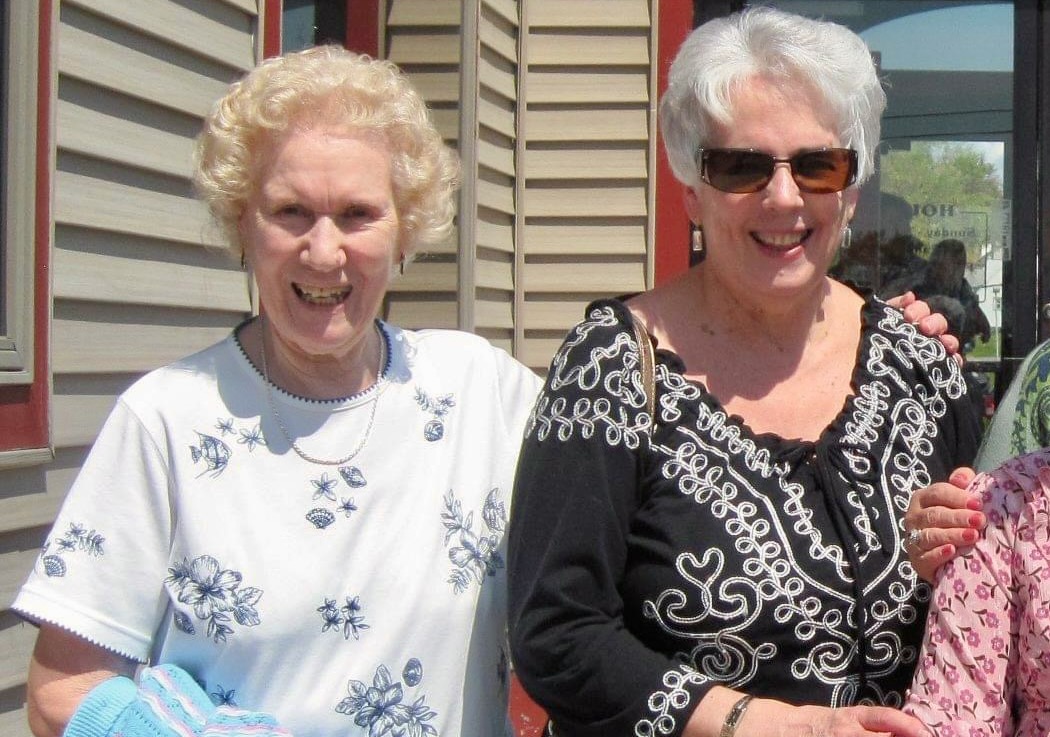
Out of the seven sisters, only one is left, my Aunt Orvetta, the blonde in the middle. My mother sits to my aunt’s right. I look at photos like this and pine for the days when connections could be made with a letter or a phone call or a visit. Now the connections are made through memory.
I am so grateful for how photography, over so many years, has helped me stay connected to my family. So many of them have died, but when I see photos like the one above, I can almost hear their laughter.
Many thanks to Donna for this thoughtful and expansive challenge. If you choose to participate in this week’s challenge, take Donna’s words to heart:
Have you ever thought about how photography connects the world? Nobody sees the world exactly the same way you see it, and our impressions are as unique we are. How you interpret this week’s challenge is up to you.
Please include the Lens-Artists tag and/or link in the comments so we can find you.
Also, thanks to John for last week’s challenge, AI. What fun that was! Participating in John’s challenge helped me feel a bit less intimidated by AI, and I really enjoyed the contributions and conversations around it.
Ritva will host next week’s challenge starting Saturday 12:00 EST. Visit her site and get ready to be inspired.
Interested in knowing more about the Lens-Artists challenge? Click here for more information.
This is my first Mother’s Day without my mom. I don’t grieve my loss of her as much as I first did, but I miss her. She was 99, just over a month shy of turning 100, and she was done with life. She wanted to go, and it would be cruel of me to wish that she hadn’t. Instead, I’m grateful that she lived long enough for us to finally get along with each other.
I am my mom’s youngest, and I was unexpected. I often felt unwanted as well, being that my birth and childhood seemed to coincide with my father’s decline into mental illness. When I was quite young, I was intimdated by my mother. She had a strong personality, and she didn’t seem to care how deeply her words might cut.
When I became a teenager and then a young adult, we were like oil and water. She’d argue that she just wanted to be friends with me, protect me from the dangers of the world. I’d argue that I needed to make mistakes. I needed to be on my own.
But there were other times. I confided in her when my boyfriend stood me up again, or when I found out that a different boyfriend had been cheating on me. When she couldn’t talk me out of moving to California, she took me with her to AAA and got me all the maps I’d need to find my way.
There were times in my life when I thought I wouldn’t miss her once she was gone. It was easy to feel that way while she was alive, and we spent most of our time arguing.
After her second husband died, and she was living on her own for the first time in her life, she changed. She mellowed. Live and let live. Other than the occasional admonishment to remember my brother’s birthday, we got along. She’d talk about birds mostly, or playing the slot machines at the casino, or getting her hair done, or going berry picking, or going to lunch with my sister and a few nieces. She’d talk about my sisters or the grandkids or her remaining siblings. Mostly she’d talk about herself.
As the years went by, we had more frequent but brief conversations. She tired easily. And after her daughters had died, she cried a lot.
In the spring of 1992, I wrote the first draft of a short story for a writing workshop led by Jerome Stern. I have spent the better part of my writing life trying to sort out my parents’ relationship and to see my parents as individuals, separate from me.
My mom and dad when they were so young.
I wasn’t privy to their intimate moments, their lives before I showed up, and even after I was born, I was shielded from knowing too many details. So I had to turn to fiction to help myself understand what their lives might have been like.
The result is “Love Me Tender.” My story is available through BookFunnel. You can download your preferred reading format through this link: Love Me Tender.
Here’s a brief description:
Sometimes we love someone we can’t help, beyond loving them. Irene Newkirk loves her husband but his mental illness continues to worsen despite hospital stays and treatments and Irene’s desperate efforts to keep her family whole. Love Me Tender tells the story of a few hours in Irene’s life as she comes to grips with the fact that her husband won’t be coming home again.
Again, this story is free to read, unless you want a print copy which is available at Lulu.
My story is not available through Amazon or any other outlet but BookFunnel and Lulu.
I always like to save the best (or good) for last hence my list is in reverse order.
The Ugly (1 thing)
Shortly after my mother died, my brother–my last remaining sibling–cut ties with me. His choice. In fact, his last words to me were “We’re done here. Don’t bother to contact me for anything further.”
Before my sister Shirley’s death, I had not spoken to or seen my brother in roughly ten years. I admit that I didn’t make an effort to see him when I visited home, nor did he make an effort to see me. After our sisters died, we started communicating, mainly about our mother since he was now her primary caretaker. We talked or texted daily after she fell and was in hospital and then after she died. He seemed to want my opinion about things. There were moments when I thought we might have a normal brother-sister relationship again.
Silly me.
All I needed to do to piss him off was question how he was (or was not) executing our mother’s will.
The Bad (1 thing)
The bad was learning a lesson the hard way. When someone tells you, “it’s not about the money,” you can be sure that it’s always about the money.
The Good (3 things)
My mother is at peace. I remind myself of this as often as I can because I feel selfish in my sadness that she’s no longer with us. I hadn’t been with her at Christmas for many years, but I always looked forward to calling her. The reality of not calling her this year, and of not sending her the wreath I would normally send, hit hard. I took myself offline so I wouldn’t have to pretend to be jolly. But now that Christmas has past, I feel a bit stronger, more able to embrace the fact that my mother is at peace.
I am at peace with my mother. She had made certain stipulations in her will that were not being honored by her will’s executor. So I made it right in my own way. I honored her wishes and, in that way, eased some of my grief.
We have a butterfly nursery. In early December, when nighttime temperatures threatened to dip into the low 30s, my husband brought in a couple of passionvine stems that had a couple of larvae (caterpillars) on them. He wanted to try and save them. Little did he know that there were also eggs on those stems. Over the next few weeks, I counted at least 20 chrysalis in our little tent nursery. The first emergence of a Zebra Longwing butterfly seemed like a miracle. And then two emerged. And then three. We’ve released seven to our backyard, near their favorite plants. And now we’re waiting. Either we’ll have more butterflies emerge or the remaining chrysalis will die. We do our part; Nature does the rest.
A lonely (but not for long) chrysalis.
Zebra Longwing butterfly larvae.
Two butterflies almost ready to be released.
My husband giving one butterfly a helping hand out of the nursery.
Here’s goodbye to 2023. Hello, 2024! I hope the New Year brings you as much peace and contentment as brushing Raji brings to him.
One of my most favorite bloggers, Ally of The Spectacled Bean, happens to like zinnias. Actually, I believe she likes them a lot. A couple of months ago, I bought a pair of zinnias from a local nursery. They were in the same pot, a mix of yellow and pink. Sadly, the yellow zinnia did not survive, but the pink one has and it is quite a showy flower.
I would argue that the above photo doesn’t do the flower justice, but I do like how you can see the various stages of life on this plant. The following photos are more to my liking.
This slideshow requires JavaScript.
They are such a delight when the sun is shining directly on them! The challenge for me is whether I should transplant them to a sunnier venue, which would likely be off my deck and outside my range of vision when I’m sitting at my computer, OR keep them on the deck and repot them as necessary with hopes that they will survive the winter.
I believe zinnias are annuals, but in my climate, I’m hoping these might become perennials.
Wendy
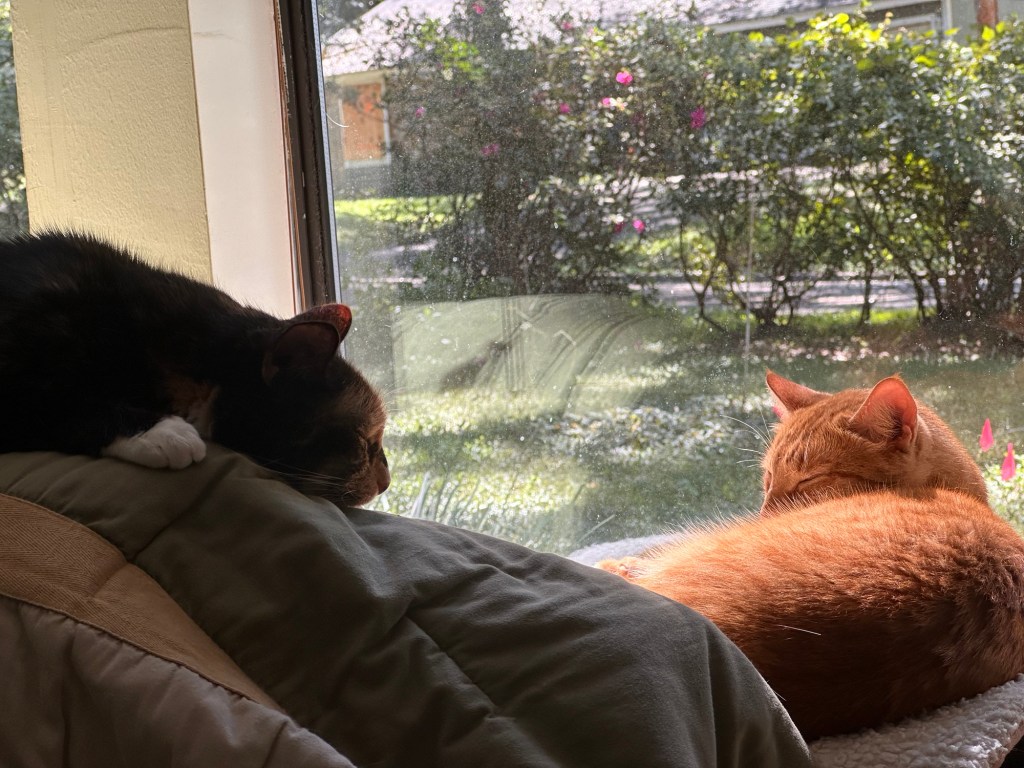
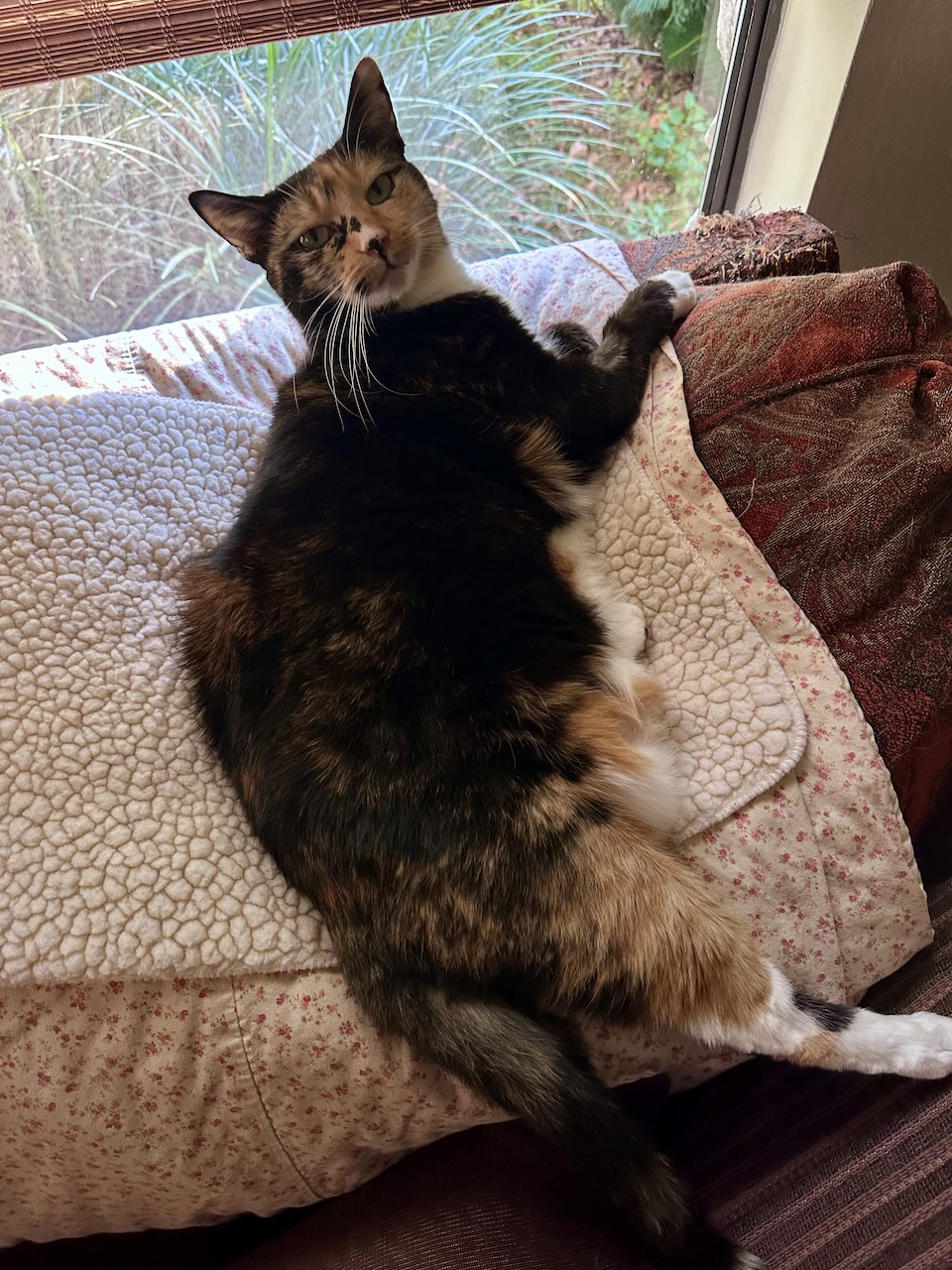
Wendy is doing quite well after our (not hers) brief scare. She’s doing all her cat things normally, including swatting at Raji now and then. [One night, when they were both gathering around my legs while I was reclined, watching TV, she swatted at Raji when he got too close. He punched her back. Seriously, he punched her. Chaos ensued.]
Writing
I have been writing. For the first five days of November, I was quite earnest in my writing and found some nice support from other participants in Summer Brennan’s Essay Camp. [By the way, Summer is starting a series of essays on essays which I’m looking forward to reading. If you’re interested in learning more, she has an free introductory post here: Introducing the Essay Series.] I have been using NaNo to track my word counts, but not much else. I feel myself sliding into a rut. Unfortunately, I’m preoccupied with a family issue, and I thought writing about it would help clear my head, but family issues are the gifts that just keep giving, aren’t they?
On the bright side, refocusing on my writing has made me think about the stories I’ve already written and what (if anything) to do with them. Some have been published so rights have reverted back to me. I don’t have much enthusiasm for finding new publishers for them, but I want to share them “with the world.” One idea I’ve had is to have booklets of my short stories printed, along the lines of Creative Nonfiction Foundation’s (now defunct) True Story series, and then I can gift them to interested readers.
Does anyone reading this post have experience with printing booklets of their stories? Please share if you do.
I’d also love to have some recommendations for printing services to narrow my search. So far, it looks like it might be expensive.
Meanwhile … last night I saw an interesting contrail from my Adirondack chair … no filters on this photo.
On this day, October 25, my mother would have turned 100. She died on September 22, peacefully by all accounts, but, sadly, not in her home as she would have preferred. Up until September 3, she had been living alone in a double-wide mobile home, coveting her independence which was only possible because of my brother and our cousins who brought her food, cooked for her, cleaned up after her, and gave her company when she was in the mood for it.
My mother didn’t mind being alone. She had her phone if she wanted to talk to someone. She had the birds outside her kitchen window to entertain her. She had a front porch where she would sit on warm days and watch her neighbors come and go. She had her TV shows, and she dozed … a lot.
One could argue about how independent she truly was. The thing is, while others worried about her being alone at night, she didn’t.
Then she fell one night and wasn’t found until the next morning. From there, it’s textbook statistics. Hospital, surgery, rehab, COVID, comfort care, death. Just as with her life, her dying seemed to go on much longer than we thought possible. But, as far as anyone could tell, she was sleeping those last few days. At peace.
She missed “her girls” terribly.
My mom’s girls–Shirley and Charlotte.
First, Shirley died in July 2022, then Charlotte in November 2022. My mom might have been happy to live to 100 if my older sisters had still been alive. They had been her constants, more so than my brother or myself.
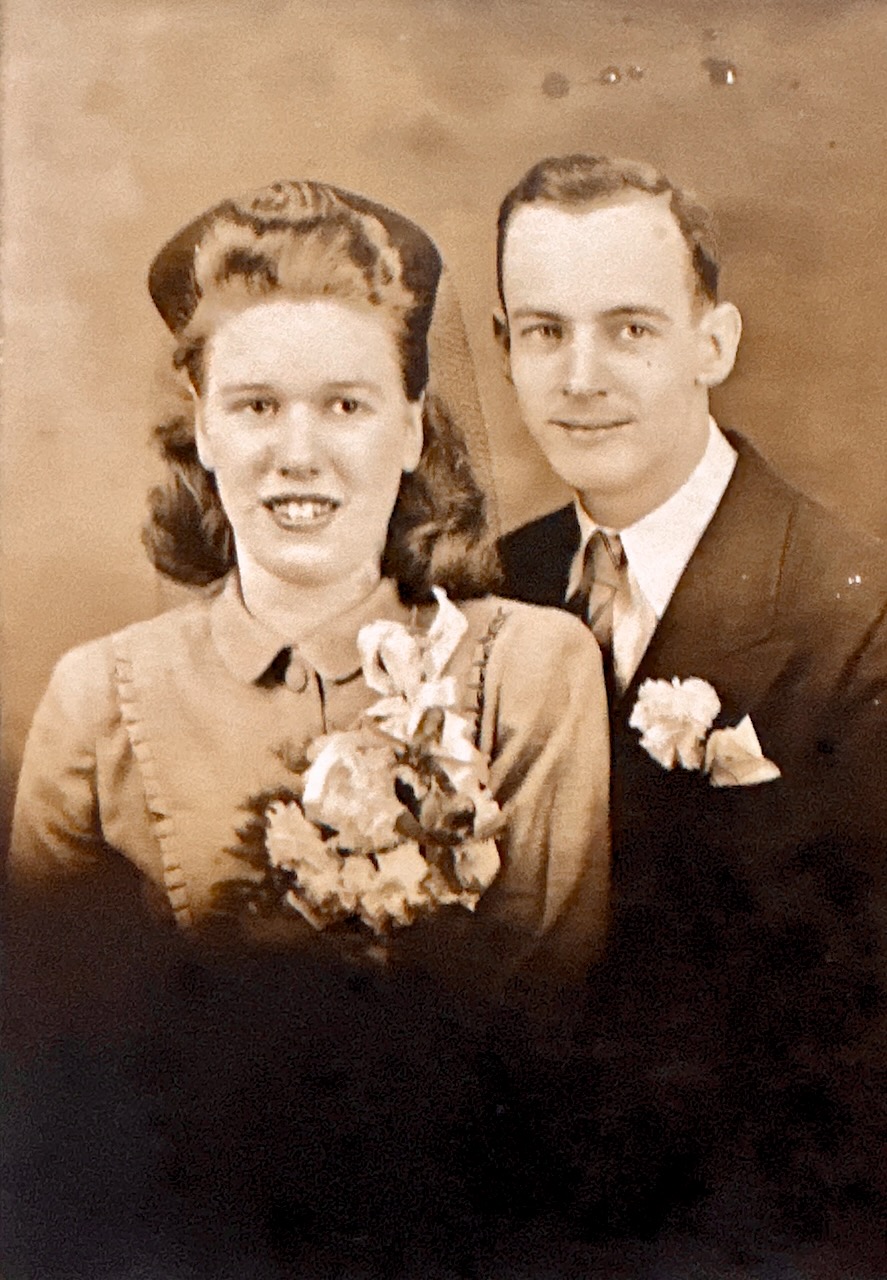
My mother married in 1942, I think. Pathetic that I don’t remember her wedding date.
My mother and father’s wedding photo.
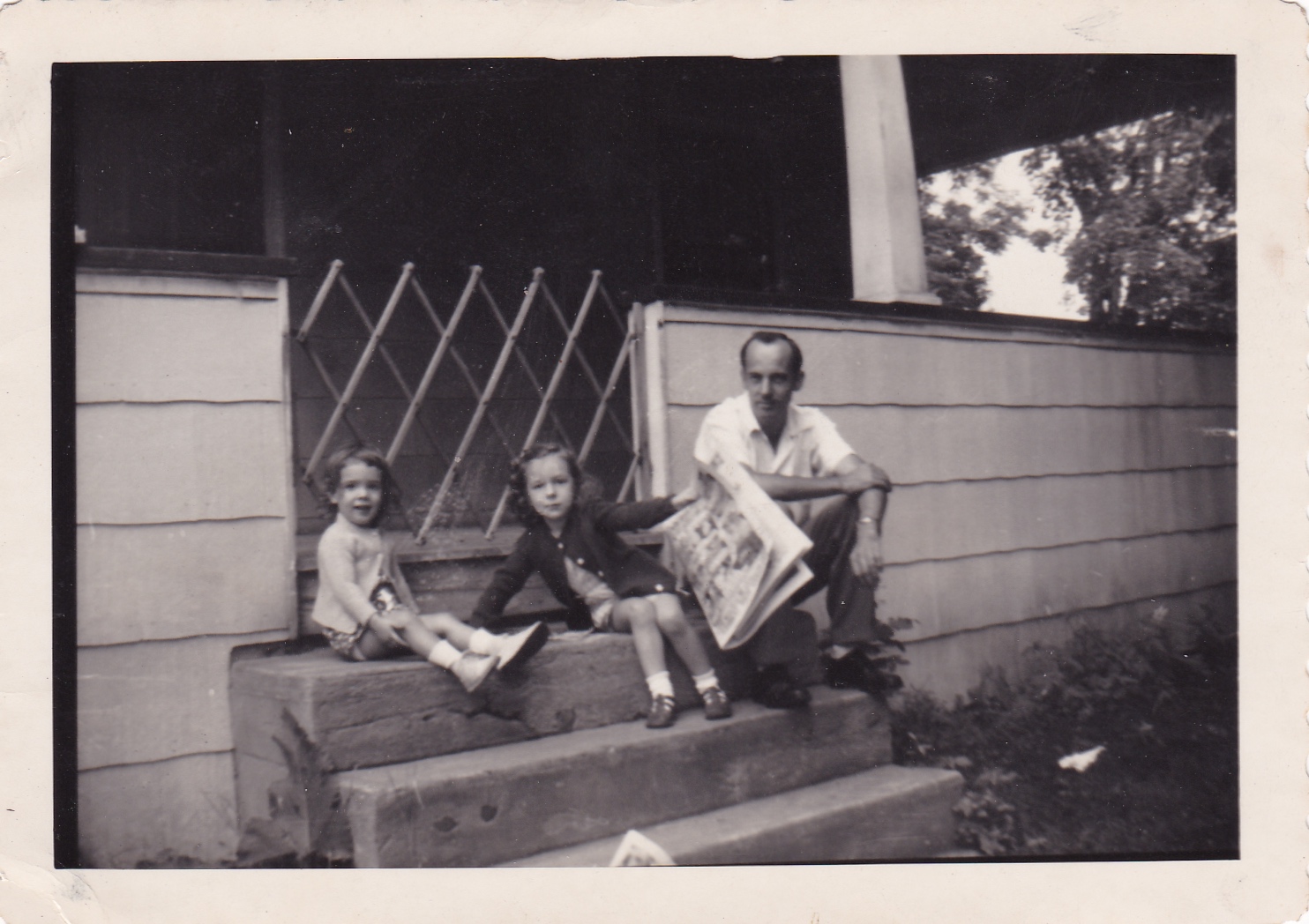
Charlotte came around in October 1944, Shirley in August 1946. For the next eight years, it was just the four of them: Dad, Mom, Charlotte and Shirley.
Dad with Shirley and Charlotte.
My brother didn’t show up until August 1954, then me in June 1957. I once made the mistake of asking my mom if she had planned our births so that Shirley and Charlotte would be old enough to babysit me and my brother. She admitted that she hadn’t expected my brother and me. She hadn’t planned our births and, she added, something like abortion wouldn’t have occurred to her because “it just wasn’t done back then.”
My mother was sometimes too honest.
Mom.
I remember my mother as always working, inside the house and out. If she wasn’t working at a grocery store like Philbrooks’ Market or a discount store like the Big N, she was busy working inside the home. Cleaning, cooking, fixing. Even when she finally settled down for the night to watch a TV show with us, she had mending to do. I used to watch as she slipped a glass jar inside the leg of her pantyhose and stitched up the runs. I wonder if she is why I always feel like I’m wasting time when I just sit and watch TV, my hands idle.
I remember our relationship when I was growing up as mercurial. One minute we’d be laughing at some joke together, the next we’d be throwing daggers at each other with our eyes. Of course, it was worse when I was a teenager. I was the youngest, but, by no means, did she spoil me.
She once said she didn’t want to make the “same mistakes” with me that she had made with my brother. Whatever that meant. My brother was in trouble no more or less than any other kid his age. But my mom took every mistake we made as a slight on herself, as an accusation of bad mothering.
My mother wanted to let me go but without me ever leaving home. She wanted me to learn but without the benefit of experience. She wanted something other than an early marriage and babies for me, but she was afraid of what that would be. For all of her independence, she didn’t want to teach me to be independent. So we fought and eventually I left.
We fought even while I lived in California, sending angry letters back and forth. I remember reading one of her angry letters while I was soaking in the bathtub. I remember tearing it up, but I no longer remember what she wrote.
When I was growing up, I rarely felt that her love for me was unconditional. I often thought that I bored her or exasperated her. Sometimes she even scared me, her anger unexpected, her silent treatment dropping the temperature in our house to freezing. And yet when she hugged me, she hugged so tight I thought my ribs would crack.
As I developed physical and emotional distance from my mother, I started to understand. She was one of 12, born somewhere in the middle to a middling farmer and his wife who died too young. My mother did what all her six sisters did, which was to marry and have babies. I don’t know how long she and my father enjoyed their marriage. I was about 10 when I witnessed for the first time my father having a nervous breakdown and listened to the soft brushing of her palm on his back while she tried to comfort him.
But it wasn’t his first breakdown, and it wouldn’t be his last. And here was my mother who was somehow expected to keep us all afloat while my father went in and out of the state hospital, then to a halfway house, then through a divorce and finally into the care of my sister Shirley.
My mom and dad when they were so young.
As I began to imagine the weight of responsibility she must have felt, I also began to be fascinated by her. I became less concerned with her as my mother and more interested in her as a woman who was once young like me, who used to watch sunsets with her sisters and wished she had clothes in those colors.
(She did eventually. At one time, after she remarried, she had a pair of polyester pants in every bright color that you might find in a box of 64 Crayola crayons. She was also quite proud of the fact that the pants only cost about $2 each. My mother was frugal from the day she was born until the day she died.)
In writing this post, trying to celebrate what would have been my mom’s 100th birthday, but, frankly, feeling tired of writing posts like this, I find myself struggling to avoid the obvious.
How could I have been a better daugther?
Let me count the ways.
[Insert list that never ends.]
My only comfort is I really believe she knew how much I loved her. That, despite all the struggles, the frequent shadow-boxing of our personalities, she made me fall in love with her by finally becoming herself, becoming something other than a wife and mother.
She became Florence, a woman who loved to watch birds, to pick berries, to play the slot machines, to eat two hot dogs with chili sauce, to gossip, to talk on the phone, to know whose birthday is when (and how old they are), to live in the moment because the past is past and the future might never be.
I’ll end this post with the verse I picked out for her prayer card:
Fill not your hearts with pain and sorrow, but remember me in every tomorrow. Remember the joy, the laughter, the smiles, I’ve only gone to rest a little while. Although my leaving causes pain and grief, my going has eased my hurt and given me relief. So dry your eyes and remember me, not as I am now, but as I used to be. Because I will remember you all and look on with a smile. Understand, in your hearts, I’ve only gone to rest a little while. As long as I have the love of each of you, I can live my life in the hearts of all of you.
My oldest sister Charlotte would have been 79 today, October 7, if she had lived. She died on November 26, 2022.
Charlotte was my mother’s first baby.
My mom and Charlotte in December 1944
The first-born child of Florence.
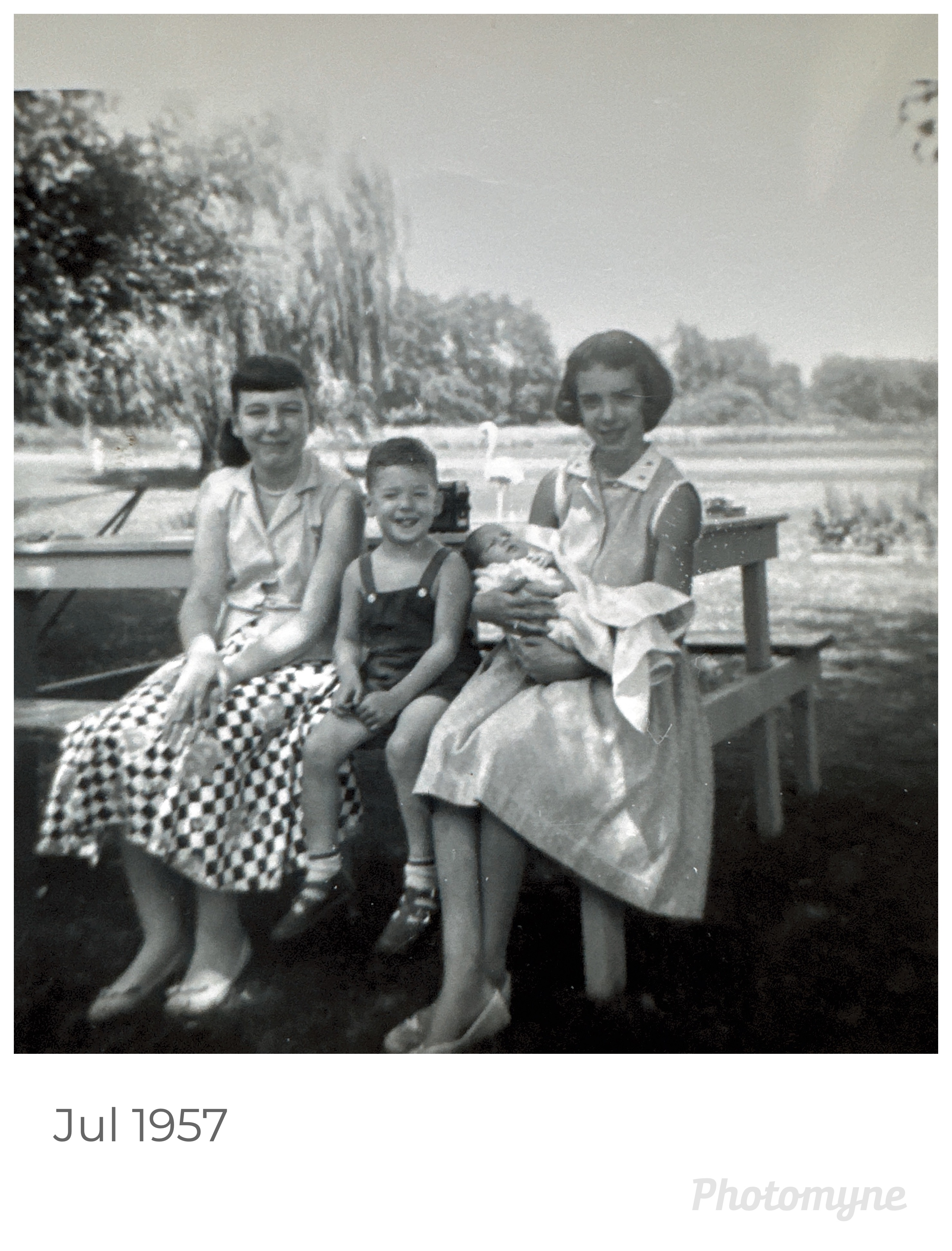
She was a few months shy of 13 when I was born. Here she is with my brother sitting between her and our sister Shirley. I am, of course, the baby in the photo.
The four of us: Charlotte, my brother, Shirley and me.
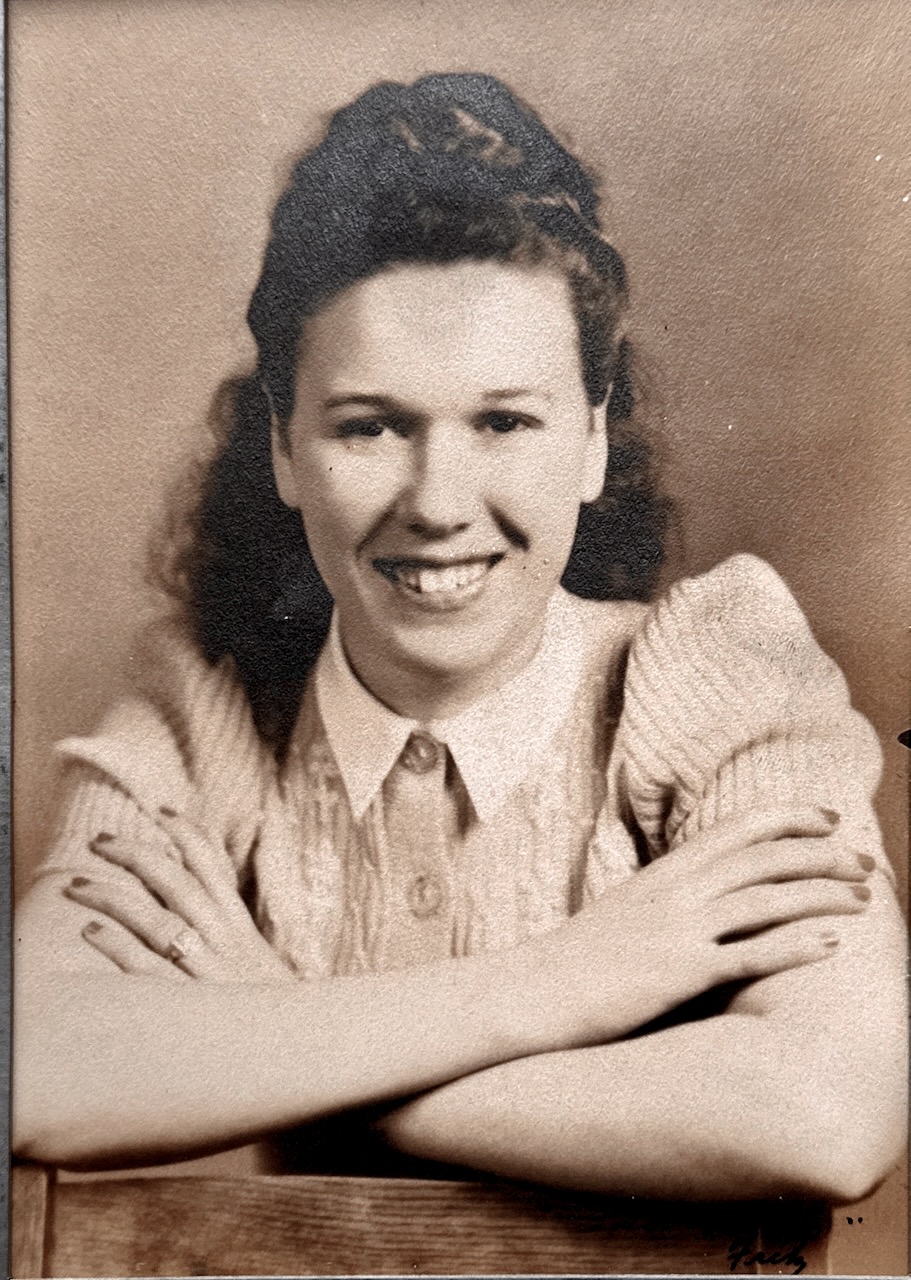
Over the years, Charlotte blossomed into a beautiful young woman. I was often gobsmacked by her beauty. None of these photos have dates so the order is possibly random.
This slideshow requires JavaScript.
My sisters Charlotte and Shirley took radically different paths from each other. Shirley married the man she first met when she was 16 and stayed happily content with him and their growing family until her last breath. Charlotte suffered through two failed marriages and then became a widow after six short years into her third marriage to a man who possibly loved her more than all the others that came before him. He also loved to sing as did she.
Charlotte being serenaded.
Charlotte had rheumatic fever when she was a young adult, leaving her with a weak heart. She was cautioned against having children because of it. According to one of my cousins, Charlotte had the fever during her first marriage, and it was our mother, not Charlotte’s husband, who got her medical care.
I often viewed Charlotte as a tragic figure, looking for love in the wrong places, struggling to support herself, pining for the children she could not have. She eventually found happiness in St. Petersburg, FL, which too quickly turned to grief, but through it all, she had friends who made her feel loved.
I failed at that. During the last several years, Charlotte and I shared a mutual dislike, due in no small part to our political differences. When my mother started spending winters with her, we would drive down from Tallahassee and visit, trying to be as pleasant as one could be with someone who didn’t welcome our presence. It hurts to remember those tense visits, the TV so loud that we could hardly converse, my sister quick to argue if I said something she didn’t like. I came away from one visit, the last one we had, feeling that my sister actually hated me.
We had had some good times together, times when we’d go out for a few drinks, long phone calls where she’d tell me stories about coworkers, the two-and-a-half weeks I stayed with her while she underwent heart valve replacement surgery. There was something about my sister that made you want to help her. I might have gone a bit overboard with that back then, helping her when she didn’t want or need it, and then feeling resentment it when she didn’t seem appreciative. That wasn’t fair of me.
Eventually our phone calls became shorter and farther between. I felt that the harder I tried to find common ground with Charlotte, the more I realized what little in common we had. It hurt. It hurt to call her and not be able to say something as simple as “How are you doing?” without her snapping back, “I’m fine. Of course, I’m fine. Why wouldn’t I be fine?” It hurt to think that the sound of my voice was enough to twist her mood into something ugly.
It hurt, but what hurts even more is that the last time we did talk on the phone, when she was in hospital because she couldn’t breathe on her own anymore, that last time I was so close to telling her I love her. The words were in my mouth, but I couldn’t say them. We had been so angry with each other for so long. Somehow I knew that by saying I love you, I’d be saying Good-bye. And I just couldn’t do that. I couldn’t admit that she was dying.










 Marie at 1 Write Way