Book Advertising Sites. Check out this list of sites to advertise your books, with commentary from Charles E Yallowitz. Definitely bookmark-worthy!
Tag: books
-
I’m not really a gadget geek. Really, I like to keep things simple. I like the simplicity of picking up a book and leafing through its pages. Still, several years ago, I became smitten by e-book readers.
I don’t remember how the love affair began. It was the early 2000s and discussions about ebooks and ebook readers were slowly making their way into the mainstream. Somewhere, somehow I got wind of a Gemstar eBook reader that I could purchase online for roughly $99 (or $149 for a color version). I opted for the black and white version, wanting to keep things simple. And thus the affair began.
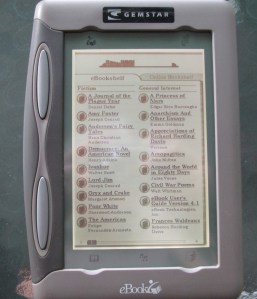
Gemstar GEB 1150 My Gemstar is a solid 22 ounces, about the size of a paperback, with a grip on the left side that makes it easy to hold with one hand. It has a touch screen, a stylus specifically for navigating the “Bookshelf” and two buttons on the left side for paging through books. It has about 8 MB of memory and I also use a smart media disk of 128 MB. On my Gemstar, I have contemporary books such as Newjack by Ted Conover, classics such as Les Miserables by Hugo, and lesser-known works such as The Amateur by Richard Harding Davis. I must have purchased the Gemstar around 2003 because I also have a few articles from the New York Review of Books saved there from that year.
Alas, within a few short years, support for the Gemstar evaporated entirely: no technical support, no online bookstores dedicated to the Gemstar. The flame had gone out of the affair.
And, yet there was still a spark. A few years later, on a camping trip, my husband and I huddled together in our small tent, on a dark windy night. I pulled out my Gemstar and read parts of Newjack to him until he was ready for sleep. I often said then and I’ll say it again now that the portability of an ebook reader is its greatest advantage. I had a long list of books for my husband to choose from that night, and I could not have backpacked all those books into camp. While the Gemstar was my first love, it may also be my last. I have since bought a 3rd-Gen Kindle (right before Amazon came out with the Fire and substantially dropped the price … damn you, Amazon!) But I missed the expanded memory that I had with my Gemstar, the touch screen, the ability to add books and articles of various formats. I liked the Kindle at first but now it’s primarily an overpriced word game player.
Then I got an iPad 2 which I bought with some hard-earned second job money and found (oh, crap!) that I could have just put the Kindle app on my iPad and been done with it. I love the touch screen and would read books or catch up with news on the iPad during my lunch hour. But still, I wasn’t satisfied. I was itching for something simpler, something more ebook dedicated, something I could read in bed without the lights on, without an LCD burning my eyes out. I have read review after review after review comparing the Kindle with the Nook with the Kobo with the iPad. Although we have a Barnes & Noble in town, I was hesitate to buy a Nook. B&N may not be as big as Amazon, but, bleeding heart liberal that I am, I wanted something more “indie.”
In April I purchased a Kobo Glo. I had found good reviews of the device, it’s capacity for storage, various ebook formats, and its “night light.” Unfortunately I had to buy it online since the one independent bookstore in my town didn’t carry it. Here’s where the blues comes in: I can’t get the wireless to work, no matter what we do (reset, factory reset, unsecure our network, secure our network). The device doesn’t always recognize the memory card, and the touch screen can be a little quirky. I’m using Calibre to download and add books outside the Kobo BookStore, but that can be a little squirrelly too. And even though I thought I had thoroughly vetted the Kobo, I’ve since learned from Calibre that “The Kobo has very buggy firmware” (from their manual).
Sigh. When my Kobo works, it’s wonderful, and I have enjoyed using it to read at night. Nobody is disturbed by the gentle light around the edges of the screen, and my eyes don’t get fried. Yet, today it took several attempts to transfer a bundle of new books from Calibre to my Kobo. Admittedly, I may have not been syncing correctly. All these gadgets seem so sensitive to how they are handled. Even some of the apps on my iPad are having hiccups following the latest system update.
My Gemstar and I never had such problems. To remind myself of how advanced technology was, I’m recharging my Gemstar and recharging our affair.
-
Self-doubt, self-publishing, and other selfish writer-isms. This blog post by Eric John Baker is worth a read not just for the post itself, but also for the comments. The debate of traditional vs self-publishing is still raging, only now I think with more nuance. Not only is it easier to produce hard copies of our novels, poems, and stories, but there are also more venues for selling your work than there were just a few years ago (think: Amazon, Smashwords). Writers aren’t stuck with the old vanity presses that took your $$$ and gave you a printout with a cardboard cover in return. Each route has its downside, though, and deciding which way to go is tricky. Getting picked up by a traditional publisher can take years, even with an agent. Sending out submissions can be time-consuming, costly (postal fees), and deflating (as when the number of rejections you get equal the number of submissions you’ve sent). Self-publishing might be less expensive (relative to postal fees of submissions) and quicker, but then who is going to market your book, who is going to make it sell? Then again, even in traditional publishing, writers are expected to go on book tours. They might have help with their itineraries, perhaps some of their travel expenses are reimbursed. But they are the ones selling their books, they are the ones doing the hawking. Getting published by a traditional press might give a writer a bit more “legitimacy,” but the writer still has to put as much if not more work into the process, especially post-publication when the book is suppose to sell and make the publisher a lot of money.
I suspect that eventually I will self-publish. I’m not a patient person generally, and I’m getting less patient as I get older. I am easily dismayed by rejection letters (especially form letters). And I’m an introvert, a shy, sensitive introvert. Not the person you want to send on a book tour. I won’t give up entirely on traditional publishing. I can still keep submitting and hope that the rejection letters eventually become more personalized. But given the short time-frame I have before me, the best I can hope for is to bring a novel or collection of short stories to a point where it is ready for prime-time (meaning I will employ a professional editor) and then self-publish and, in my own quiet way, spread the news and hope for the best. And the best might be the two or three total strangers who pay to read my book. And that will be okay.
-
Another website has opened up, to give self-published authors more visibility: IndieReader.com. Read the article here in the Christian Science Monitor. IndieReader.com describes itself as being “For self-published and print-on-demand books and the readers who love them.” Founder Amy Holman Edelman proposes to do for self-published books what Sundance has done for independent films. For an annual fee of $149, IndieReader.com will “promote, market and sell your book” on its website, if they deem your book to have met “certain standards of quality, both in terms of basic spelling and grammatical errors and content. All books must be well written and offer something of value to our customers.” Be sure to always read the fine print when $$ is involved. From the IndieReader.com Terms of Service:
2. Annual Fees and Costs. a. The fee for inclusion on the website is $149.00 per year, regardless of the number of books that each author features on the IR site. The fee for submitting the first book is included in the annual fee, however, there will be a submission fee of $25 for each book after the first. b. This fee is NON-REFUNDABLE.
IndieReader.com is a business and as such should charge fees, and it should reserve its right to reject books that don’t meet its standards. Yes, that makes it sound more like traditional publishing with all its gatekeepers, but IndieReader.com holds the promise of access to good writing, regardless of the author’s name recognition.
-
James Gleick has an intriguing essay in this Sunday’s NY Times, How to Publish Without Perishing. Although I’m an aspiring author, I’ve always thought that Google’s efforts to make millions of books available online was a great thing. Yes, copyright should be protected (published authors, please note: if I can read excerpts of your book in a bookstore, why can’t I also do it online?). What gets me excited about having access to so many books is: (1) the ability to search and find information much faster than I can thumbing through indexes; and (2) the opportunity to read those books currently out of print (which also makes me wish there were more “print on demand”-type books so I wouldn’t have to succumb to slogging through Amazon’s penny pile to find a beat-up copy of what I want.) And technology (i.e., reading online) will never take the place of the book that we’ve known and loved since Gutenberg. Computers are not designed for close reading, which is probably the real reason most web-based content is short, easily consumed in less than a minute. Ebook devices such as the Kindle or the now-defunct Gemstar (one of which I still own) are great if you’re on a long trip and want to have your library with you. I haven’t tried the Kindle as yet, but I’ve done quite a bit of reading on my old Gemstar (Jarhead, no less). But when I’m home, with the luxury of curling up on my couch for a quiet evening, there’s nothing better than a book, preferably, hard cover.
-
Remember my rank about self-published authors needing book reviewers in order to gain legitimacy? Well, one such reviewer just contacted me! Floyd M. Orr , a self-published author himself, offers to read and review iUniverse publications at his website, POD Book Reviews & More. He doesn’t mince words when it comes to his preference for only iUniverse books:
“My attitude toward iUniverse is unlike the horde of what I call the slap-fighters on the POD blogs and message boards. I am tiring of the snotty attitudes of those people, both the ones who have their own blogs and those who just pop up and dominate message boards created by others. I have only three negative things to say about iU: price, price, and price. They charge too much in set-up fees, book retail prices, and wholesale prices to the authors. Absolutely everything else I can say about the company is professional and positive. I have no interest in supporting competing companies, so this offer is for iU authors only.” (For the rest of this post, which explains the why and how of his service, please click here.)
From the list of reviewed books thus far, Mr. Orr has not suffered a shortage of reading material by limiting submissions to iUniverse. He also posts interviews with authors and agents, and other interesting tidbits of POD publishing. I’m looking forward to spending more time on his website and seeing what gems I can find that have never made it to The New York Times Book Review.
I’m really glad that Mr. Orr contacted me and made me aware of his website. If any one else out there has a “business” of reviewing POD books, please let me know and I’ll be happy to post a link to your website. Or you can leave a comment and provide your contact information there.


