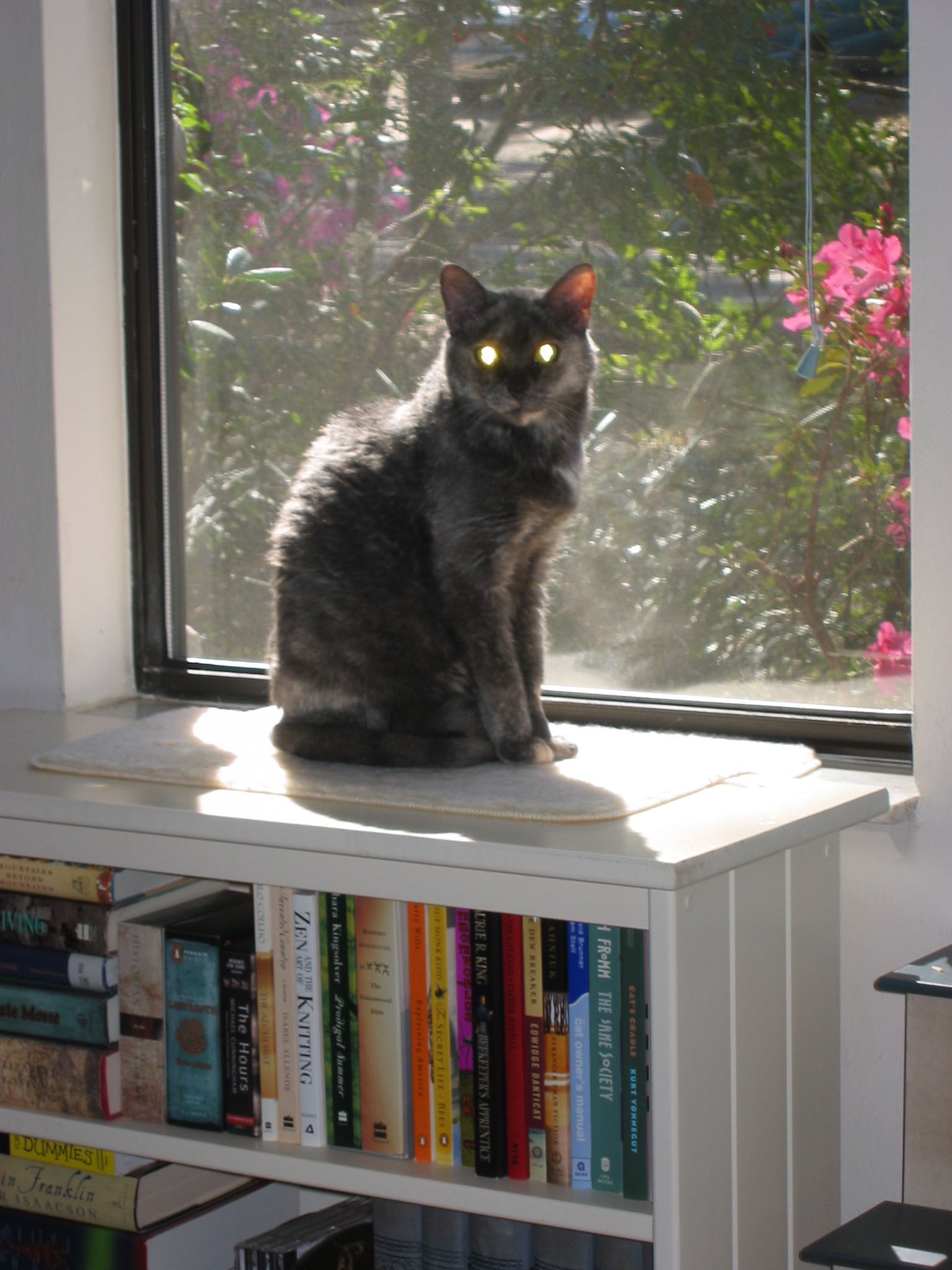
My husband and I have a lot of books. Mine are mostly fiction; his are nonfiction (environment, politics, history). I often think of my husband as better read than myself although he rarely reads fiction. On the other hand, my girlfriend and I can dominate a social gathering with our discussion of our favorite fiction authors. But, it’s only been in the last few years that I’ve really taken up with reading contemporary authors. My journey has been odd but interesting.
When I was (much) younger and there was only the one-room library up the road for my summer reading adventures, I had only what that small room could offer. I remember reading Hans Christian Anderson and being both drawn to and repulsed by his stories. I also remember wanting to change the ending of his stories. As I got older, I grabbed more of the hard-cover books because they made me feel like a grown-up. Or I would sit in the magazine alcove and leaf through old issues of Vogue and Elle magazines. In the last summer of my teens I read D.H. Lawrence, Anais Nin, Henry Miller, and . . . Albert Speer. I think I even tried to read The Gulag Archipelago. I have a vivid memory of reclining on a lounge chair in my neighbor’s yard, sunbathing, while awkwardly holding open a very thick paperback copy of Solzhenitsyn’s book.
It was a strange summer.
And for the next 20 years as I drifted in and out of college classes and between degrees and jobs, I read the classics: Shakespeare (totally lost on me when I was in high school), Dickens, Austen, Eliot (George and T.S.), the Brontes, Woolf, Forster, Ford, Donne, Pope, … there was a time when I could recite every author/poet/essayist that I read or was assigned to read. I’ve since forgotten most of them.
After leaving college and applying myself to the work-a-day world, my reading shifted more to magazines: The Nation, Harper’s, The New York Review of Books, The Atlantic. Periodicals from which I could read an essay or short fiction as my last mental exercise before going to bed. [Note: I’ve been a magazine subscriber for over 30 years. While I was in college, however, those magazines often just piled up while I tried to finish the next day’s reading assignment.]
Since I’ve been seriously writing again (or writing seriously), I’ve started reading contemporary authors, as in authors who are still alive. They’re not dead. They might not be white. And most of them are decidedly not male. Joan Didion, Barbara Kingsolver, Louise Penny, Elizabeth Wein, Robert Galbraith (sorry, he’s a she), Val McDermid, Joyce Carol Oates (I have a love-hate relationship with that woman). All my life I’ve leaned toward women authors, but that’s another blog post.
I have no doubt that many of you could spout off a list of books/authors you’ve read that is twice or ten times as long as mine. My list isn’t exhaustive. I would have to get up off my ass and go to my bookcases to remind myself the books I’ve read or intend to read. I don’t feel like doing that right now.
I used to feel self-conscious about either my lack of “well” reading or my inability to remember everything I’ve read. But then I read this essay in Harper’s by John Crowley: On Not Being Well Read (sorry, you need to be a subscriber to read the whole thing.) Mr. Crowley has a reading history not much different from mine, in that it wasn’t perfectly linear with an early and long immersion in classic literature. He muses about the idea of being “well read” or “widely read” or “much read.” He discusses a book I’ve never heard of, How to Talk About Books You Haven’t Read, but notes that your interest in following the lessons of this book may have more to do with “your need for approval from yourself and others.” Crowley has the opposite problem. While he acknowledges that he has “surely forgotten more of the books [he’s] read than remembered,” he still remembers a lot and some of what he remembers is esoteric enough that he gives the “impression” [his italics] of being well read. He also discusses the fact that not everyone reads every book in its entirety. [Look for discussions on Donna Tartt’s The Goldfinch and you get the idea that a great many more readers probably don’t finish as many books as we think they do.]
But what I really appreciated about Crowley’s essay is that in the end, it doesn’t matter. Having books is it’s own joy.
“But now that I am in my eighth decade, my seventh of devoted reading, isn’t it perhaps time to correct my lacks, to make myself whole, as the legal phrase would have it? As I write, I have in view a lot of the books I would ask myself to take up; they’ve been there for years, they move with me from house to house. Like many people who have a lot of books on shelves, I have had casual visitors ask if I’ve really read them all, in a tone that might suggest wonderment, or suspicion of pretense. And of course I haven’t read them all. Many are there just because I haven’t read them: because I want, or once wanted, to read them, or at least consult them. They are books I’d like to have inside as well as outside.”
So you, dear Reader, how do you fare with the reading of books? Do you consider yourself well read? What does “well read” mean to you? And, finally, for this is very true of me, do you have books on your shelves you haven’t read but that you keep just because?
 Marie at 1 Write Way