I hate planning because, more often than not, my plans get upended by unforeseen circumstances. For example, …
I plan to finish a painfully detailed and tedious project at work by week’s end only to find an error in my SQL query which means I will have to fix said error and then redo several days’ worth of work. To add insult to injury, I crash our server in my effort to fix said error and then have to wait until the next day before I resume my work on the project. As of this post, I am still behind on that project.
Some time ago I wrote about “letting go” of my earliest writings (you can read that post here). Just for the record, I still have most of those early writings, slowly rotting away on decades-old onion-skin typing paper. I will eventually let go of them, but only after I’ve scanned them and resigned them to an indefinite existence in the Cloud.
Today, letting go involves leafing through my files, a tidy box of folders, hanging and otherwise. (more…)
I am not a classic hoarder. You don’t have to navigate through narrow alleyways of towering books, magazines and newspapers to find my bathroom, or my kitchen, or me. I do love books and have far more than I will ever read, and I keep them properly in bookcases (for the most part).
I also love paper. Especially paper that has my writing on it. Even if that writing is from my sophomore year in high school. (more…)
Sometimes I wait too long to write and then the thoughts, or the threads weaving together an essay, deteriorate from being left out in the rain. Nothing I write comes out of whole cloth, and weaving is long, laborious, sometimes tedious work. I know because for several years I literally wove cloth on a 36-inch 4-harness Harrisville loom. I made a few things, but eventually I sold the loom to a friend and haven’t woven anything since. Sometimes I feel that way about writing: that I want to sell my tools to a friend and move on. Writing is such hard work. Which leads me to a bit of a diatribe. Thus spake my inner bitch:
I envy writers like Jennifer Weiner who can “produce at a deadline pace.”
She has published, what, eleven books in 13 years? And yet she roars with indignation at the publishing industry for being condescending toward female writers. Ya think, Jennifer? Please tell me what industry in this world is not condescending toward women. Just where is it do women no longer struggle to be taken as seriously and treated as equally as men? I came of age during the height of the women’s movement. When I was 12, I was a radical feminist, reading about rape in marriage and desperate to break free from a world that thought I deserved no better than to live in a single-wide with crying children and a husband who drank and beat me.
Maybe that’s why women people like Weiner annoy me so much. According to a New Yorker article (thanks, Kevin, for mentioning the article otherwise I never would have unearthed the issue from the stack of books and magazines next to my bed), her debut novel is in its 57th printing. She has a writing “closet” that “may be bigger than some of the apartments occupied by struggling writers in Brooklyn.” She has a summer home in Cape Cod. She has a personal shopper, someone who reminds her to pack underwear. She has been “outspoken about female writers whom she considers unsisterly.” And that is where she totally loses me. I may forgive her for wanting more when she already has more than many other writers (male as well as female) even dream of having. But the infighting that she appears to relish seems to serve no purpose other than to advance her own agenda: promotion of Jennifer Weiner.
I don’t begrudge Weiner’s writing style, her “commercial novels.” As Rebecca Mead notes, however, “literary criticism, at its best, seeks to elucidate the complex, not to catalogue the familiar.” That’s not to say that all commercial novels are unworthy of literary criticism. The Chief Inspector Gamache series written by Louise Penny, in my humble opinion, is worthy of literary attention.
English: Louise Penny (Photo credit: Wikipedia)
Yes, there is a cataloguing of the familiar in her series. They are police procedural novels and as such a particular pace and certain tropes are expected. Plot presumedly drives the stories forward; yet, I keep reading Penny’s novels for the characters and the settings. I read them because the people within her novels are complicated and their lives are complicated and the settings (modern Quebec, a quaint village, the near fatal freeze of winter, the life-draining heat of summer) intertwine with their lives to make things even more complicated. I come away from these novels still feeling thoughtful, still pondering the fine line between love and hate, good and evil, the demons within and the demons without. Because Penny’s novels are categorized as a particular genre (mystery, crime fiction, whatever), she may never get the accolades that Weiner claims is often denied writers who are female.
But I don’t hear Penny complaining. In fact, if you friend her on Facebook (https://www.facebook.com/louisepennyauthor), you’ll find that Penny seems to be quite content with her writer’s life. She is about as prolific as Weiner, having produced nine novels in as many years. Her tenth is due out in August 2014. But in contrast to Weiner, one gets the feeling Penny is still pinching herself to see if her success is just a dream. One gets the sense that she feels lucky, the kind of lucky that many artists describe as “being in the right place at the right time.” Yes, I’m admiring Penny for her humility. Perhaps I’ll be criticized for that.
Can I still consider myself a feminist if I choose not to take up arms like Jennifer Weiner and damn the literary critics for looking down their noses at commercial novels because you know they only do that if those novels are written by women? No, wait, Stephen King has had the same complaint for years.
Cover of Stephen King
Maybe I just don’t get it. Maybe I have a stronger class consciousness than a gender consciousness. After all, I feel unequally uneasy at a women-only dinner party as I do at a fancy restaurant where I have to pretend I know which fork to use when. I grew up among a lot of women. Cousins, sisters, aunts, mother. I’ve known from an early age that women aren’t always “sisterly” toward each other. Before I learned to play the part of a middle-class female, I was often condescended to by other women. I was consider stupid, slow because I was, in their presence, a fish out of water.
Eventually I married well, learned to appreciate fine wine, and appropriated the manners and preferences of my middle-class friends. For a while anyway. I’m still married well, but now I openly enjoy good cheap wine and most of those middle-class friends have moved on, no doubt because they found me to be a bore. I feel no great loss there. The complaint of wanting more, More, MORE from those who already have plenty bore me.
I’ll give this much to Jennifer Weiner. At a book signing event, “[s]he took time to talk to everyone.” She appreciates her readers. She knows without them she would be nothing. If she chooses to write for them and if they happen to prefer her stories to those by, say, Doris Lessing, then so be it. More power to her. I hope she continues to be successful and to make her readers happy. I might hope she won’t consider this blog post “unsisterly” of me.
Now, if you’ll excuse me, I believe I’ve misplaced my inner Pollyanna.
I think sometimes as writers we forget about our own preferences as readers. How many of us writers would be willing to pick up (even for free) a book or story if the first few sentences don’t grab us? Read on for more about contracts between readers and writers and for the lively discussion.
When I took a graduate class called “Writing the Novel” a few years ago, I learned two very important things. First, if you tell a writer that her work in progress is a romance novel when she thinks she’s writing literary fiction, be prepared to see a chair fly across the room. Second, there’s something called “The Contract with the Reader.” Let’s forget about throwing chairs for a while and focus on the contract, which was something I had never heard of before.
Let’s pretend you’re in a bar and a guy sitting to your left says, “You want to hear a story?” Of course you don’t, but you say, “Sure. Thrill me.” He knows sarcasm, so he says, “Tell you what. If I give you a four-sentence setup, and you agree that you’re interested in hearing the rest, then you owe me a beer. How’s that?” So of course…
Are you writing a fictional series? Are you lost in a sea of characters and events that are increasingly difficult to manage? Then read Sarah Cradit’s post on how to get your series in order.
Writing a series is not as simple as just writing several books in a row. Nor is it as easy as taking one long story and breaking it into several parts. There are a lot of nuances to writing a series that many writers just do not think about until they’re smack in the middle of it, and by that time its either too late OR you’ve just created a mountain of work for yourself that you might have avoided.
Maybe, just maybe, I can help you avoid some of that work.
Here’s a post that wonderfully describes the difficult but subsequent joy of following your heart. In a comment to this post, I wrote that as English majors we study (or studied as in my case): language, culture, gender, psychology, sociology, political systems, economics … in effect, we study the world.
As graduation season rolls around once again, the ratio of meaningful life reflections to “It’s Gonna Be May” Justin Timberlake memes scattered throughout my Newsfeed peeks at an astonishing 5:1. These personal progress reports, ranging from the 140-character tweet (respect) to the facebook note novella, spark pre-mature nostalgia and prompt me to reflect on my own collegiate transitions. For one, I can no longer imagine an existence without the aid of Google Calendar, those merciful colored blocks, and the illusion of order they lend my life. For another, I finally mustered the courage to retire an outmoded, social and self expectation-fueled dream in favor of my true passion.
A year ago today, I was lying in my bed in sweatpants, wide awake for the 54th consecutive hour and surrounded by cyclohexanes (some of them printed on sheets of notebook paper, some ingrained in my vision). I was seeing chair conformations…
This is a wonderful post for all of you currently writing fiction and needing advice/suggestions about character arcs. As I was reading Debbie’s post, I realized that I provided different arcs for different characters in my last two NaNoWriMo novels. That’s a good thing, but I hadn’t put much thought into why I was doing that. Debbie’s post actually gives me an understanding of what I’ve done and (hopefully) how to make sure the arcs worked for the characters.
1. Character arcs are not 100% necessary. I’m going to get this out of the way first thing.
This argument is made all the time, and there’s some truth to it. There are some very successful characters that never have a character arc. James Bond is the one most mentioned. While he was retooled somewhat when Daniel Craig took over the role in the movies, the character has never undergone a significant arc. Miss Marple never has an arc, or Hercule Poirot, or Stephanie Plum.
See a pattern here? They’re all characters in a long-running series of stand-alone books. While there are series characters that have arcs (I would argue Indiana Jones is an example) most don’t have them. Mainly because having the characters change would disrupt the series too much.
2. However, not giving your character one can simply be laziness on your part. Just because there are…
In exchange for an honest review, Ms. Reyner provided me with a copy of her debut novel, Twelve Days–The Beginning. My intent in reviewing her book was mainly to provide feedback regarding a particular chapter that she had softened out of concern that detailed content might be too brutal. So I read her novel in the space of two days (including the wee hours of one morning) and provided her with the following review. Ms. Reyner gave a kind review of my review so I’ve since posted it on Goodreads and Amazon, and now here:
Twelve Days – The Beginning is an emotional whirlwind of a novel. At first, Elise Grayson seems to have it all: great marriage, great job, great friends, great looks. But author Jade Reyner doesn’t take long to start peeling back the layers of deception in Elise’s life, as she tries and fails to keep her secrets. First, her best friend and favorite “eye candy,” Cole Andrews, sees through all her lies; ironically, he is the one she confides in, not her best girlfriends who are left in the dark until the truth refuses to be hidden. Then Elise meets Vaughn Granger, a tall, dark, and handsome, and highly sexed man who serves as Elise’s boss. Initially she fights her attraction to him, and initially I wanted her to because I was afraid he would be no better than her husband, that he would be just another man to dominate and control Elise.
But Granger is different and he shows Elise what it means and how it feels to be truly loved and worshiped. Although married for ten years, Elise has had limited sexual experience. Granger not only opens a new sensual and sexual world for her, but Elise also experiences a sexual awakening, the kind of awakening that, at least in our dreams, can only happen with someone who truly, truly loves us. The sex scenes are explicit but not gratuitous: there’s a context for every touch, every kiss, every caress. The same is true of the physical and sexual violence that occurs: the detail provides a searing look at Elise’s reality and an unforgiving portrayal of the monster that is her husband.
I did find myself frequently arguing with the characters–usually Elise–as I read along, a good sign that I was hooked, that I was invested in their exploits and decisions. Admittedly, Elise and her sermons on the sanctity of marriage and her stubbornness often drove me up the wall. She makes some, what I can only call, stupid decisions, but she makes them because she really thinks she is doing the right thing. I’ve worked with survivors of domestic violence, and it never ceased to amaze me how desperately some of the women I worked with wanted to believe that only if they acted rationally, then all would be OK. They needed to believe that their lives were not the nightmare that everyone else told them it was. I see Elise going through this, wanting to believe that there still some rational part of her husband that she could reason with. So, while I was sometimes angry with her, I also understood her need, her desire that everything turn out OK.
Of course, in real life, things don’t turn out quite OK and the novel has a hell of a cliffhanger. Fortunately, Ms. Reyner provides her readers with a taste of the sequel, Twelve Days – The Future, and we can at least be assured that there is indeed a future for Elise and a future for us as Ms. Reyner’s readers.
On the trail at Chimney Rock, Point Reyes National Seashore Park, California July 2012
It’s been a week since I submitted my final word count to Camp NaNoWriMo and my brain still feels as empty as this great expanse of sky. I’ve written little since: mostly comments, an attempt at poetry during a downturn in my mood, and the ubiquitous note-keeping I do at my day job. I had thought of planning to edit one or both of the novels I’ve written in the past 6 months. Remember, they are both first drafts so editing will open the opportunity (and challenge) of rewriting. But … always there is a but … my physical environment is suffering from neglect and my other projects are demanding their due.
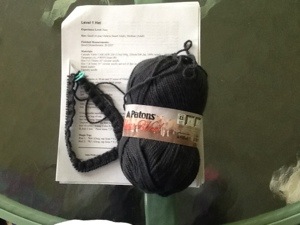
For one, I’m engaged in The Knitting Guild Association’s (TKGA’s) Master Hand Knitting Program, Level 1. For those of you interested in such endeavors, here’s a link: http://www.tkga.com/?page=AboutTKGAMasters
I actually had completed Level 1 almost 20 years ago, started Level 2 and then just quit. I am an avid knitter and have been knitting for over 40 years. I can also sew and crochet, but knitting has always defined me. I’ve made everything from baby blankets to cardigans to socks to shawls to scarves to pullovers. As the years go by, my knitting has become simpler, except for the socks and a venture into Entralec.
In recent years, I’ve resisted patterns like cardigans that require lots of finishing. Even with socks, I prefer to knit toe-up two-at-a-time because that method requires the least amount of planning and finishing. So why am I enrolled in the Level 1 Master program again? (Beside the fact that after 20 years, the association has updated its standards and requirements.) In truth, because I thought if I ever attempt to sell my knitting, it might be helpful if I could be “certified” as a Master Knitter and for that, you need to complete all three levels of the Master program. But knitting is labor-intensive and selling would only work if I was willing to do it for free. And, once knitting becomes a job, the joy goes out of it for me.
My writing is much like my knitting: I love the process (the knitting, the writing). I love the end product (the sweater, the novel), but I don’t like everything I have to do to get there (the sewing of seams, the editing). And, as with knitting, once the “fun” goes out of writing, so goes the writing.
After all these years of writing and knitting, I feel like I’m still discovering myself as a writer and a knitter. And I’m starting to let go of that urgency to “Be” something or someone, to define myself by someone else’s precepts. I’m a contrary student: I love to learn but I hate instructions. I love to find out something new, but I hate being told what to do.
Yet I intend to finish Level 1 of the Master program, even if I have to write a two-page, single-spaced report on blocking (really, is there that much to be said on blocking?). Level 2 will depend on how much of Level 1 I might be asked to re-do. And with my writing, it will be easier to simply create anew rather than rework what I already have. We’ll see. For now, I have some knitting to finish.






 Marie at 1 Write Way