Today–August 2–is my sister Shirley’s 77th birthday. If she were still with us.
I wrote this micro memoir a few months ago.
Sister
It wasn’t that hot, not that day. But a line of white crusted her open mouth, and the white hair capping her head was damp with sweat. She leaned sideways as if she would fall out from the passenger seat. I reached out to her, but she waved me off, holding onto the car door as she pivoted on the seat. I held down my scream as she jerked her body up and out of the car. A puppet missing a few strings, she was no longer its master.
I hovered behind her, torn between rushing up to her, making her take my arm, and running away, getting back in my own car, and flying south, away from the sight of her decline, away to my old photos of her when she was a teenager, holding me on her lap; or a young bride beaming next to her equally young husband; or the farmer’s wife, posing for the local newspaper with her husband and three boys; or a contented grandmother, toddlers on either side of her, intent on the book she was reading to them.
She walked through her house, me and our husbands close behind, but not so close to make her angry. She picked up one, then another of the shawls I had knitted for her. Purple, gray, and brown lacey patterns draped over the backs of chairs, ready for when she felt a chill or when she wanted to feel the love that grew within me as I ran to catch up and close the gap of 11 years between us.
When she called several years ago and told me she had Parkinson’s, I felt time fall away. I couldn’t be that mysterious hobo of a little sister anymore, a role I luxuriated in, so different from her openly traditional wife-and-mother. My heart ran ahead of me, trying to make up for the years when I was too busy living my own life, never realizing we couldn’t run fast enough.
My sister doing what she loved most. Here she is holding a relative’s baby. She wrote: “Lousy picture of me, but at least the baby is good.”
I wrote this post in 2019 and reposted it in 2022. I’m doing so again this year. Every Memorial Day (and most days in-between), I think of Ted Albers and how much I miss him. While Memorial Day is for remembering those veterans we’ve lost, do me a favor and also hold close the ones who are still here.
I wasn’t born yet when my family moved in next to you.
My older sister got your heart first. You still had dark hair. You often told me how pleased you were when my family moved in. You never had children of your own. You never married. My family came ready-made for you.
Did your heart sing when I was born? Perhaps more than my mother’s heart?
Anyone looking would see how you took possession of me like a blood relative, like a grandfather aching for a child to caress and teach and spoil.
Your hair is now gray at the sides. I don’t remember this photo (I was only a year old) but it doesn’t surprise me to see myself as full in the moment, on your lap, feeling loved.
You wouldn’t miss my birthdays. Somehow it seemed that you enjoyed them more than anyone else, maybe more than me. I felt like everything I did interested you, entertained you. Even simply opening a gift, my self-consciousness starting to show, the one-year-old’s glee giving way to the four-year-old’s apprehension.
You let me be wild and plastic where my own family wanted me quiet and still. I didn’t have to be still around you. I could, as I often did, suspend myself between your refrigerator and chair. I wore dresses but acted like a tomboy, flashing my cotton underwear. I was too young for anyone to think twice.
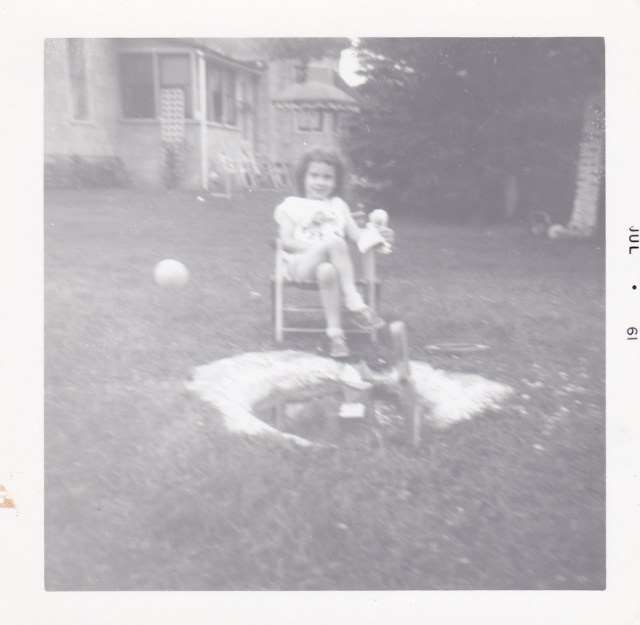
You let me play-act. I’m a famous movie actress enjoying a drink by your pool. I spent more time in your house, your backyard than in my own.
It seems sometimes I hung on to you for dear life.
And we might have both liked cats … at least I did.
You served your country. You were inducted into the Army on March 9, 1942, a few months before you would have been considered too old to serve. Earlier they had rejected you because of your varicose veins, but then they changed their minds, as the bodies came home or soldiers went missing.
You told me how the other men called you “Pop” because of your age, how you wrote letters for the ones who could not write, protected the vulnerable from the bullies in the camps. You cooked, something you enjoyed anyway, until August 1944, when you were attached to General Patch’s Seventh Army. You never told me how you saw your friend shot in the middle of the forehead while you were both fighting from a foxhole. You never told me how you went into shock, had to be hospitalized, and then was sent back to the Front.
You did tell me you were captured by the Germans.
From a local newspaper: George Albers has been notified by the War Department that his brother, Corp. Theodore Albers has been reported missing since December 23, 1944 in Belgium. The last his family heard from him was December 15, 1944.
You remained missing until Germany surrendered and you were found in a POW camp. You were quiet about your experience, only saying that often you subsisted on only black bread and water and that you had to be deloused before leaving Germany.
As you saw the end of your life growing near, you talked more.
They would only feed us every three or four days. And we had to work in a steel factory. One day I said, “I won’t work if I can’t eat.” Well, that was the wrong thing to say. They wore these long, thick leather gloves and the guard hit me across the face, knocked my glasses off. Then he kicked me where I shouldn’t be kicked and beat me so bad I was in the hospital for, oh … five or six months. I don’t remember where they took me. Just I was gone for five or six months.
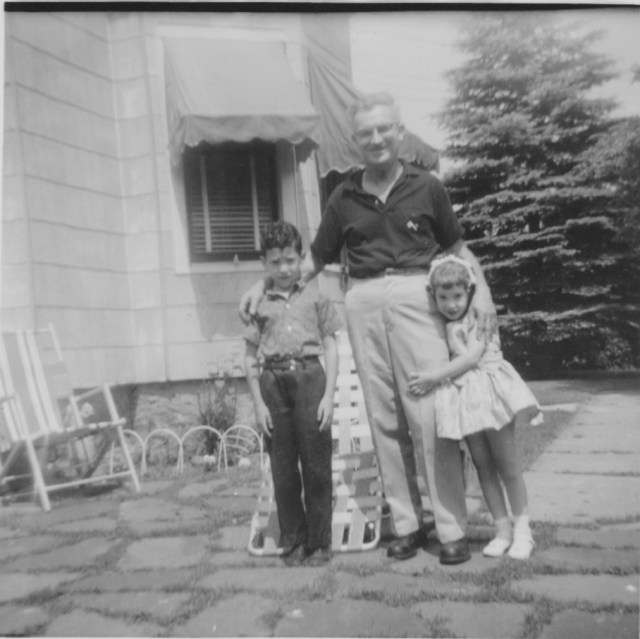
You got smaller over the years, and I got taller. The last time I saw you, the last time we hugged, your head rested on my chest.
You died on April 5, 1994, but you still live in my heart.
RIP Theodore Albers, World War II veteran, former Prisoner of War. Thank you for your service, but more than that, thank you for being the best part of my life.
It’s been so long since our last hike at Big Basin Redwood State Park in California. But it isn’t that last hike that comes to mind; it’s the first one we made one winter. My not-yet-husband Greg and I had been living together for about 18 months when we decided to spend a couple of winter nights at Big Basin. At the time (the late 80s), it was an easy two-hour drive from our San Francisco apartment. We spent the previous night packing our sleeping bags and other gear, preparing food while The Talking Heads’ movie Stop Making Sense played out on our TV.
It was a cold winter. We practically had the park to ourselves; it was so cold no sane person would think about spending the night in a tent. We were sane, but also young. That first night we set up camp and walked around a bit, returning to eat and retire early.
I wanted to read. I don’t remember what novel I was reading at the time, but it was a paperback. I remember that because turning the pages while wearing thick wool gloves took as long as actually reading a page. I reclined in one of our Nifty chairs, a two-piece chair of slotted wood and dark blue cotton panels. It sat low to the ground. I wore a wool cap, wool sweater, long underwear, a hooded storm blue parka, thick wool socks, jeans, and hiking boots. I draped scarves around my face. Greg cocooned me in blue, green and red patterned wool blankets that he had bought in Ecuador.
We were slotted in among tall trees and deep green bushes, a thick border between us and our neighbors, except we didn’t have neighbors. Instead, we had uninvited guests, an unwelcoming party of five young raccoons who, at the first scent of our roasting hot dogs, decided to crash our little party of two. They came out of the bushes, advancing on us, their bandit eyes fearless and curious. It was cold. They were hungry.
“Shoo, shoo!” We waved them away, normally not afraid of raccoons, but we were outnumbered. Finally, Greg took a big stick, a fallen branch, and pounded the ground in front of them. They looked at him, shrugged, and went away reluctantly.
That night I bundled into my sleeping bag and lay listening to a barred owl hoot as it flew from one tree to the next. I was warm except for my nose which felt like an ice cube. The raccoons came back and tried to jimmy open the cabinet where we had stored our food. I smiled knowing they could never break in.
The next day we went on our hike, starting off with three layers of clothing. That morning I had had to chop through a layer of ice to get to the water in our bucket. The seven-mile trail we took was flagged as “strenuous” by the park. Seven miles of drops and climbs, from the bottom of waterfalls with dark green ferns and moss, up to chaparrals with manzanita shrubs dotting the stony, bare hillside.
We lunched on a platform overlooking one of the falls, taking in as much with our senses as we city people could: the tang of muddy earth, the lull of rushing water, the slipperiness of moss-coated stones. Our calves were cramped with the strain of hiking this roller-coaster of a trail. This trip, this vacation, was a pilgrimage to a place on earth we knew we had to enjoy now while we could still walk.
The air was fresh and wet and cold, the temperature rising to the forties, maybe the fifties. By the end of the hike, my left knee gave out and I had to walk sideways for the last half-mile. We had warmed enough to strip down to one layer — long-sleeve t-shirts and jeans — stowing all the rest into our too-small backpacks.
At the end of the hike, the temperature was dropping and the light was fading. We bee-lined for the showers. Have you ever taken a hot shower in an ice-cold stall? Any bit of your skin that isn’t covered by hot water feels the knife-edge of freezing air. I always thought I would linger during my shower, but I never could last long, the cold air and hot water battling over my body. By the time I toweled off, I was starting to shiver. I couldn’t get my clothes on fast enough.
Back to camp and a fire and some brandy. More hot dogs. More raccoons. They kept their distance this time and all was well until I reached for the bag of pistachio nuts that I had left on the picnic table. It was gone. Panicked, because I loved pistachio nuts and had only eaten a few, I searched under and around the picnic table. Then I heard it. The familiar crunch and crack of the nuts being broken open and then devoured. The raccoons had stolen the bag.
I glared at the bushes where they were hidden, unseen but not unheard. Outwitted by raccoons.
As we stood around the fire, sipping the pint of brandy, I wondered out loud whether Greg’s former girlfriend — the one just before me, the one who left him and then tried to come back — would have been a better camping companion, more experienced and fun. He laughed out loud and said, “No, she’d be lying in the tent right now if she came at all.” She was not, never had been, a good camping companion. “You’re a superior woman,” he said before he kissed me.
As we packed up the next morning, making sure we weren’t leaving any crumbs for the felonious raccoons, a doe and her fawn sauntered into our campsite. They paused when they spotted us, and the four of us stood staring for a minute or two. We were in awe by their proximity; they were waiting for us to leave so they could forage. I poured some trail mix — peanuts and raisins — into my hand and held it out. The doe leaned her head forward, taking only as many steps as she needed. Her soft muzzle tickled my palm. She never took her eyes off me and kept her body between me and her fawn.
We dropped the rest of the mix on the ground so the fawn could eat too.
This wasn’t my last winter hike at Big Basin, but it was the last one where I looked deep into the eyes of a doe as she ate out of my hand. It was the one where I learned that I had won the heart of the man I loved.
***
Hello, everyone, and thank you for reading. This story was written in response to a February flash challenge hosted by Mom Egg Review. No worries. I’m not going to post daily, but since it took me ALL day to write this, I just thought I’d go ahead and share. Here’s your reward for sticking with me this far.
Raji in a somewhat drugged state before his annual checkup with the vet.
I wrote this post in 2019. Every Memorial Day (and most days in-between), I think of Ted Albers and how much I miss him. While Memorial Day is for remembering those veterans we’ve lost, do me a favor and also hold close the ones who are still here. (By the way, he would have loved the figurine of the girl playing the flute.)
—
I wasn’t born yet when my family moved in next to you.
My older sister got your heart first. You still had dark hair. You often told me how pleased you were when my family moved in. You never had children of your own. You never married. My family came ready-made for you.
Did your heart sing when I was born? Perhaps more than my mother’s heart?
Anyone looking would see how you took possession of me like a blood relative, like a grandfather aching for a child to caress and teach and spoil.
Your hair is now gray at the sides. I don’t remember this photo (I was only a year old) but it doesn’t surprise me to see myself as full in the moment, on your lap, feeling loved.
You wouldn’t miss my birthdays. Somehow it seemed that you enjoyed them more than anyone else, maybe more than me. I felt like everything I did interested you, entertained you. Even simply opening a gift, my self-consciousness starting to show, the one-year-old’s glee giving way to the four-year-old’s apprehension.
You let me be wild and plastic where my own family wanted me quiet and still. I didn’t have to be still around you. I could, as I often did, suspend myself between your refrigerator and chair. I wore dresses but acted like a tomboy, flashing my cotton underwear. I was too young for anyone to think twice.
You let me play-act. I’m a famous movie actress enjoying a drink by your pool. I spent more time in your house, your backyard than in my own.
It seems sometimes I hung on to you for dear life.
And we might have both liked cats … at least I did.
You served your country. You were inducted into the Army on March 9, 1942, a few months before you would have been considered too old to serve. Earlier they had rejected you because of your varicose veins, but then they changed their minds, as the bodies came home or soldiers went missing.
You told me how the other men called you “Pop” because of your age, how you wrote letters for the ones who could not write, protected the vulnerable from the bullies in the camps. You cooked, something you enjoyed anyway, until August 1944, when you were attached to General Patch’s Seventh Army. You never told me how you saw your friend shot in the middle of the forehead while you were both fighting from a foxhole. You never told me how you went into shock, had to be hospitalized, and then was sent back to the Front.
You did tell me you were captured by the Germans.
From a local newspaper: George Albers has been notified by the War Department that his brother, Corp. Theodore Albers has been reported missing since December 23, 1944 in Belgium. The last his family heard from him was December 15, 1944.
You remained missing until Germany surrendered and you were found in a POW camp. You were quiet about your experience, only saying that often you subsisted on only black bread and water and that you had to be deloused before leaving Germany.
As you saw the end of your life growing near, you talked more.
They would only feed us every three or four days. And we had to work in a steel factory. One day I said, “I won’t work if I can’t eat.” Well, that was the wrong thing to say. They wore these long, thick leather gloves and the guard hit me across the face, knocked my glasses off. Then he kicked me where I shouldn’t be kicked and beat me so bad I was in the hospital for, oh … five or six months. I don’t remember where they took me. Just I was gone for five or six months.
You got smaller over the years, and I got taller. The last time I saw you, the last time we hugged, your head rested on my chest.
You died on April 5, 1994, but you still live in my heart.
RIP Theodore Albers, World War II veteran, former Prisoner of War. Thank you for your service, but more than that, thank you for being the best part of my life.
I wasn’t born yet when my family moved in next to you.
My older sister got your heart first. You still had dark hair. You often told me how pleased you were when my family moved in. You never had children of your own. You never married. My family came ready-made for you.
Did your heart sing when I was born? Perhaps more than my mother’s heart?
Anyone looking would see how you took possession of me like a blood relative, like a grandfather aching for a child to caress and teach and spoil.
Your hair is now gray at the sides. I don’t remember this photo (I was only a year old) but it doesn’t surprise me to see myself as full in the moment, on your lap, feeling loved.
You wouldn’t miss my birthdays. Somehow it seemed that you enjoyed them more than anyone else, maybe more than me. I felt like everything I did interested you, entertained you. Even simply opening a gift, my self-consciousness starting to show, the one-year-old’s glee giving way to the four-year-old’s apprehension.
You let me be wild and plastic where my own family wanted me quiet and still. I didn’t have to be still around you. I could, as I often did, suspend myself between your refrigerator and chair. I wore dresses but acted like a tomboy, flashing my cotton underwear. I was too young for anyone to think twice.
You let me play-act. I’m a famous movie actress enjoying a drink by your pool. I spent more time in your house, your backyard than in my own.
It seems sometimes I hung on to you for dear life.
And we might have both liked cats … at least I did.
You served your country. You were inducted into the Army on March 9, 1942, a few months before you would have been considered too old to serve. Earlier they had rejected you because of your varicose veins, but then they changed their minds, as the bodies came home or soldiers went missing.
You told me how the other men called you “Pop” because of your age, how you wrote letters for the ones who could not write, protected the vulnerable from the bullies in the camps. You cooked, something you enjoyed anyway, until August 1944, when you were attached to General Patch’s Seventh Army. You never told me how you saw your friend shot in the middle of the forehead while you were both fighting from a foxhole. You never told me how you went into shock, had to be hospitalized, and then was sent back to the Front.
You did tell me you were captured by the Germans.
From a local newspaper: George Albers has been notified by the War Department that his brother, Corp. Theodore Albers has been reported missing since December 23, 1944 in Belgium. The last his family heard from him was December 15, 1944.
You remained missing until Germany surrendered and you were found in a POW camp. You were quiet about your experience, only saying that often you subsisted on only black bread and water and that you had to be deloused before leaving Germany.
As you saw the end of your life growing near, you talked more.
They would only feed us every three or four days. And we had to work in a steel factory. One day I said, “I won’t work if I can’t eat.” Well, that was the wrong thing to say. They wore these long, thick leather gloves and the guard hit me across the face, knocked my glasses off. Then he kicked me where I shouldn’t be kicked and beat me so bad I was in the hospital for, oh … five or six months. I don’t remember where they took me. Just I was gone for five or six months.
You got smaller over the years, and I got taller. The last time I saw you, the last time we hugged, your head rested on my chest.
You died on April 5, 1994, but you still live in my heart.
RIP Theodore Albers, World War II veteran, former Prisoner of War. Thank you for your service, but more than that, thank you for being the best part of my life.
I love this essay to the moon and back. I love when someone’s writing sparks me to write, especially when it’s something other than what I intended to write.
Last night my husband and I were talking about my spider phobia. He has taken up macrophotography and is excited about photos he took of a tiny spider on a fiddleneck fern. I glanced at one photo and had to immediately look away, as the sight of the severely magnified monster was like a kick to my gut. And yet … after almost 30 years living in Florida, I no longer panic when I see a Golden Silk spider. In fact, I might just walk up to it, as long as the spider is at eye level and not overhead where it might mistake my frizzy gray hair for another web.
I’ve adapted by getting over some of my phobias and dislikes. I eat foods now that I would never eat as a child. I listen to a wider range of music now, instead of only Bruce Springsteen. But what really struck me in Jan’s essay was being “allowed to be ourselves and for that self to be re-framed throughout a long life.” At 61, I often think I should have myself all figured out by now, be as constant as the sun and the moon, be as predictable as my cat Junior waking me up in the wee hours with his lonely cries. And yet I’m not. I’m constantly shifting, and the shifting drives me crazy.
When I visit my family, I see people who haven’t changed much over the decades. They have deep-rooted lives with children and grandchildren; cousins, aunts, and uncles; friends they’ve known since high school. They haven’t wavered (much) with their politics, the foods they like to eat, and the music they like to listen to. They adhere generally to the same cultural codes they always have. I’m not saying this is bad, as I’ve often envied them the ability to so strongly identify with their own people, place, and time.
Salt of the earth.
I’ve seen or heard shifting around the edges of their long-held beliefs and values as the world around them changes and intrudes. I’ve seen or heard them pushing back against injustice, inequality, discrimination, lawlessness. This is growth, but not necessarily a reframing of their lives, individually or collectively.
Since I was a child, I hadn’t felt I belonged. Any effort I made to believe that I was a member of a tribe, that I felt cohesion with a group, quickly failed. The fact that I had to make an effort belies the truth of my belonging. It’s not that I was treated as a foreigner in my own extended family, but that I felt as one which, of course, was in part because I was treated as one. I was always an oddity.
I remember when I was a kid, I wanted to go on a hike with my cousins. Vague memory as all my memories are, but the gist was this: We had been camping and were going to go for a hike up a hillside. I don’t remember my age, but I don’t think I was yet a teenager. I started off on the hike and then, for some reason I can’t remember, I turned around and went back to camp. I changed my mind. I don’t know if I saw something that scared me. I don’t remember if I thought the hike was too hard. Maybe I wasn’t dressed properly for a hike, didn’t have the right shoes. Maybe I was afraid of being left behind, which is something that seemed to happen often enough for me to be afraid of it happening again.
When I was much younger, perhaps 5 or 6, I went to the Fonda Fair with my family. There was a “Mystery House.” You were supposed to go in one end and come out the other, and it was pitch black with scary sounds and maybe ghosts jumping out at you. I was allowed to go providing I hold onto my brother’s hand. It was pitch black. I couldn’t see anything. People were laughing and I didn’t understand why, what was so funny. This was scary! My hand was let go and I found myself blocked by a wall or maybe a door. I couldn’t see anything but I could hear people. Some teenagers moved past me, laughing. Someone noticed me, remarked that a little girl was there and she was crying. But no one offered to help me through the house. I managed to turn around and exit through the entrance. Whenever I think of this event, I recall feeling humiliated. Not only was I embarrassed, but I sensed my family, my mom, was embarrassed too. People thought it was funny that I came out through the entrance, crying. I don’t remember anyone trying to comfort me. I could be wrong, but I’d like to think that if someone had, I would remember.
Back to the hike: I had a well-founded fear of being left behind, and I believe that even though I wanted to go on the hike, it quickly became evident that I would be left behind. No one of my cousins would be interested in lagging behind with me. If I couldn’t keep up, it was my own fault. So I turned around and went back to the camp and never asked to go on a hike again.
Flash forward 20-some years, and I’m visiting my home and family for a few weeks, after having moved to California a couple of years before. One of my cousins is also visiting and she tells me about a hike that she and some other cousins were planning. I tell her I’d like to go and she promises to call me. In the brief time I had been living in California, I had started hiking. I was broke most of the time so hiking and going for long walks was one way to entertain myself without spending money. I was looking forward to hiking with my cousins, being part of a group that I hadn’t been much part of when I lived home. It didn’t matter where we were going as long I belonged.
My cousin didn’t call. By the time she got back in touch with me, the hike had been and gone, and my cousin confessed that she hadn’t taken me seriously.
“Why would I have said I wanted to go on a hike if I really didn’t want to?”
“Well, you never wanted to go before.”
“That was years ago. I’ve been hiking in California. I like to hike now.”
“Well, I didn’t know.”
Right, she was remembering me as I had been, fixing me in a time I was trying to grow out of.
My struggles with growth, with allowing myself to reframe my self as I journey through life, have their origin in my childhood and adolescence. When my mother would jokingly complain that I was so unpredictable as to be predictable. When I go home and the contrast of how family remember me and how I am now is so stark that even I don’t always recognize myself. That might be one good thing about having lived in one place for almost 30 years, especially as an adult, when growth and reframing can be incremental, at worst a slight tremor. Not like the earthquakes of growth when I was a child and adolescent, when one day I was playing with Barbie and Ken and Midget and Skipper and the next day I was no longer a child and let my dolls rot away in an attic. I’ll say this for my mom: She tried to keep up.
My changeability was a source of frustration for my family. I understand that, but I also understand it’s why I could never “go home” again. Going home would mean going back to whoever I was that my family remembered the most, not who I am now. It’s also why I fantasize about leaving Florida and starting anew somewhere else. I want to grow, to reframe. To do that while nothing around me changes is not just hard. It makes me feel odd, like a foreigner in my own country.
The following post was originally written in February 2009 and published on this blog in March 2013. Since I’ve gained a few new followers since 2013, here it is again. .
###
I had just wanted to get some fresh air. I had been indoors, attending training and conference sessions, for almost five days straight. It was early December, in Atlanta, and dark after 5 pm. I just wanted some fresh air, but it was too dark to stroll around the hotel grounds, so I decided to risk the rush hour traffic and walk to the mall. Malls are supposed to be good walking places, or so I’ve been told, since I usually avoid malls. I’m a bit agoraphobic. I don’t like crowds, especially, the unorganized, almost zombie-like crowds of malls. But I wanted some fresh air, and to get out of my hotel room, and maybe, just maybe, buy myself a treat since I was feeling homesick and probably suffering from SADS.
I smiled easily at the shoppers I passed as I went through the glass entrance doors. I didn’t know anyone here. I could browse and stroll with a great cloak of anonymity. I turned a corner, looking straight ahead, wondering if the mall had a Barnes and Noble or a Borders, and was prepared to bulldoze myself through the opposing traffic of shopping zombies, when she caught my eye. A diminutive young woman dressed in a black long-sleeve sweater and tight black pants, slinked around a kiosk, calling out to me, “Have you heard of the Dead Sea salts?”
She had a thick accent, almost a caricature of the Jewish accent heard on sitcoms. I thought, “Seinfeld?,” and stopped as she cautiously touched my arm. She was smiling and holding a bottle of lotion. She went on about the Dead Sea, and its salts, and how this line of skin care was Oprah’s favorite. Did I know about the Dead Sea? I said yes, and felt myself pulled toward her kiosk, although she did not touch me. It was if the kiosk had caught me in its tractor beam, and I floated toward it, the young woman still talking about the miracle properties of the dead sea minerals.
She buffed the nail on my index finger, making it shine as if it had just been lacquered. I admit I was delighted. My nails are usually so dull, I said, and nail polish doesn’t stay on. She rubbed oil into my cuticles and admonished me to never use nail polish or to cut my cuticles, not even to push them back.
“That’s very unhealthy,” she said in a tone so serious that I wanted to laugh. We bantered about the cost of the nail care kit that she wanted to sell me. “How much is it,” I asked, with a smirk suggesting that I knew it would be too much. “A million dollars,” she said, “but, for you, forty dollars. It’s such a deal.” I grimaced. Fourteen dollars was more like it, I thought but didn’t say.
“Lemme show you something else. You will love this. All my clients love this.” She grabbed my hands, positioned them over a basin, and then spritzed them with water. “This is so wonderful. You will thank me for this.” She seemed genuinely excited and I wanted to be excited, too, but I could feel myself flag. It had been a long day, a long week, and I had only wanted to get some fresh air. She put a small scoop of oil and salts in my hands and told me to rub. A lemony scent drifted up to my nose, and the rubbing, the gritty, oily sensation, made me pine for my hotel room and the bath I could take if I could only get away from this tiny woman who had thrown a spell over me.
She was very close to me, her straight dark brown hair often brushing against my shoulders. Her movements were quick and sure, and I began to feel like a solid lump of dough next to her. She never stopped talking. She never stopped her spiel. She rinsed the oily salts off my hands and then applied a thick cream that made my skin feel smooth and plump and soft.
“And how much does this cost,” I asked in a monotone voice. She responded with her usual “A million dollars, but, for you …” She explained how she could give me her discount and that she would give me her phone number so I could always call her when I needed to order more.
“Don’t buy from online,” she said, shaking her finger at me. “It’s much more expensive online.” She turned her back to me, and I looked quickly around, wishing there were more people in the mall, wishing I could step back and disappear into a sea of people. She swung around, her large dark eyes filled with delight as she asked, “Do you use eye cream?”
Before I could answer, she was dabbing at the skin just around my right eye, telling me how thin the skin is there, how it needs to be pampered, how you should never rub that area, and how this miracle gel will make my wrinkles disappear. Then she grabbed a mirror, wanting me to see the difference between the skin of my right eye and my left eye.
What I saw made me want to weep. The wrinkles around my eyes were nothing compared to the pallor of my skin and the deep criss-cross of lines across my neck. I was 52 but I suddenly felt and looked much older. The woman prattled on, seemingly oblivious to the horror I felt at my reflection. She put the mirror down and began to stack little boxes next to the cash register, again saying what a good deal she would give me, how I will bless her for this in six weeks time. I was rooted to the spot and felt my only means of escape was to pay the woman.
Pay her whatever she wanted, pay her anything if she would just let me go. She handed me a receipt. Four hundred dollars. My price of freedom was four hundred dollars.
I managed to get back to my hotel room without being seen by any of my fellow conference goers. The bag handles left deep grooves in my pampered palms, and I felt so humiliated, so ashamed at spending so much on so little.
In my room, I laid out my goods on the bed, opened up my laptop, and waited for it to boot. When my browser was up and running, I typed “Dead Sea Secrets” into the Google search bar and began my quest. I hadn’t wanted any of this stuff. I had only wanted fresh air. But I needed to know if at least I had gotten a deal.
Yesterday would have been my father’s 96th birthday.
I think he’s rather handsome.
He died in his sleep in November 1992. The kind of death anyone would want. At least at the end, someone (God?) cut him some slack. You see, he hadn’t had an easy life. Born in poverty. Never finished high school. Classified 4-F. And he couldn’t hold a job. That, in a weird sort of way, was my good fortune, or so one of my sisters told me once a long time ago.
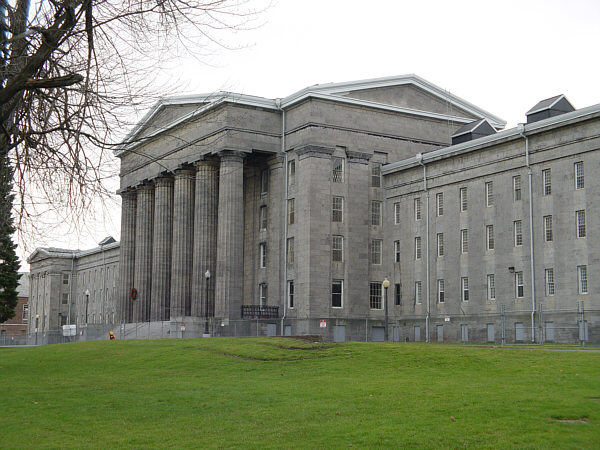
You see, I’m the youngest of four. My sisters are 13 and 11 years older than me, my brother 3 years older. The middle sister remembers our father as working during most of her childhood, not there to take her to matinees like he did for me. Not there to draw pictures for her on demand like he did for me. But she forgot that those were the earliest years of my childhood. By the time I was around 10, he was starting to spend less time at home and more time at Utica State Hospital, formerly known as the New York State Lunatic Asylum.
Not a fun place to visit your father.
I do agree with my sister that I had some fun times with my dad. He and I both took perverse pleasure in Grade-B horror films. You know, the ones produced by Hammer Film and that usually only showed during theater matinees or at 2 pm on the TV. And, yes, I have a memory of finding him on our neighbor’s porch (because we didn’t have a porch), sitting out the hot summer afternoon, sweat glistening on his dark hairy arms. But when I handed him a piece of paper and pencil and demanded, “Draw me a man,” he compiled. Even gave the man a corncob pipe to smoke.
I think my parents were happy once. Before it all got too much.
Happy Days
My mother told me that Dad had had his first nervous breakdown when he was only 17 and she didn’t know about it until later. But, she went on, she would have married him anyway. He was 23 when they married. She was 19. Perhaps as far as anyone knew, he was okay. They had met at a dance. My mother was one of seven sisters and five brothers growing up on a farm run by a father who was “not progressive.” (My mom’s words, not mine.) She might have felt a desperate need to leave. These are all fragments of memory. And they are all I have.
My father loved to play the piano, although I don’t remember him having much of a repertoire. I gave my mother a recital once. She was in the kitchen washing dishes while I banged away happily. I can imagine her standing at the kitchen sink, praying for mercy. I don’t remember when exactly, but it seemed that soon after, the piano disappeared.
I loved banging on this piano.
By the time I was a teenager, my dad was sometimes living at home, sometimes not. By then I had witnessed two of his nervous breakdowns. Once when I was about 9 or 10 and I heard, rather than saw, him fall apart over the Vietnam War and the loss of “our boys” and heard, rather than saw, my mother rubbing circles on his back, trying to soothe him. The second time when I was about 14 and he had just come home from the Village Tavern. He collapsed on the cot in the dining room, crying and banging on the wall, his back to me. I couldn’t make out what he was crying about. Something about not being able to take it, I think. I called my sister and stayed until she showed up. I was terrified the whole time. I was never afraid that he would hurt me. He had never laid a hand on me, and somehow I knew he never would. I was afraid of his pain, the utter anguish that poured through his tears.
I can’t tell you what was wrong with him. No one seems to really know. My mom and my middle sister have said that he was diagnosed as schizophrenic. But he didn’t hurt anyone. He wasn’t suicidal as far as I could tell. He just cried a lot and blamed himself for things that he couldn’t control. Like the Vietnam War. He had it in his head that the war started when he quit the creamery and so there was a connection. He felt responsible. I once accused him of thinking he must be God. When he laughed, slightly chagrined, I thought maybe he was really okay.
He had a fixation on Oral Roberts, a man I came to loathe for the spell he cast over my dad. He sent money to Oral Roberts and in return got a small plastic plaque that read “Something good is going to happen to you.” Nothing good happened to or for my dad. And he blamed himself because, you know, if Oral Roberts said “something good was going to happen to you” and nothing did, you had only yourself to blame.
We went on that way until I was 18 and my mother no longer received Social Security checks for me. And then she wanted to remarry. She felt she could finally go ahead and start living her own life. Whatever had been between her and my dad was no longer there. It just wasn’t sustainable through all the pain and struggle. By this time, my dad was well enough to live “independently,” but not at home. He lived in a “halfway house,” with other men who had had it rough, so to speak. I don’t think, I don’t remember if I ever visited him there.
So my mom and dad divorced, my mom remarried, and my dad start visiting my middle sister when he could. And then I moved to California. He became very ill at one point. Blood clot in his abdomen and we all thought that was it for him. And no one thought that was fair. My mother said, “He doesn’t deserve that.” He had never hurt anybody so why should he suffer?
But he recovered and my sister was able to move him to a facility where he could get round-the-clock care. It was essentially a hospital. It smelled like a hospital. He had a hospital room to live in. Nurses abounded. But it was also a five-minute drive from where my sister worked. On one visit home, I was treated to this.
I think the piano was the one thing, the one constant in my father’s life that gave him pleasure. You couldn’t count on people, especially your youngest daughter who avoided you whenever possible and rarely brought friends home when you were there. Then again, that middle daughter more than compensated.
On a visit from California. I don’t think I was ready to see him like this.
I am grateful that for the most part he seemed happy during his last few years. He was whittled down by God knows what kind of medications he was on and off, by the shock treatments he received in Utica. He had Parkinson’s as if having mental health problems wasn’t enough. Yet, his needs and desires were few. Give him a piano and he’d bang away, play the same song over and over, but be happy. Smile at him and he’d smile back. Send him cards with kittens on them and he’d carried them around in the little bag attached to his wheelchair.
He didn’t ask for much, and I gave him very little in return. I spent most of my youth and early adulthood fearing that I would turn out like him. I cry easily. Especially when I was a teenager, I did a fair amount of acting out. If my family had known half of what I did, they might have sent me to Utica too. It’s taken me a long time to understand that my father’s mental illness was not genetic, that it was more environmental than anything else. Maybe.
My father wasn’t always sick. I just have few memories of when he wasn’t.
This post is my way (pitiful though it is) of asking my dad for forgiveness. I wasn’t a good daughter. I let my sister and my mother do all the heavy lifting. I want to go back to that night, so many years ago, when I was staying up late because I wanted to watch some stupid horror movie. I heard Dad come down the stairs and I sighed. I didn’t want him there, with me. I wanted to be alone. But he came into the living room, “What ya watching,” and sat down. As the movie grew in suspense and we both jumped when a door was suddenly pulled open, we laughed and looked at each other. I think I said something like, “I’m glad you’re here.” Code for “this movie is too scary to watch alone.” He laughed again and we went back to watching the movie.
Well, Alabama ain’t my home and Lynyrd Skynyrd ain’t my favorite band (except for Free Bird and that in large part because it was the favorite song of a cousin I looked up to). But Alabama is my husband’s mother’s home state. The city of Montgomery in particular. A place he last visited more than 50 years ago when he went as a little boy with his mother and sister to visit his Mamaw (look it up). Recently we took a trip to Montgomery to see if it had changed since my husband’s last and only visit.
You laugh.
But this is the Real South I’m talking about. Sometimes some things don’t change.
We were only in Montgomery for one full day, which we spent driving and walking around, seeing what might spur my husband’s imagination memory.
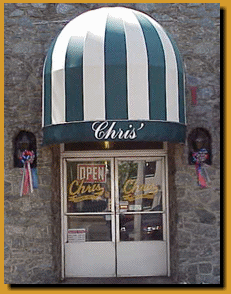
My husband had his first chili dog there when he still wearing knickers. Like I said, about 50+ years ago. And the place is still there. They still serve chili dogs although my husband complained it wasn’t quite the same as he remembered.
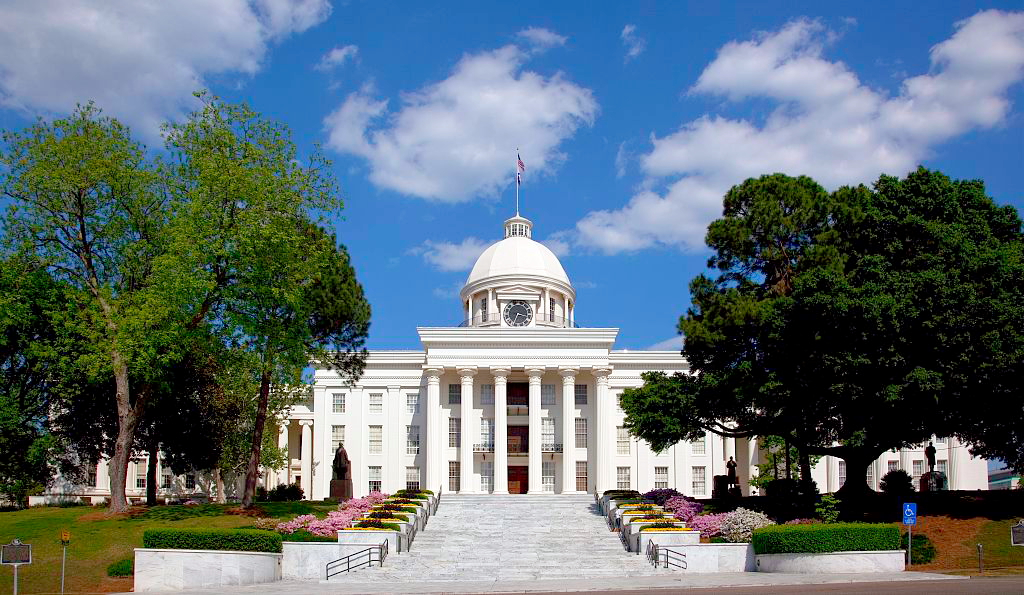
The Capitol building was a high point as was the walk up to it, on Dexter Avenue. The flowers in this photo were not in bloom during our visit, but it was still a sunny day with blue skies and fluffy clouds.
My husband had a vivid memory of seeing a gold star embedded in one of the steps to the Capitol. Something to do with Jefferson Davis, he recalled but being just a child, he was fascinated by the star, not the history. Where exactly on the Capitol steps would it be, he didn’t know.
Inscription: “Placed by Sophie Bibb Chapter Daughters of the Confederacy on the spot where Jefferson Davis stood when inaugurated President of the C.S.A. Feb. 18, 1861.”
Finding the star wasn’t difficult at all once I looked it up on my iPad. And the view from that spot was rather pleasant, although my photography skills are rather lacking.
The view from the Capitol building, down Dexter Avenue. Montgomery, Alabama. May 2015.
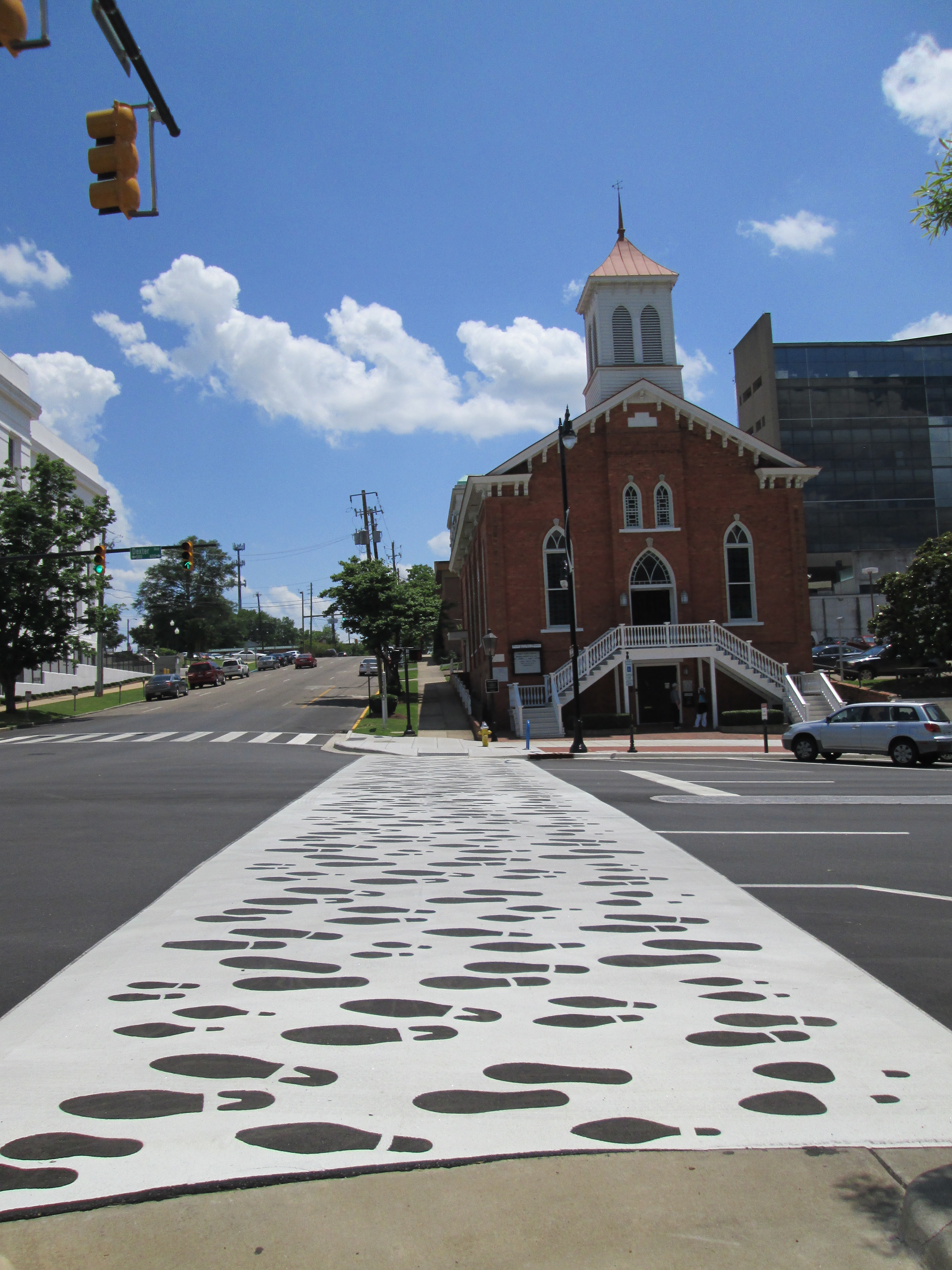
Only two blocks before the Capitol building was a modest church. It’s stature smaller than many of the other many churches in Montgomery (and I do mean to use the word ‘many’ twice). We might have just walked by Dexter Avenue Baptist Church, the church where Dr. Martin Luther King, Jr. was pastor for several years. Services are still held at the church and a small museum is on the bottom floor. I’m not a church-going believer, but this is one church in which I would be happy to seek shelter.
Dexter Avenue Baptist Church, founded in 1877, and first known as the Second Colored Baptist Church. Dr. Martin Luther King, Jr., served as pastor from 1954-1960.
But in an interesting juxtaposition, on the corner opposite the church, a tombstone-look marker reminded us of Montgomery’s long journey forward.
Yes, in 1942, some people still pined for the good ole days of the nascent Confederacy, when they could sip mint juleps in the shade of their verandas while their slaves toiled to their deaths under the searing Southern sun. If they couldn’t go back in time, they would surely make sure that people knew of their desire.
The juxtaposition didn’t end there. Directly across Dexter Avenue was another marker, a newer one that filled me with hope.
And the strangely moving sight of shoe prints, all kinds, all sizes, stretching from the Civil Rights marker above, across Dexter Avenue, to the Dexter Avenue Baptist Church.
One image I didn’t capture but still sticks in my mind as clear as the moment I saw it: In the ladies’ room at the Planetarium (yes, Montgomery has a planetarium and a very nice one, too), the soap dispenser had an interesting insignia. The insignia described Alabama as both “The Cradle of the Confederacy” and “The Birthplace of the Civil Rights Movement.” It looked something like this, but on a soap dispenser.
This seal represents the South to me, not just Alabama. On the one hand, history and one’s part in it should not be forgotten. “Cradle of the Confederacy.” The marker, commissioned by the United Daughters of the Confederacy, directly across from Dexter Avenue Baptist Church. These are reminders of Alabama’s history and the role it played in the Confederacy and the Civil War.
Wrongs must be righted. “Birthplace of the Civil Rights Movement.” Shoe prints stretching across Dexter Avenue, representing the March from Selma to Montgomery. The marker commemorating that march. These demonstrate that Alabama is moving forward in history, not forgetting its history but (hopefully) refusing to repeat it.
Or am I giving Alabama too much credit? Perhaps Alabama still pines for those days long gone, those days before we knew what what we were capable of doing to each other. Perhaps some think there’s still a chance the Confederacy can be reborn and, for them, “Cradle of the Confederacy” is a source of pride.
What do you think, Dear Reader? Are these odd juxtapositions of historical importance? Or is there some poetry here, like a song suggesting, “it’s complicated.”
The following “memoir” was published online elsewhere, only the website has since disappeared. Thus, I resurrect my creative attempt at remembrance here. (more…)

 Did your heart sing when I was born? Perhaps more than my mother’s heart?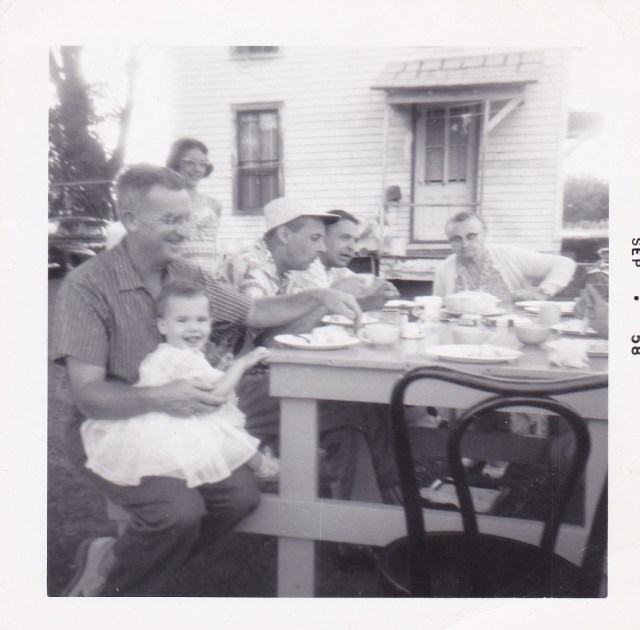











 Marie at 1 Write Way
