Check it out!
https://kevinbrennanbooks.wordpress.com/2018/01/15/the-disappointed-housewife-is-live/
New online literary mag is open for submissions … and getting ready to launch on January 15th! Read on for more details …
 The Disappointed Housewife is approaching!
I’ve received a number of fun pieces the last few weeks, and though I’m still keeping the pre-launch submission window open, the big day will be January 15. Mark your calendars.
I hope all my readers here at What The Hell will quickly follow the new lit mag and start spreading the word. But I’m also eager to see new submissions coming in so I can build up a nice catalog of material for readers. I’ll be posting open submission calls at a variety of places, hoping to find a lot of writers willing to try new things. Of course, I’ll always give readers of this blog a fair shot at publication because loyalty deserves reward. If you have something you think would fit in at TDH, send it on over. Or read the pieces that I’ve already assembled to get a feel for…
View original post 249 more words
A couple of friends recently emailed me, asking if I was okay. Not only have I not been blogging over the last several weeks, I haven’t even been visiting my friends’ blogs.
Life happens.
Shortly after our return from our best-road-trip-ever, I was told that one of my cousins was in jail. C and I were born the same year so he’s not a young’un who was caught behaving badly. (Out of respect for him, I won’t use his name (C=cousin) and the details of his arrest are nobody’s business.) This is the very first blot on his record … very first … ever. So, this isn’t a case of people shaking their heads and saying they saw it coming. Nobody, at least nobody I know, saw it coming.
I don’t know C very well. We grew up in different towns, went to different schools. Our moms were ten years apart with a few siblings in-between. I say were because C’s mom died last year. While it’s not surprising for people to die in their 80s, my aunt’s cancer diagnosis and her death two months later shocked all of us. And devastated C. I tried to reach out to him when his mom/my aunt was ill, but we played the usual phone tag and then when we finally connected, we couldn’t talk because we were crying.
And over the past year or so, we had both thought to call again. But life happens. You go to work. You think, I’ll try tomorrow. And tomorrow and tomorrow. Now this.
My sister told me, thinking I already knew from my mom. Hell, no. This is how my family rolls: if you can’t do anything about it, why tell about it. I’m in Florida. What the hell can I do for my cousin in New York. I could … and I did … get his phone number and started playing phone tag. Sometimes his phone was off and that totally creeped me out. He was out on bail and awaiting sentencing and I was so worried that he might … he just might … decide he couldn’t face jail time. Yeah, I was actually worried he might take the permanent way out because in so many ways I imagined he felt like his life was over.
Then he called me back. It was such a good call. Damn, I was so glad to talk to him. We laughed. We got choked up. He said my mom was a “freak of nature” because at 94, she’s still sharp and strong. I almost peed my pants laughing.
This guy I hardly know. This guy that I have no other reason to talk to except for a few interactions over the years. This guy that I have always thought of as a nice guy, a really nice guy. And he is still that nice guy. That hasn’t changed. He fucked up, to put it simply. No lives were lost. No serious injuries. But still. Jail time because he did fuck up.
So we talked and I asked him if he wanted me to write and he said of course that would be great. He had served in the military and still remembered how important mail was back then.
So I have been writing, but I’ve been writing to C and it’s really weird. It’s like I’m writing my autobiography because we didn’t grow up together and I left home when I was 21 and there’s so much we don’t know about each other. It’s awkward because my letters are all about me when I want them to be all about C. When he writes, he asks questions. He wants to know about the accident I had in 1981 and the cancer I managed to sidestep. He wants to know what I think about faith. And because I’m writing, I tell him everything. Sometimes it’s really hard because I’m awakening memories and feelings that I prefer to keep buried. But they are stories that help him get to know me better and, perhaps more importantly, distract him from his immediate circumstances.
And as I read his letters, I think gee, he really is such a nice guy. I want him to find within himself the strength I know he has (hello, he was in the military). I want him to stop beating himself up. He’s remorseful. He regrets what happened. Now let’s move on and look forward and see this as an opportunity to put his life back together in a way that will be so much better than it was. I want to make it all better. And I can’t.
His letters are full of his concern for how all this impacts the people he loves. If only if only if only. You want to turn back time, just one day, even just one hour. When I think back on the accident I had in 1981, it still gives me chills to remember that I almost didn’t go to work that day, and that if I had just gone home instead, I wouldn’t have gotten hurt. But we can’t live life that way, can we.
So. I am surfacing to share this much. There are other things going on in my life that would have derailed my blogging anyway, but this is the most important, most immediate thing. If I had to choose between spending two hours writing a blog post and spending two hours writing a letter to my cousin, well, the choice is obvious.
But. The need to write for my blog and read my friends’ blogs is still there so I’m surfacing. To be continued … :)
If you’re new to my blog and want to know how this road trip began, click here for the first post. For our time in Casper, Wyoming, click here. For our experience with the Total Solar Eclipse, click here. For our drive through Colorado (aka the drive from Hell) and the oasis also known as Trinidad, click here. This will be my last post on our great adventure to see the Total Solar Eclipse among other things.
Our stay in Santa Fe, New Mexico, was a welcome respite from the fairly hectic traveling and anxiety-ridden anticipation of the Total Solar Eclipse that took place the first half of our road trip. Once we were in Santa Fe, we chilled. We relaxed. We drank coffee every morning on the quiet patio.

We walked to Whole Foods, replenishing our snack stock and buying ingredients for at least one nice meal at “home.” We walked to restaurants that were nestled in and among private residences. We walked to the plaza and the Georgia O’Keefe Museum.
I’ve been a fan of O’Keefe for a long time, admiring the woman as well as her art. She always impressed me as being stoic and unconcerned with the opinion of others. She would do her art regardless. In reflecting on her transition to the artist she became, she wrote:
This was one of the best times in my life. There was no one around to look at what I was doing — no one interested — no one to say anything about it one way or another. I was alone and singularly free, working into my own, unknown — no one to satisfy but myself (emphasis mine).
As a writer I struggle with the tension between satisfying readers and satisfying myself. It’s not always the same thing.
Another aspect of O’Keefe that I’m drawn is to her humility. I’m not saying she was a humble person. I don’t think it’s possible to be both humble and world famous. The ego won’t allow it. But she had humility in that she knew her celebrity was the product of chance. She once said, and I have to paraphrase because I haven’t been able to find the quote, that she just happened to be in the right place at the right time. If she had been born at another time, perhaps her art would not be celebrated. It was all timing. Well, talent and vision, too, but without timing …
The Georgia O’Keefe Museum in Santa Fe is a wonderful place, small, but full of O’Keefe’s life work and then some.
On our second full day in Sante Fe, my husband wanted to do a time lapse … of something, anything! As you might remember from a previous post, his efforts to do a time lapse of the Milky Way over Hell’s Half Acre failed. In order to do a proper nighttime time lapse, you need clear skies; even out in the western states, clear nights can be hard to come by. You’re at the mercy of Nature so you learn to take what you can get. We set out for the mountains, specifically Hyde Memorial State Park. The first part of the drive took us through a strange landscape of Flintstone-like mansions. Ah, we thought, here’s where the wealthy live, in their adobe bubbles. I am so bored with the uber-rich these days I can’t be bothered wasting my iPhone’s battery life on pictures of their overly expensive, tacky compounds so … nothing to see here.
Finally, we entered the park and found a decent turnout with enough of a gap between the trees for Greg to get a clear view of the sky. While he fiddled with his photography, I took my own pictures and played with stones.
I think it was at this point when I remarked to Greg that I had probably spent more time outdoors on this trip than I had the previous half year in Florida. I exaggerate but the sentiment is true. Regardless of the time of day or night, on this trip I was never beset with bloodsucking mosquitoes, skin-burrowing chiggers, or biting ants. I would live in the moment without having to swat away flying insects or scratch myself raw. Saying goodbye to the west was not going to be easy.
On our last night, just to make it harder on myself, I looked up at the sky as we walked back from dinner …
Saying goodbye had to happen. As it turned out, that was a good thing since Hurricane Harvey was on the path to wreaking havoc and destruction. We had planned to go home via Dallas, Texas. Instead it was the Texas Panhandle, then Oklahoma, Missouri ever so briefly and, finally, the long slog through Alabama.
It was a good trip overall and even though I don’t like to drive, I will definitely be more than willing to drive back to Santa Fe or even Trinidad the first chance we get. Santa Fe is my new dream city (sorry, San Francisco) and Trinidad is my new dream affordable city.
Thanks for riding along with me on this great adventure. Regular sporadic programming will now resume.

This is a different story for John. It is in the Family Life genre and tells the story of brotherly love, riches to rags, and redemption with a little paranormal thrown in. Normally John writes thrillers but this time he has stepped into a different place. This book was written with love for the story and the hope it will be an enjoyable read.
The blurb:
When a former pro football star and broadcaster, now a Wall Street maven, is accused of insider trading, will he be able to prove his innocence and expose those who are guilty?
Greg and his boyhood pal dreamed of big success in professional football and then later in business. Greg was the only one to live the dream. Now the founder of an investment fund Greg is faced with a routine audit finding by the SEC. The audit points to irregularities and all the tracks lead to Greg. The justice department hits him with an indictment of 23 counts of fraud, money laundering, and insider trading. His firm goes bust, and Greg is on his own.
His best friend knows he is innocent but has been ordered under penalty of eternal damnation not to help.
If you enjoy stories of inspiration, riches to rags, redemption, brotherly love, and a little of the paranormal, Circumstance of Childhood will keep you riveted.
An excerpt:
I look down at my drink and wonder what will happen tomorrow. My daughter Constance wants to come and visit. She lives in New York, and before all hell broke loose, we didn’t see each other often. I missed her so much, and it seemed as if I had to beg her even to talk on the phone. Now, it’s like she wants to be here every weekend. It’s only an hour’s flight by the shuttle or three by train, so she can come when she wants. I just can’t figure out why she got so clingy. I have my troubles, but it doesn’t have anything to do with her. No use in asking her husband either. Though a nice enough guy, I always wonder if he has someplace important to go when I visit. He never sits still and stays busy on the phone or at the computer. He makes a good living, but it seems a person could take an hour to sit and talk. I’d looked forward to some kind of relationship when he and Constance got married. It’ll never happen with him.
When I take another pull at my drink, I notice the burn feels less. It happens every time. First sip initiation, I call it. It’s like the first puff of a cigarette, hits hard then, after, nothing. I decide to let Constance pretty much have the agenda tomorrow. She and I have not had a chance to talk about anything deep for a while. It could just be that she blames me for her mother running off with that guy with the house on the Hudson. He has a title, and the old gal couldn’t resist, but I think the daughter always felt I should have done something. Her mother’s sleeping with another guy and what the hell can I do about that?
I’ll just go with the flow. If she wants to go out, we will. If she wants to stay in, we can do that too. I better think about getting some food in the house. Of course, we can always order take out. I need to move on to my drink and let this go. Tomorrow will be what it is. I remember the day she was born. I looked down at her in my arms and promised I would do anything for her. I love her more than life itself, and I hope we can somehow get to the root of whatever’s wrong. She sounded strange on the phone this morning, and I feel helpless to do anything about it. I hope she opens up when she gets here.
For some reason, I feel tired. Perhaps I’ll go ahead and finish my drink. Maybe I’ll just go home and forget the burger. First, though, I’ll just shut my eyes for a minute. My hands feel good when I put my head down.
“Hey, Greg,” Jerry says. I barely hear him. “What’s the matter? You taking a nap? Greg?” I can feel him shake me, but I have no interest in waking up. His voice gets further away, and I think he says, “Oh, my God, Sophie, call 911, quick.” Now the room goes silent.
Author Bio:

John began his writing as a full-time occupation after an extensive business career. His specialty is thriller fiction novels, but John also writes poetry and short stories. His first book, My GRL, introduces the exciting adventures of the book’s central character, John J. Cannon. The second Cannon novel, His Revenge, continues the adventure, while the final book in the trilogy, Our Justice, launched in September 2016. The latest, Circumstances of Childhood, a family life story, is available as of October 1st, 2017. All books are available on Amazon in paperback and Kindle editions.
John lives in Port Aransas, Texas with his wife and their spoiled rescue pets.
John’s other books:


Available on Amazon at https://www.amazon.com/author/johnwhowell
If you’re new to my blog and want to know how this road trip began, click here for the first post. For our time in Casper, Wyoming, click here. For our experience with the Total Solar Eclipse, click here.
We left Wyoming in good spirits. Interstate 25 was a pleasant drive, even if the speed limit was 80. I’m a speed limit driver for the most part so it irks me when drivers in the right lane try to push me (seemingly literally at times) to go faster. No such anxiety in Wyoming. Believe it or not, drivers on I25 were pretty laid back. So laid back that I actually did drive the speed limit in order to pass RVs that were chugging up hills. I was comfortable with the attitude of the drivers around me who didn’t seem to care how fast or slow anyone else was driving, as long as no one made a fuss about it. You see, deep down, I hate driving. If I could live my life, traveling included, without ever having to set foot on a gas pedal, I would happily do so.
But I digress. And that relaxing exit out of Wyoming wasn’t going to last anyway.
We turned south, our destination Trinidad, Colorado. Yes, there is a Trinidad in Colorado and the town has a pretty interesting history. It was once known as the “Sex Change Capital of the World.” You can read all about it on Wikipedia: https://en.wikipedia.org/wiki/Trinidad,_Colorado.
My husband picked Trinidad because it was only a few hours from the border with New Mexico and we had business to attend to in Colorado. Anyway, traffic picked up once we left Wyoming. Makes sense, we thought. More people, less land. We stopped in Fort Collins to fill up our stomachs as well as the Prius and to have a look-see. It seemed like a nice town although pretty congested with cars and humanity.
Hell began as soon as we got back on the interstate. From Fort Collins to Colorado Springs, it was bumper-to-bumper traffic across all five lanes of the interstate. Sometimes we sat in traffic. Sometimes we crawled. Often other drivers would cut in front of us as if leap frogging in stop-and-go traffic was an intelligent design. Twice we almost had a fender bender.
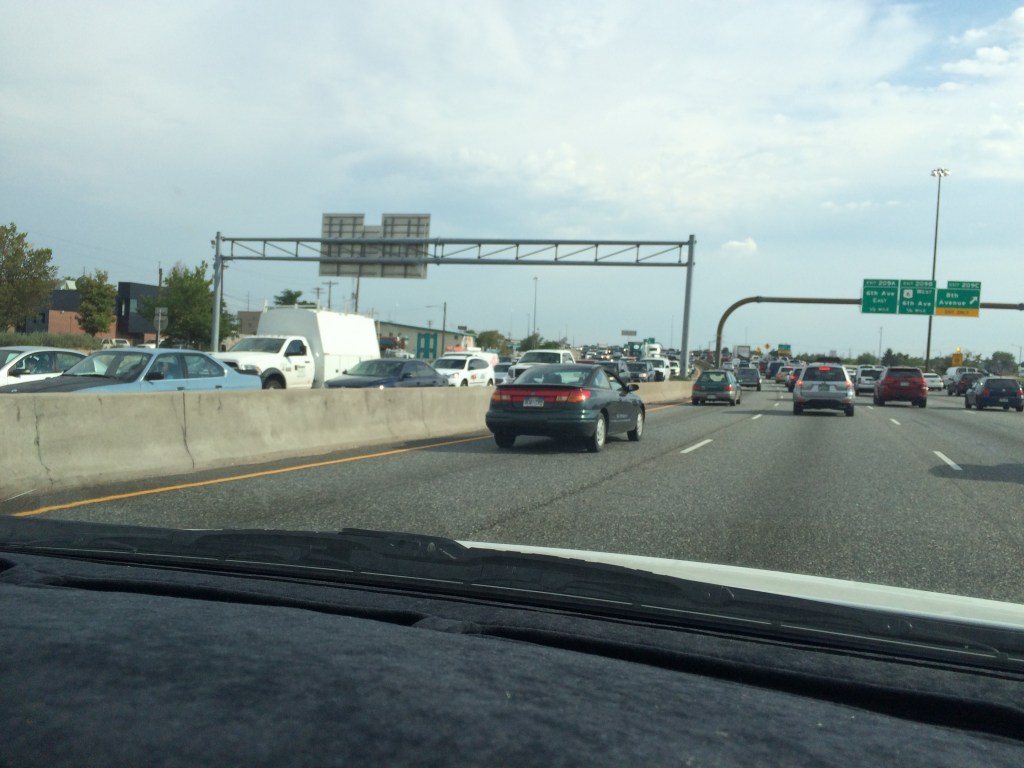
The worst part was seeing time slip away from us. We wouldn’t get to Trinidad before dark. I made the most of it by taking pictures, of course.
I had driven us to Fort Collins and then my husband manned the steering wheel, assuming he would take us all the way into Trinidad. He couldn’t do it. Sixty miles outside the town, the sun already set, he pulled over and we switched out. I’m not a fan of driving at night, especially when I don’t know where I am. It was very very dark along this part of I25 and all I could do was follow the red lights of the traffic in front of me. Finally, close to 9 pm, my husband woke from his much-needed nap and navigated me to the Holiday Inn. Once we were settled in our room, it was all I could do to take a shower and crawl into bed.
This particular Holiday Inn had a restaurant so the next morning we treated ourselves to a proper breakfast, our conversation peppered with promises to never drive I25 through Colorado ever again. We had a bit of time to spare before heading for Santa Fe, so we first took care of some personal business and then went on a drive through downtown. Yes, I wish I had taken pictures of what looked like 200-year-old buildings lining the main street. We were exploring but we were also on a mission. Greg wanted to wash the car. We found an old-time car wash … the kind where you plunk in change (only now you can use your credit car) and wield a hose and brush yourself. While he washed the car, I took the opportunity for a couple of photos.
Finally we were on our way to Santa Fe. I drove so I couldn’t take pictures but trust me when I say that this section of I25, between Trinidad and Santa Fe, was just beautiful. Clouds, clouds, clouds. I joked to Greg that he could spend the rest of his life just taking time-lapses of the clouds, they were so many and so varied. You could see dark storm clouds off in the distance to your left, and fluffy snow-white clouds on your right. The landscape was fairly green and vast.
For Santa Fe, we had decided to stay at an Airbnb. This is only the fourth time we’ve used Airbnb but each time has been a great experience. What I like best is that we’re able to stay in a neighborhood, be around residents, not just other tourists. It gives us a better feeling for what it might be like to live in the city we’re visiting. Plus, you can dine at home and save $$$$$$$$$$$$$$$$$$.
I had reserved the Sunny Adobe Casita for three nights. Within five minutes of looking around, Greg asked if we could possibly stay an extra night.
Unfortunately at the time, the Sunny Adobe Casita was already booked for the next two months so we couldn’t stay an extra night. Just as well since by the time we left we were planning a route home that would keep us north of Hurricane Harvey.
Next week I’ll wrap up my travelogue with our trip to the Georgia O’Keefe Museum and Hyde Memorial State Park for more clouds.
Thanks for stopping by!
Here is a powerful essay by an extraordinary woman. For any woman who lives with a scarred body, this essay is a must-read.
I’ve been revisiting my issues around my own scars, what they mean to me, what they say about me, how can I see them as beautiful since I have no choice but to live with them because they will never fade away. After reading Dana’s essay, I think I can now embrace them.
The first question on the intake questionnaire was, “Why have you decided to have boudoir portraits taken now?” My first thought was, Why has it taken me so long? After everything my body has been through, it is long overdue. I’m not getting any younger, after all. I’ve already begun to list the organs I have left that I am able to live without.
During my senior year in high school, I performed in a play of one-act monologues: Talking With, by Jane Martin. My monologue was called “Marks”. A woman, unmarked by life, is cut by a suitor in a parking lot. Surprisingly, her scar would bring confidence. So she began to wear her life upon her skin, tattoos for those who touched her. Little did I comprehend the prophetic nature of those words as I spoke them.
I want to celebrate the body I have today, battered and…
View original post 3,325 more words
If you’re new to my blog and want to know how this road trip began, click here for the first post. For our time in Casper, Wyoming, click here.
Now from where I left off last week, we still had a couple of days before the main event. Most of Sunday was spent doing a “dry” run. My husband set up the canopy and a couple of chairs. The eclipse takes a couple of hours from start to finish so you do need to have some shade and a place to set your bum.
The motel had a large gravel turnout for semi-trucks and that’s where my husband wanted to set up. In fact, he had scoped out the area on Google Earth weeks before we arrived. The primary concern was to make sure his Canon T3i and laptop were communicating. My husband is the “gear head” in the family. He brought his camera, laptop and solar telescope on this trip. Doesn’t sound like much until you factor in the tripods, lenses, and sundry other small and irreplaceable accessories. We had to attach a platform to our Prius, effectually extending our trunk, to accommodate his gear. In contrast: Just give me yarn and two wooden needles and I’m good :)

The dry run was successful and the rest of the day was quiet. We were conserving our energy. After an early dinner at a local (and really, really good) BBQ, we walked around a bit, trying to wind down so we might sleep. It was a lovely evening.
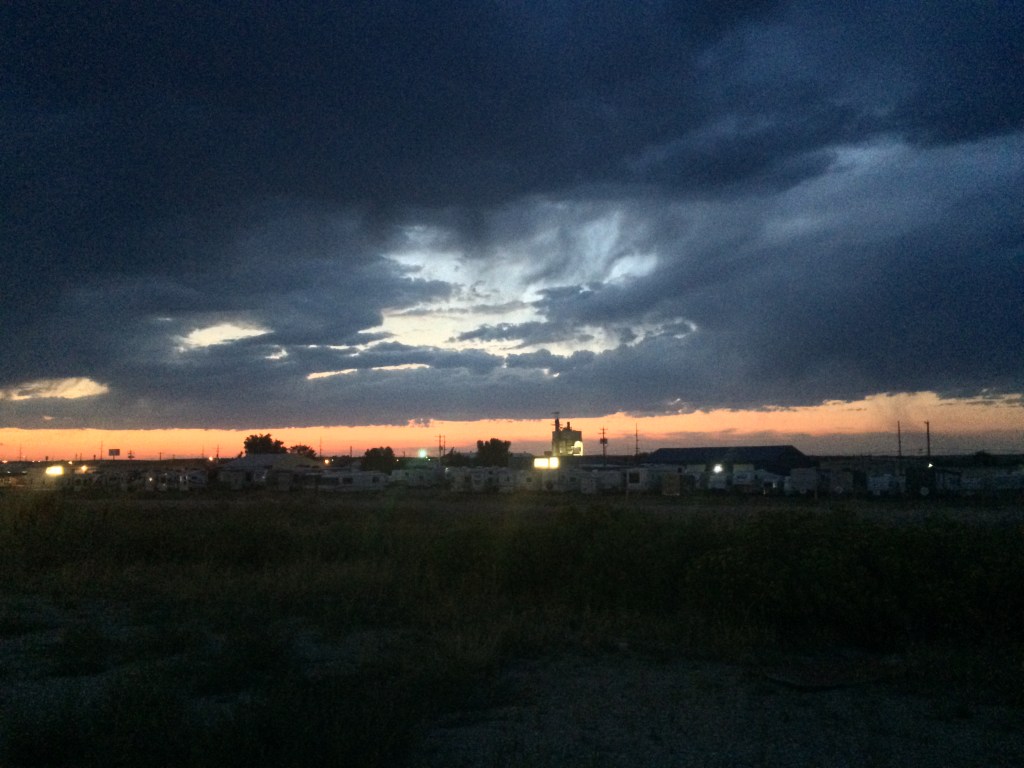
And then we saw that an RV had set up in the gravel turnout where my husband had been earlier that day. Dang! We were afraid of that and yet Greg hadn’t wanted to park the car out there too soon. Worried that other eclipse chasers might turn up in the wee hours of the morning and take all the good spots, Greg parked our car in the turnout, on the other side. At least it was still visible from our window.
The moon was scheduled to “kiss” the sun around 10:22 am and move across, with totality at about 11:43 am. We would have totality (the moon completely covering the sun) for about 2 minutes. Everyone at the motel was up early, in part because no one really slept, including us. We were all on pins and needles.
And then there were the newcomers. To our disappointment, a trio of young people from Colorado were parked right next to us. There was plenty of space still in the turnout, but, no, they had to park right next to us. They had only driven up to see the eclipse, to drink, smoke, whistle loudly, whoop and holler and make a general nuisance of themselves. The less said about them, the better.
Of course, I had to take a “before” picture.

Once the partial eclipse began, nothing else matter. I spent the next hour viewing the movement of the moon through my eclipse shades, a pair of solar binoculars, or the solar telescope. Although I don’t consider myself a gear head, I spent a lot of time looking through the solar telescope and trying to take pictures. The following is my favorite.

Up until totality, there was little evidence that anything extraordinary was happening. The sun was blindingly bright right until the moon snapped shut over it.

For the photo above, you’ll have to use your imagination because what I saw with my naked eye was a black disk ringed with white fire. That’s the best description I can give. It was the most beautiful sight ever in my life. I did get choked up. My eyes were wet but I didn’t cry. I didn’t want to miss anything. I only had two minutes to sear this image on my brain.
But I did take the time to look behind me and see … twilight.

Although the total eclipse lasted just over 2 minutes, it felt like 8 seconds. It was too soon when the first sliver of sun emerged and everything went back to normal. I can understand now why some people become eclipse chasers. Thankfully, because of Greg’s expertise, we will get to relive the experience over and over again. And this, dear friends, is what I saw with my naked eye …
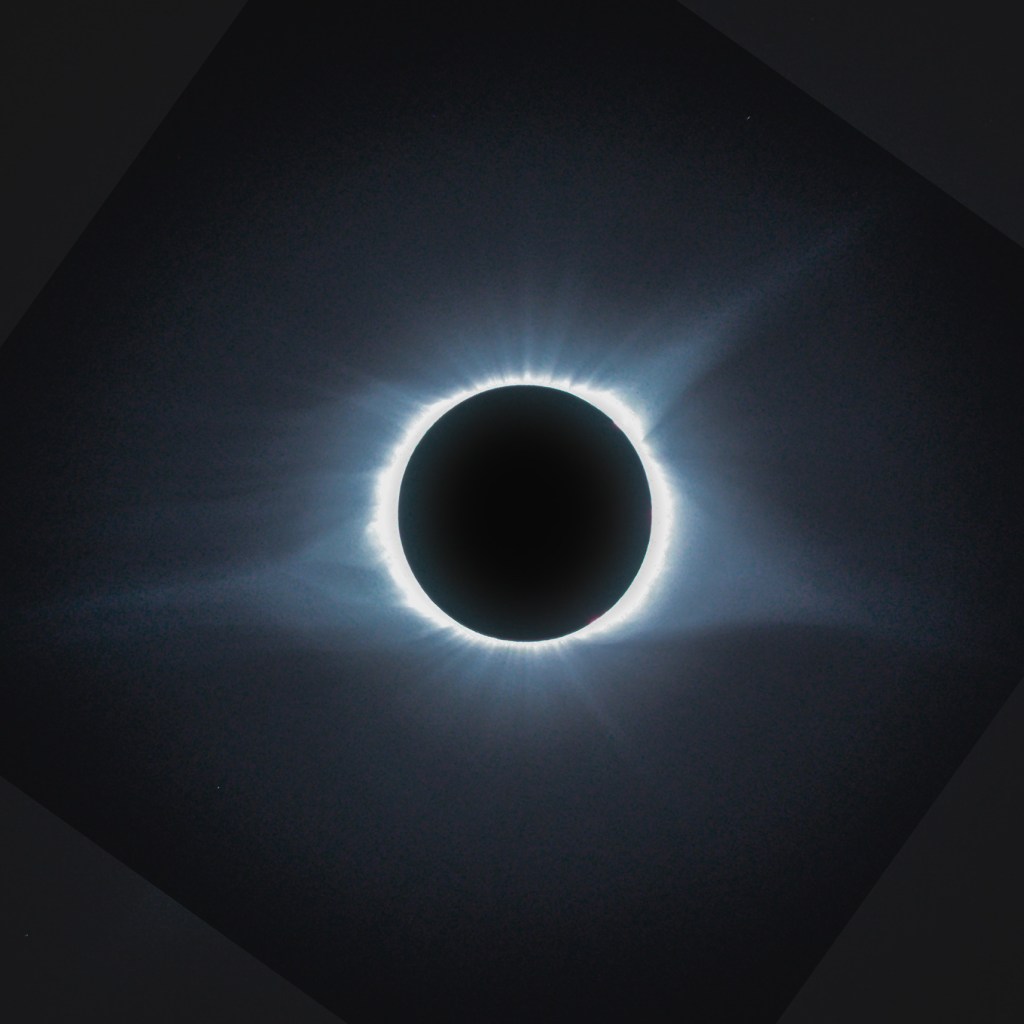
My husband is a perfectionist so it will be a long while before he’ll have the time lapse ready for viewing. But he is also playful …

Next up: the drive from Hell and on into Santa Fe, New Mexico!
If you’re new to my blog and want to know how this road trip began, click here for the first post.
We arrived in Evansville, WY, just outside Casper, in the evening, early enough to take a walk around and become oriented to our new “home” for the next few days. To our surprise and delight, we found a “rail trail” that would take us all the way into Casper. Following are some photos of the trail, overpass and tunnel.
Downtown Casper was pretty interesting. Well, this was just plain weird:

Although my husband doesn’t like to have his photo shared on social media, it was his idea to pose:

The Chamber of Commerce was one place we stopped to pick up maps and to gawk at this “water feature”:
Since the trail is about 2.9 miles one way, the next day we elected to walk into town, assuming we could find a bus back to Evansville. (Spoiler alert: we assumed wrong and wound up walking all the way back. Over 20,000 steps went on my Fitbit that day.)
We spent some time at the convention and then went searching for Hell’s Half Acre, a 320-acre geologic wonder of ravines and rock formations. We had seen pictures. We were prepared to be awed. It was only a 40-mile drive from Casper. We had snacks and water with us. And long underwear.
Hell’s Half Acre wasn’t hard to find. As we approached, to our left stood tall chain-linked and barbed wire fencing. Yup, the geologic wonder was not just closed but sealed off.
I should have taken out my iPhone and started snapping the fences that obstructed our view, but I was too upset. And my husband … more so. We had researched Hell’s Half Acre. We already knew the original diner and motel were no longer there. We already knew there would be no amenities. An aerial view on Google maps suggested that we should be able to view the rock formations and ravines. All we had wanted to do was park and film.
My husband found an opening in the fencing and decided to investigate, see if it would be worth dragging his gear through. I sat on a splintery post and wondered if we would be both charged with trepassing, or just Greg. I mean, there were no “No Trespassing Signs” to be seen. And we had come all the way from Florida so we could put the “duh” into Flori-duh if needed.
Greg came back, still angry but now resigned (to my relief) to the fact that the county meant to keep people out. There was nothing to be done but find the nearest supermarket, buy some wine, and drown our disappointment.
Since he failed to achieve the Holy Grail of a time lapse of the Milky Way over Hell’s Half Acre, the next day Greg decided that we would drive up to a scenic outlook on Casper Mountain Road. There he would film a time lapse of Casper as the sun set and city lights came on. Following are my humble iPhone photos and video.
Next week: the eclipse! Let’s hope I can show you more than just my humble iPhone renditions. (I keep telling my husband, the photos don’t have to be perfect … ).

I’ve been dipping into my indie catalog lately, featuring an excerpt from the books I’ve published since 2013. This week it’s Town Father‘s turn. This might well be the only historical fiction I ever write, unless you consider a novel set in the early 1970s to be historical fiction. Maybe so. But I had never […]


