The Knit-a-Thon has officially started. And two hours from now, I’ll be at a protest at my state capitol. Here’s more from me:
So my video might be kinda long (about 4 minutes) for WordPress so if you can’t view it … I’m just saying hello and thank you to everyone who has donated to my team of one for the Knit-a-Thon. Here’s more info if you missed it: https://givebutter.com/knitforfood25/marie-bailey/mariebailey
I show my progress on the three projects I’ll be knitting throughout the day. To be honest, not a lot of progress from my last WordPress post so if you can’t view the video, you’re not missing anything really.
You can also find me on Instagram (@marieannbailey57) and Facebook (https://facebook.com/marieannbailey). I HOPE to post pics during the day.
Again, many thanks to everyone who donated. I am planning on having a giveaway of one or all of my projects for those who donated. [The finished project has to pass my standards first.]
As I mentioned in my last post, I’m participating in a Knit for Food Knit-a-Thon on Saturday, April 5. The fundraiser will divide donations equally among four organizations: Feeding America, World Central Kitchen, No Kid Hungry, and Meals on Wheels. If you’re interested in donating, here’s the link: Knit for Food Knit-a-Thon 2025.
I’m a bit nervous since this will be my first time participating. I’m supposed to knit for 12 hours, generally 10 AM to 10 PM. It’s a honor system but, trust me, knitting for 12 hours is nothing to a lifelong knitter.
BUT.
April 5 is also the day when rallies are planned across the nation. You can learn more about that here. My husband wants to go. Two of our friends want to go. I should go. But I also committed myself to knit for charity.
So I’ve come up with three knitting projects so I can knit according to my environment. (Apologies for the poor quality of the photos. I have a learning curve when it comes other photographing indoors.)
The beginning of a watch cap in light olive.
The simplest project will be a watch cap in an overall knit 2, purl 2 rib. I’m using a design by Sandi Rosner, a knitter who also writes on Substack at A Good Yarn. [If you’re a knitter and a lover of books including audiobooks, I highly recommend Sandi’s newsletter. All her posts are free but I have a paid subscription because she offers detailed yarn reviews.] This is the kind of project I can easily do while distracted … like at a rally. Yes, I can knit standing up and no doubt I’ll probably squeeze in a few stitches while walking.
Multi-colored yarn that will be knit into a pair of socks.
The fabric in the photo above is what knitters call a swatch: usually a 6″x 6″ square knitted in either stockinette or a specific pattern with your preferred yarn and needles. The point of the swatch is to measure the number of stitches and rows per inch, or the gauge, and see if the results match the gauge of the pattern. I am the sort of knitter who tries to get around swatching, but in cases where fit is very important–for example, a sweater or a pair of socks–swatching is necessary. I haven’t measured the gauge of this piece yet, but I suspect it will tell me that I will need to use size 1 needles to knit the socks I have in mind.
The sock pattern is a simple rib stitch pattern, but with #1 needles and multicolored yarn, I need to pay attention to what I’m doing. I can watch TV more or less but I wouldn’t be comfortable taking this project to the rally. I have to be alert to any possible dropped stitches which, for me, are easy to miss when I’m knitting on such small needles.
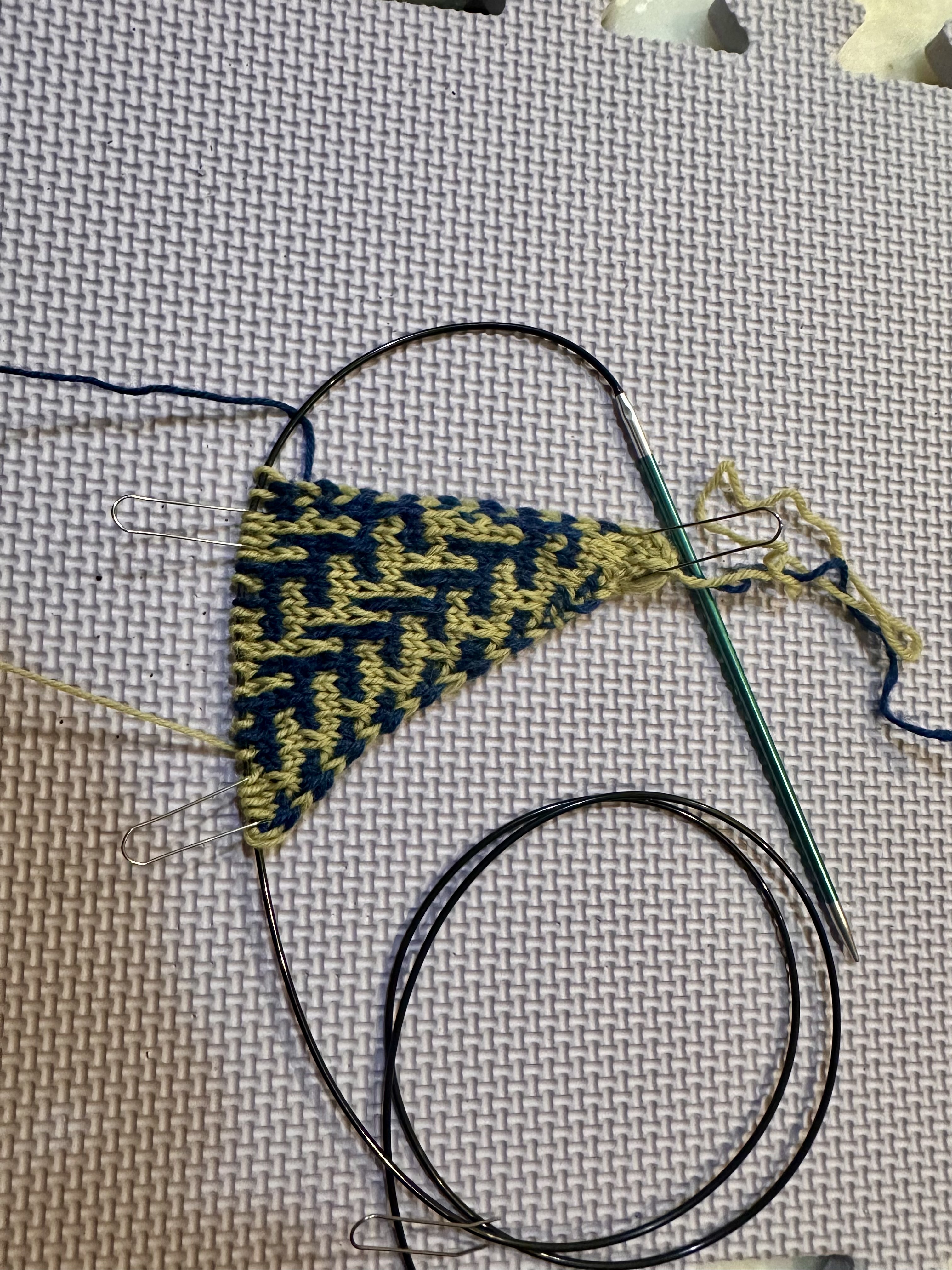
Just the tip of the iceberg that might become a shawl … or a scarf
My third project is a Pines and Needles Shawl. You can see some versions of the shawl here: Pines and Needles Shawl by Sweaterfreak. Now I didn’t knit a swatch for the shawl, but I did experiment with three different needle sizes before I decided on one that seemed to suit the yarn best. The thing, I’m not using yarn recommended by the designer. The yarn I’m using is finger-weight yarn, or yarn usually used for knitting socks, which is finer than the recommended yarn. So … I’m using a finer yarn and smallish needles (#3) which means I’ll likely wind up with a Pines and Needles scarf. I think I can live with that.
This project requires me to pay close attention. I’ve already had to rip out (or frog in knitters’ parlance) and start that little triangle over several times. Not the kind of project that I’d want to take to a rally.
So, there we are … or here I am. I am excited about knitting all day on April 5 and for a good cause, not just my own selfish pleasure in knitting. Meanwhile, evenings are getting warmer here in north Florida so Raji’s snuggling might soon come to an end, at least for the summer.
Friends, I thought long and hard about this. This morning, I decided that it’s something I simply have to do. I’ve signed up to knit for 12 hours on April 5, 2025, to raise funds for Feeding America, World Central Kitchen, No Kid Hungry, and Meals on Wheels.
Many of you know that knitting is my “happy place.” I can do other things like weave or write, but my deepest intrinsic satisfaction always comes with knitting. And that’s one reason why I haven’t been blogging very much. I’ve been knitting. Recently I completed the Elvan shawl that I wrote about here.
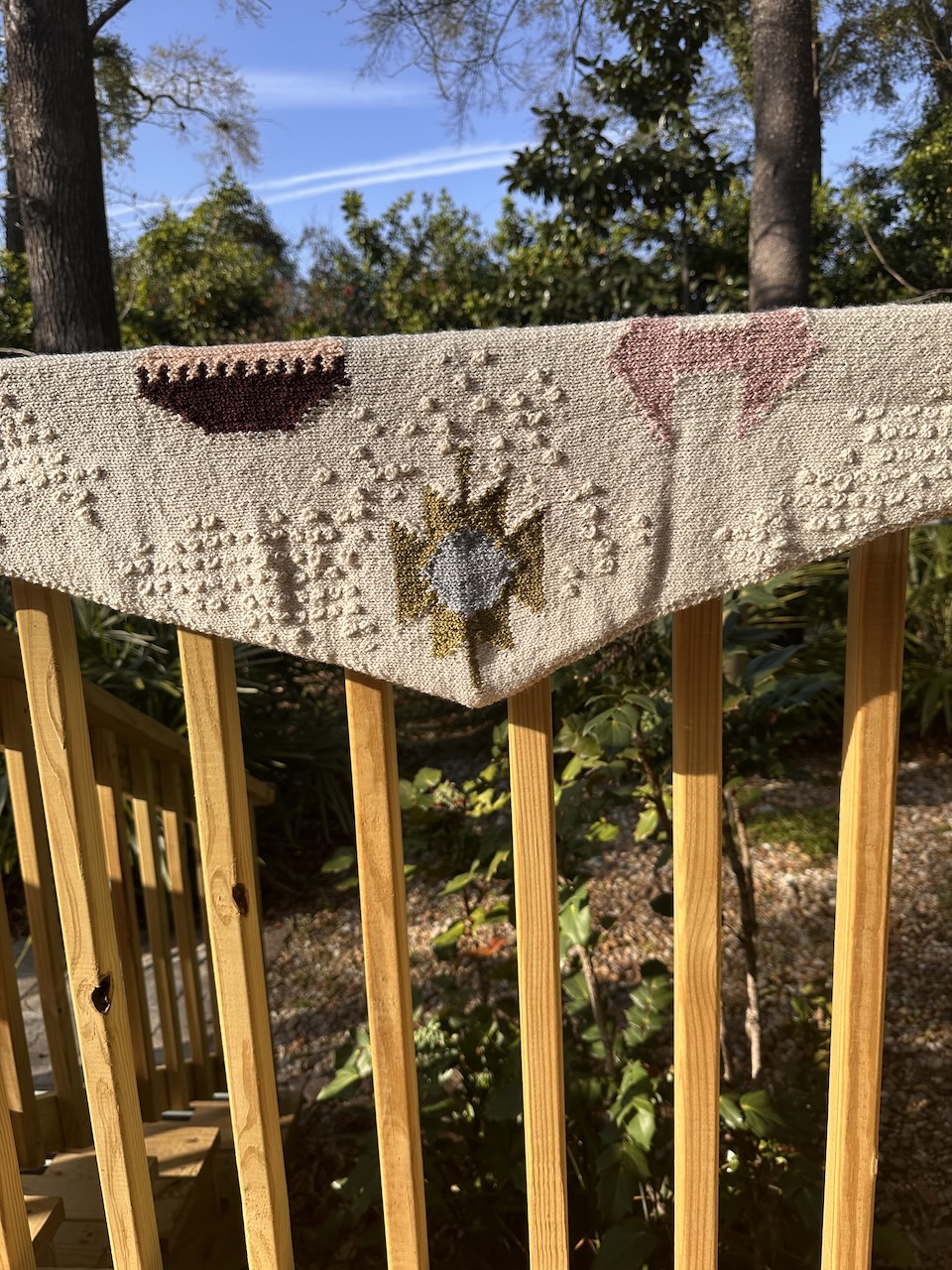
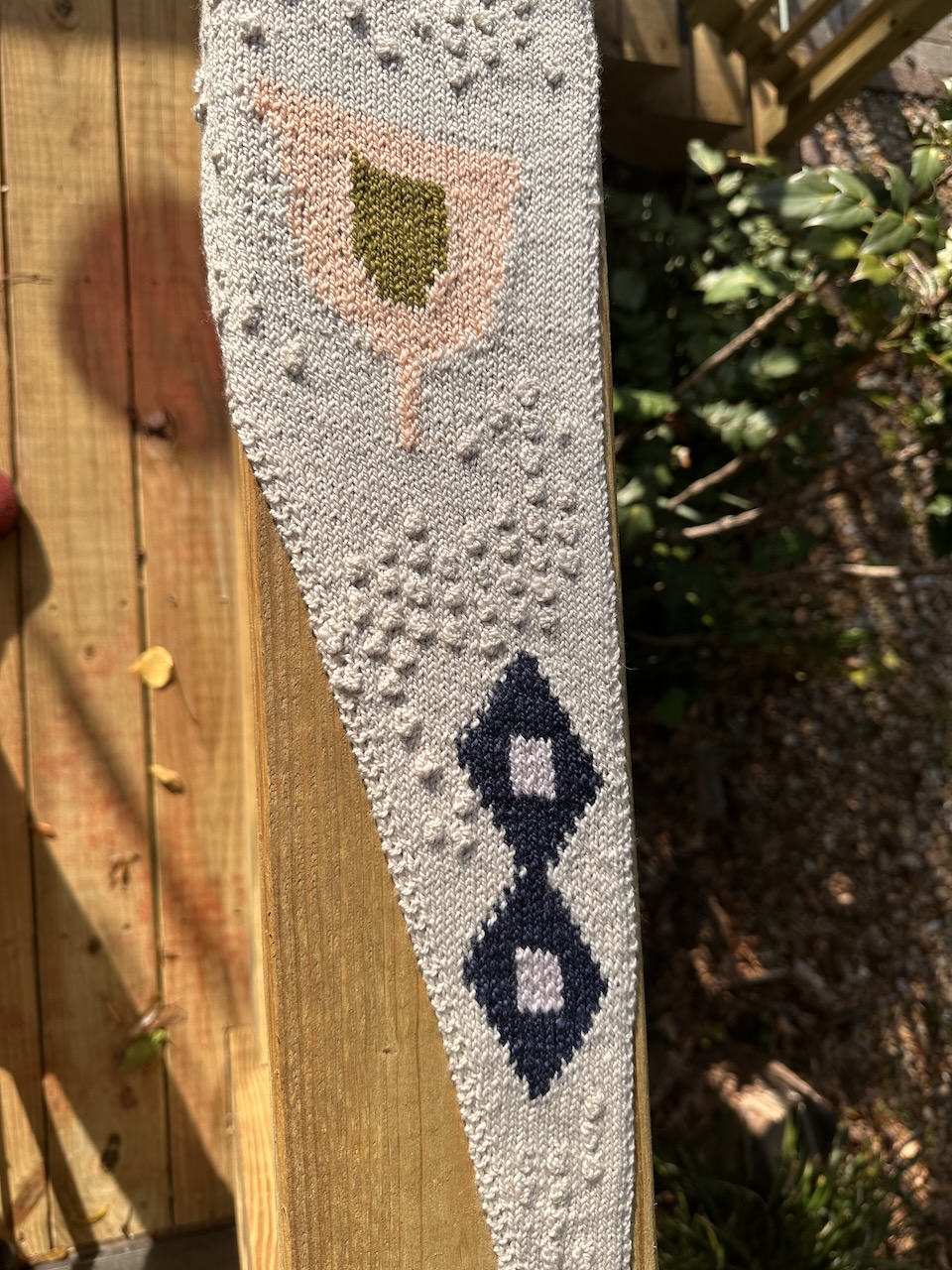
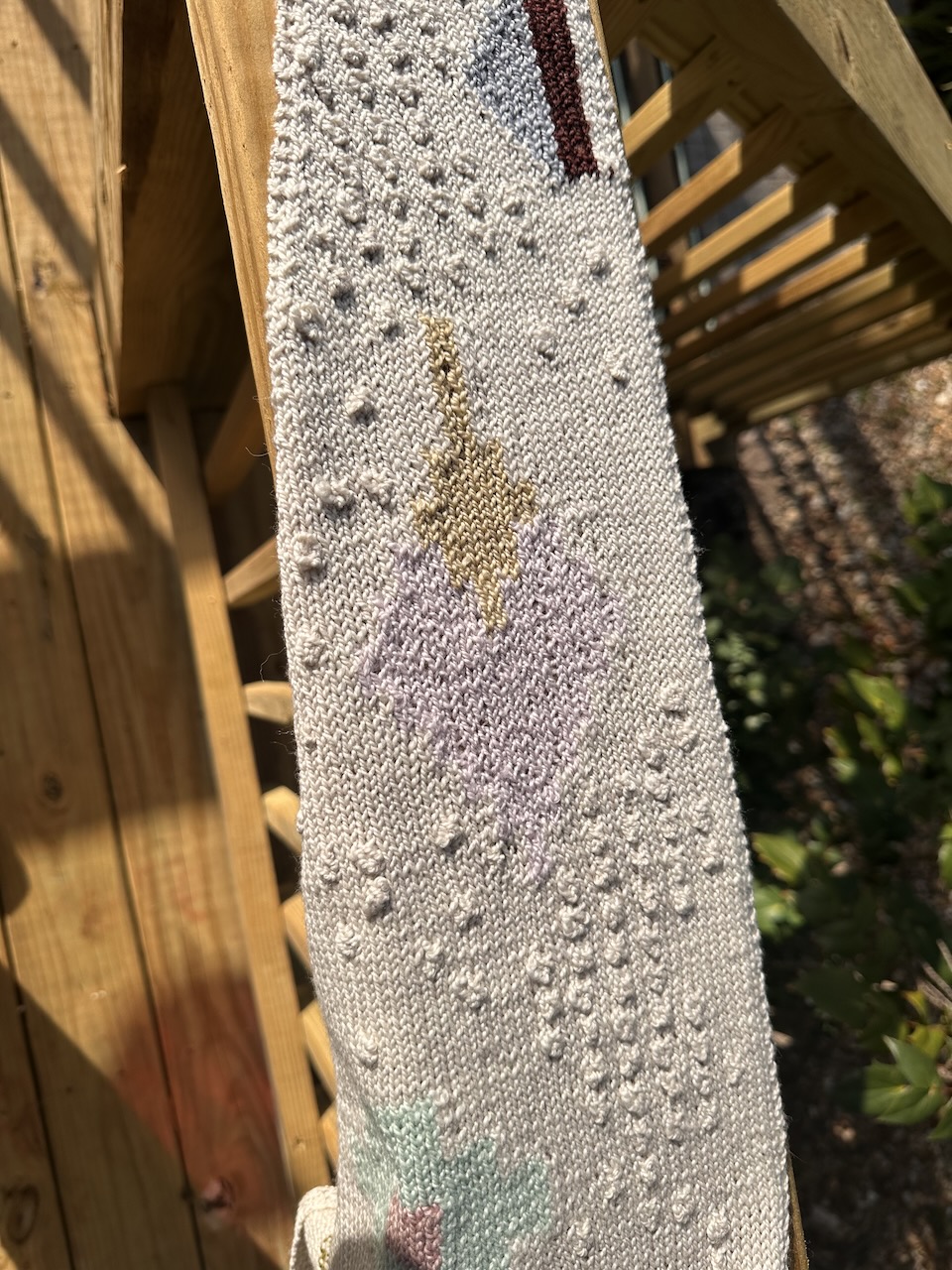
The first photo of the Elvan Shawl is from the designer, Florence Spurling. The others are my own photos showing more detail of the intarsia patterns. Generally, it was fun to knit, and the yarn was wonderful to work with.
After these photos were taken, I sent the shawl to a friend. This particular friend was someone I knew from high school, someone I had lost touch with until a few years ago when I heard that her mother had died from Covid. And then a couple of years later, she was diagnosed with cancer. Thankfully, she’s gone through her treatments and (so far, so good) has been doing well. I thought of her often while I was knitting the shawl, thinking of how sweet the soft wool yarn would feel against her skin.
She wrote to me when she received the shawl. She wrote all the words that makes a knitter’s heart sing.
And so I keep knitting.
For the Knit-a-Thon, I’m planning to knit socks. I have quite a stash of sock yarn, and socks can be done quickly. Plus, who doesn’t need socks?!
It is my deep pleasure to participate in the blog tour for John Howell’s latest novel, Detour on the Eternal Road. As John notes below, we’ve been blogging pals for over ten years. When I first met John, he quickly captured my heart with his wit, his kindness, and his great storytelling. I love seeing how successful he has been over the years. He is the hardest-working writer I know. His novels also have the best book covers. Over to you, John!
I am excited to be here with you today, Marie. You and I have been blogging for over ten years. I look back with fondness on the days when we spent more than a year writing the Top Ten lists for simultaneous publication on our separate blogs. You were always an inspiration and that continues today. Thank you for offering to host me on this stop on the tour. My latest book Detour on the Eternal Road is book threein the Eternal Road Series. Here is the blurb.
Blurb Sam and James are dragged into another strange assignment when a couple of souls on The Eternal Road drop off the radar. Archangel Michael gives them specific orders to resolve the issue and get Billy Ray Chitwood, the national race car champion, and Dale Earnhardt, his guide, back on the task of finding Billy’s Eternal Home.
Finally, meeting up with Billy Ray and Dale, the foursome finds themselves in the future where World War III has devastated the country. The team discovers the cause of the start of the war and vows to mitigate that circumstance and save the world from devastation. They encounter their old nemesis, Lucifer, who has in mind trading preventing the war in exchange for Sam accepting his offer to be his queen.
Since Lucifer’s offer is a non-starter, Sam and James must overcome Lucifer’s interference and work to change the course of history, or humankind is doomed.
Excerpt Wyatt stands by the reception desk and decides to pick up the bill himself and not bother the sheriff. Since they haven’t charged for breakfast, Wyatt assumes the old man hasn’t eaten this morning. After waiting a few minutes more, Wyatt becomes concerned that maybe the old man slept in. He heads up to the room and raps on the door.
Light shuffling follows his soft knocks on the wood. Finally, the door opens, and the old man seems ready to go.
“You had any breakfast?”
The old man pulls the door closed. “Yup, sure have.”
“Where did you eat? The bill didn’t show anything for breakfast.”
“Well, sir, I had this big ole steak for dinner and couldn’t finish it. Seemed a shame to waste good beef so I wrapped it in a napkin and had it this morning.”
Wyatt smiles at the resourcefulness of the old guy. “That would make a mighty fine breakfast for sure. So, you ready to get going?”
“I sure am, and I’m grateful for your help, what with your brothers shot ‘n all.”
“I’m always ready to help. Let’s go over to the livery and get the wagon.”
The old man nods, and Wyatt allows him to pass into the hallway. They leave the hotel and walk toward the livery—up the road and near the O.K. Corral. While walking, the old man asks, “How’d it feel to shoot the rustler?”
Wyatt explains, “I never enjoy killin’ a man, but when duty calls, I’m ready.” The old man nods and rubs his stubble.
Wyatt says, “Here we are.” He and the old man go into the business side of the livery. The horses stand hitched and ready, so Wyatt helps the old man onto the wagon. With a click of the tongue and a shake of the reins, the horses go at a slow walk out of the stable. “I took the liberty of packing lunch and water, given that your house is a far ways.”
“Again, I’m obliged to you, Wyatt. Not sure how I can repay your kindness.”
Bio John is an award-winning author who after an extensive business career began writing full time in 2012. His specialty is thriller fiction novels, but John also writes poetry and short stories. He has written seven other books that are on Amazon in paperback and Kindle editions.
John lives in Lakeway, Texas with his wife and their spoiled rescue pets.
Nature We rarely spend time on the east side of our house. Only a chain-linked fence separates us from our neighbors there, and they are on a higher elevation so we have no privacy if we are all out at the same time. Maybe not a problem; just an excuse. Still, we miss the wonder of our Camilla bushes when we neglect that side. One bush in particular gave a wonderful view of the cycle of Life, from one new bud to a spent bloom.
Snow To my utter shock, we had a couple of inches of snow in Tallahassee last week. Far less than other places (like New Orleans and Pensacola), but enough to surprise me. I’ve lived here since June 1990, and I can count on one hand the number of times it has snowed in Tallahassee. Usually we just have flurries and the snow melts as soon as it hits the ground. But this year was exceptional.
A panoramic view of our deck and back yard on early Wednesday morning.A view across our front yard.
As of this writing, we still have a bit of snow, or perhaps I should call it slush.
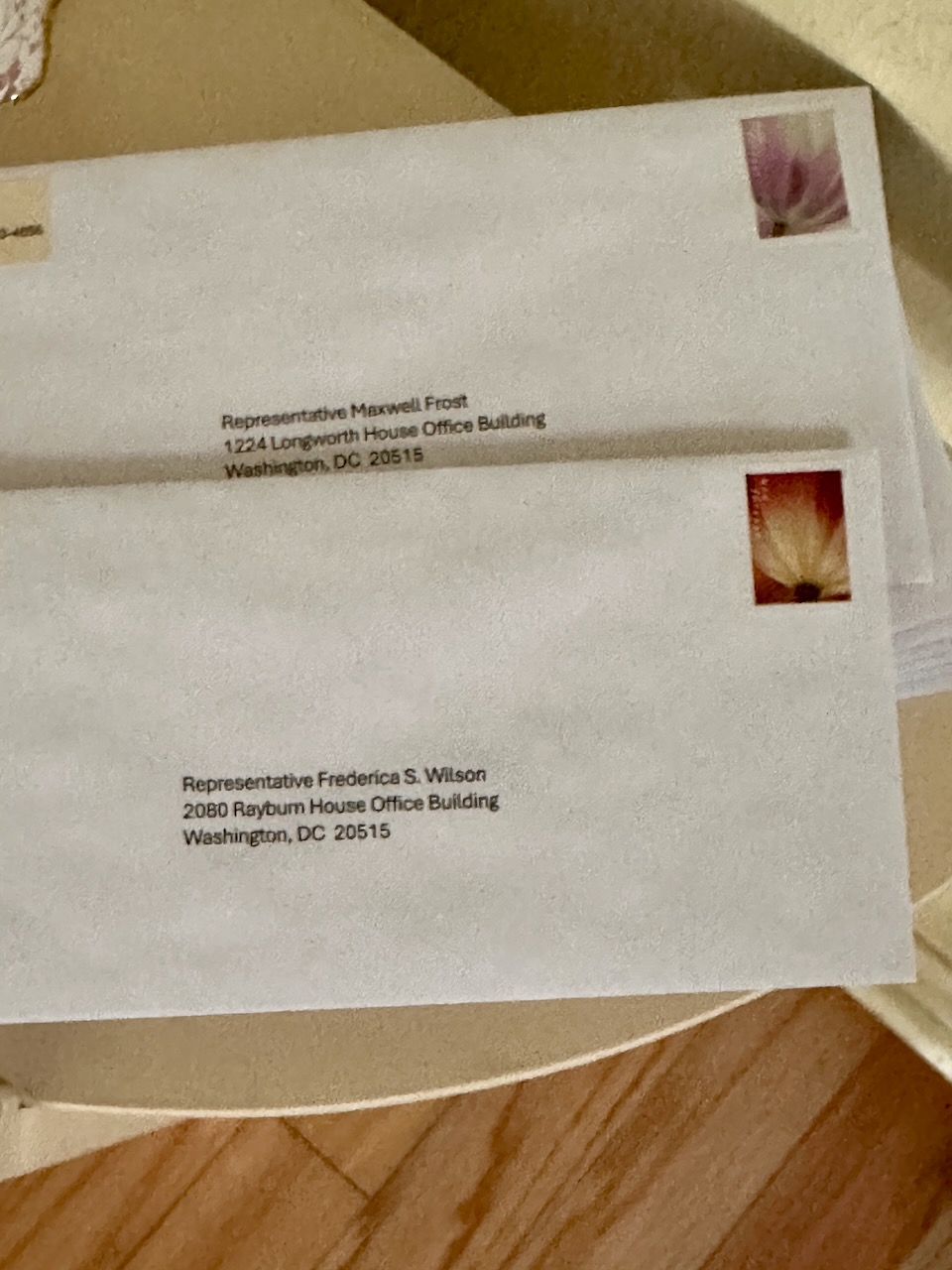
Writing Oh, I wish I could say I had started working on my novels, but alas, no. Instead I’ve been writing letters.
I may well be pissing in the wind, but given our current state of affairs, I have to do something … even if it’s just pissing in the wind. I am not limiting myself to only “my” Congressional Senators and Representative who are loyal to you-know-who. My attitude is that each Senator and Representative in Congress who is voting on bills that affect ALL Americans should listen to all Americans. I am being mindful to give praise when it’s due (hence the letters in the photo are to thank certain Florida Representatives for certain votes). But, yeah, when I see that a Democratic Senator voted for Kristi Noem, they’re going to hear from me.
So … letters and postcards for now. No novels.
Knitting Since I can knit or stitch while watching TV, I am doing that. No photos as yet. The shawl is finished but not yet blocked (i.e., washed). I signed up for a month-long knit-a-long which will start January 31. We are to knit a cardigan! One of my least favorite projects … lol. I’m hoping I can use up some of the stash that is threatening to break through my cedar chest. And maybe having a couple of Zoom sessions with a knitting expert will make the process less daunting.
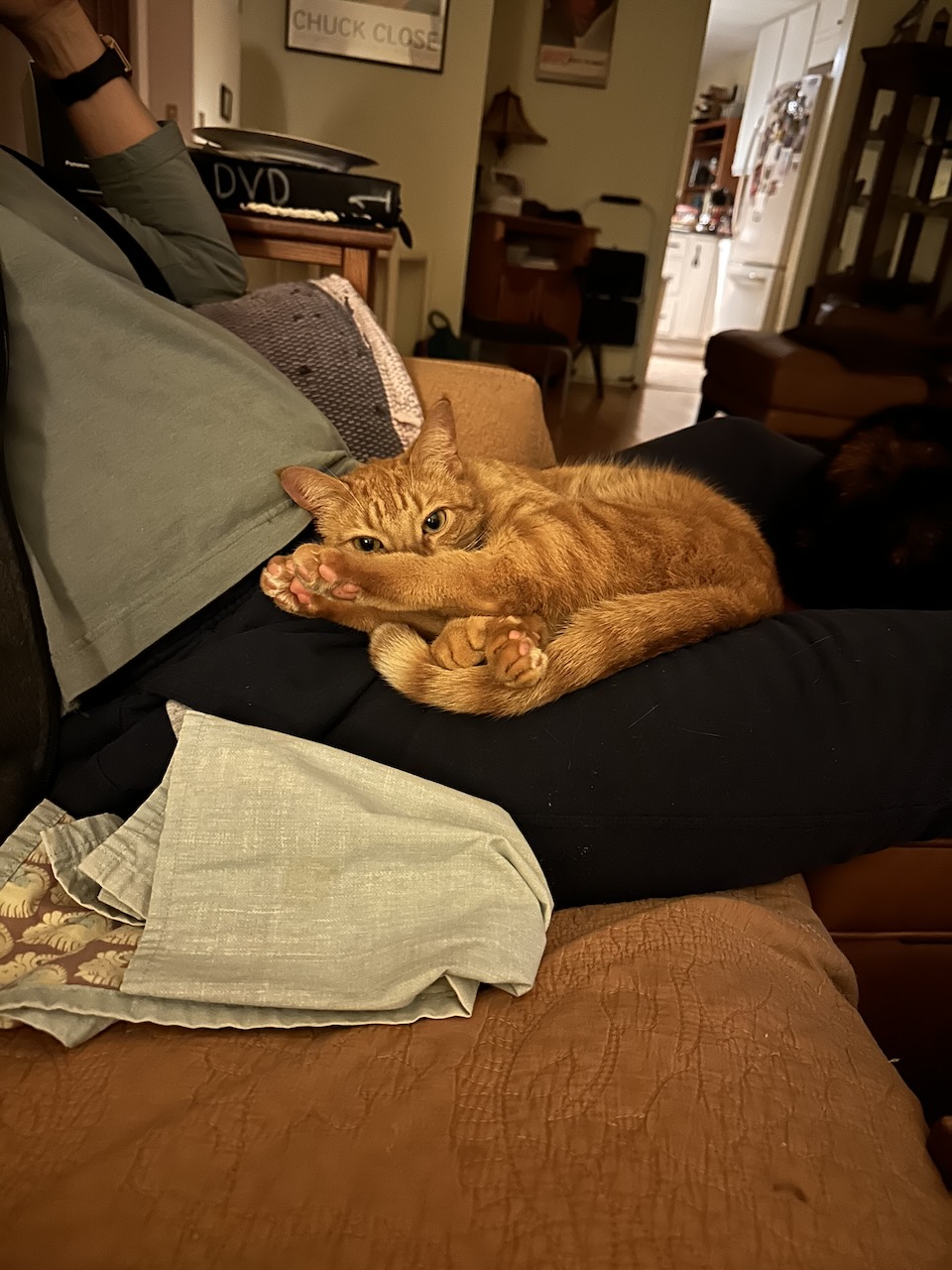
Cats Thanks to the colder-than-normal temperatures the last few weeks, Raji has officially become a SnuggleBunny!
Raji getting close and personal with Greg while he watches TV.
I doubt that he will continue with this behavior as temperatures warm but we’re enjoying this closeness while we can. Wendy often sleeps with me, but she doesn’t cuddle. No, she just curls up in the middle of the bed and expects me to work around her.
Thank you for reading! Tell me truly: Am I pissing in the wind?
Recently I began reading Jimmy Carter: River and Dreams by Jim Barger, Jr. and Dr. Carlton Hicks. It’s a wonderful book, and I’m learning a great deal about fly fishing although I don’t fish at all. I highly recommend this book of remembrances and reflections, considerations of faith and duty.
I thought of you when I read this passage by Dr. Hicks:
[…] I’ve often thought about how religion is used to justify much of the evil and cruelty that plagues our world, even as it serves as a source of great comfort, love, and compassion for many people like the Carters. Most of the people I grew up with practiced some form of Christianity, and I have seen over my lifetime many self-described Christians not only fail to love their neighbors but also choose to treat others with contempt and hatred. As for the Christian ideal of loving one’s enemies? Well, that seems to me to a completely foreign concept to so many who claim to follow the teachings of Jesus. It never ceases to amaze me how the very same religion can prompt some people to act out of fear and hatred and conversely prompt other people, like the Carters, to act out of courage and love. [pp.62-63]
I thought of you, Mr. Speaker, because while you claim you are a Christian, you do not act like one. In fact, your actions often contradict the faith that you claim. For example, on your official Congressional website, under Issues, Human Dignity, a summary statement begins with:
Because all men are created equal and in the image of God, every human life has inestimable dignity and value, and every person should be measured only by the content of their character.
Firstly, “all people” rather than “all men” would be more appropriate here, as you well know. That you’ve taken actions to deny women’s autonomy, in particular reproductive autonomy, reveals that your choice of the word men is meaningful.
Secondly, your disdain for immigrants, your desire to have families torn apart and deported, and your preference to round up human beings and keep them in cages rather than allow them the dignity to work and contribute to society give the lie to your statement that every human life has inestimable dignity and value.
As well as your claim of Christianity, your hypocrisy is shown by the following statement and your actions that contradict it:
In America, everyone who plays by the rules should get a fair shot.
Mr. Speaker:
You have shamelessly supported a convicted felon for President of the United States.
You have shamelessly courted a man who has, just as shamelessly, broken every rule to get what he wants, never mind who gets hurt in the process.
You have shamelessly embraced a man who has mocked people with disabilities, sexually preyed on women, and suggested that people born with birth defects–even ones in his own family–should just be left to die rather than receive life-sustaining treatment.
You have shamelessly encouraged the advancement of a man who has referred to U.S. soldiers who were held as Prisoners of War or injured during service losers.
Mr. Speaker, you fool no one. Christians who believe as the Carters believed see right through you. You might feel that you’ve won this round, but the fight for Democracy is not over. It will never be over as long as there are agents like yourself who seek to establish an autocratic theocracy, restricting our inalienable rights until we are no more free than those living under the Taliban.
Those of us who truly believe in Democracy, who truly believe in the dignity and value of all human beings, will never give up.
Although it’s not my first Christmas without my mom and sisters, I felt their absence more keenly this year. Especially the absence of my sister Shirley since Christmas was her favorite holiday. I still remember the utter shock on her face when, years ago, I said that my husband and I had stopped exchanging gifts. I barely managed to stifle a laugh at her reaction.
I do give gifts to my family, but I expect and ask for nothing in return. The gift is in the giving, as they say. But this year, I received a very special gift.
Front cover of the photo book.
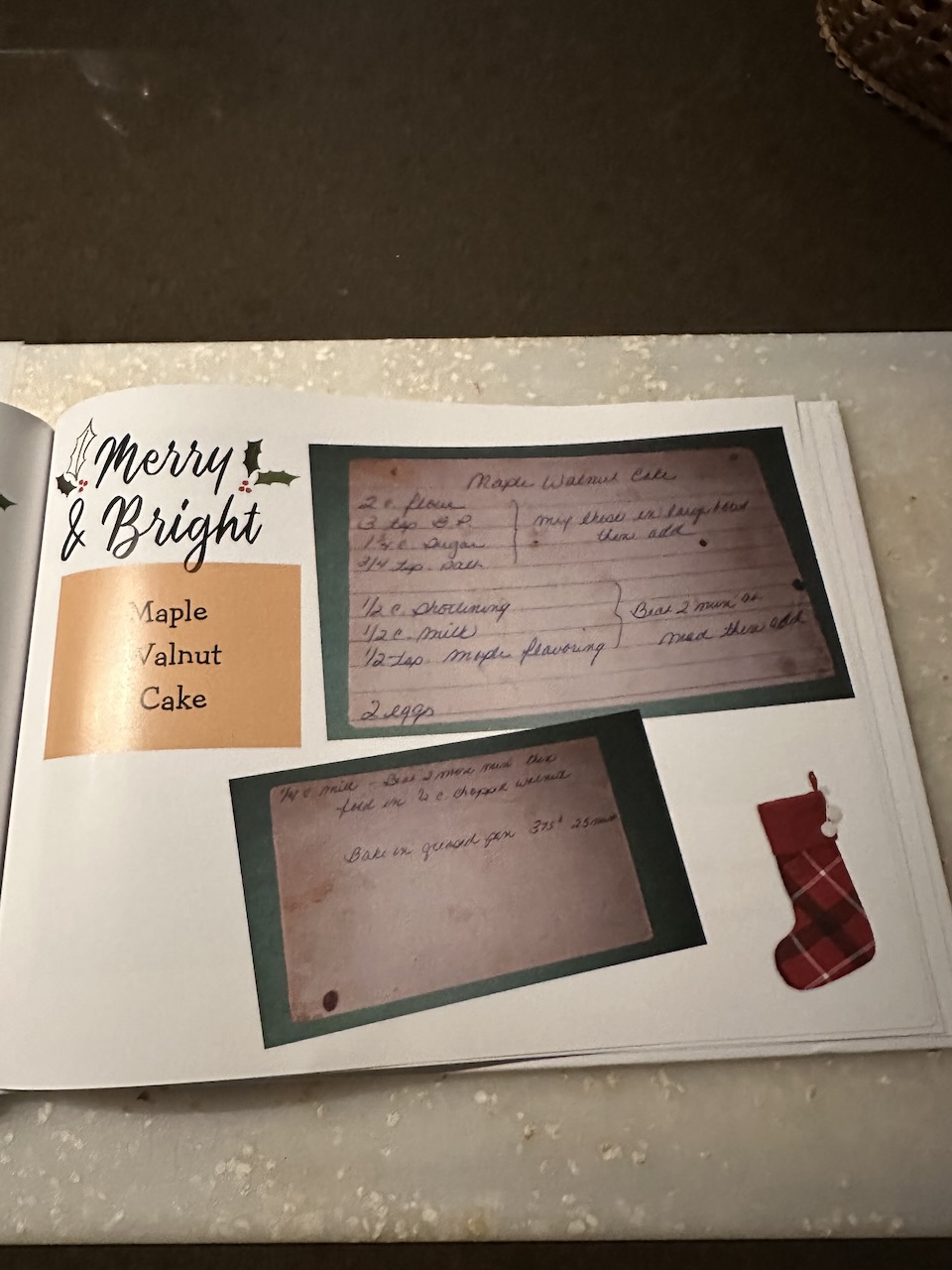
Inside this book are copies of my sister’s recipes for cookies and cakes.
I can’t express how it felt to see her handwriting, the old recipe cards with smudges and stains from frequent use. I can only say that it was a lovely gift to receive at the close of this year and one that I will always cherish.
Writing
I don’t make New Year’s resolutions. I don’t make goals anymore. I often have tasks related to housekeeping, doctor’s appointments, grocery shopping, but they are not the sum of my days.
Still. I do want to renew my focus on writing. I have four unfinished novels. Three of the novels are a kind of trilogy as they share the same characters. One is a standalone. All were first drafted during a National Novel Writing Month. I want to finish them. Get them done. I don’t want to write anything “new” until they are out into the world. I haven’t set a way for publishing them yet (all of them need considerable editing first) but I’m not in this for the money. As I did with my short story Love Me Tender, I might produce the novels using Bookfunnel and Lulu.
Nature
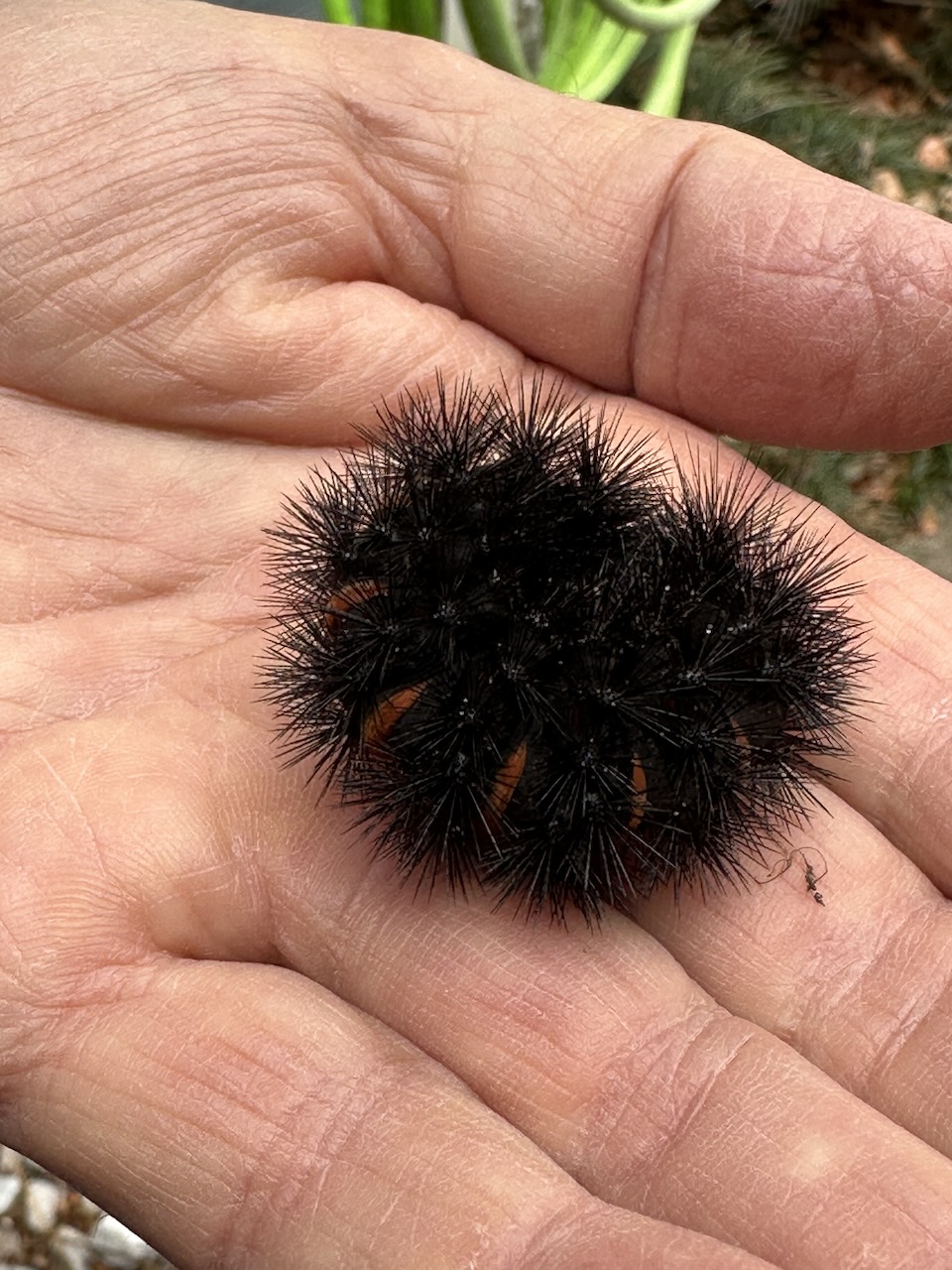
I’m continually surprised by what I sometimes literally unearth on our property. While weeding around the tendrils of our strawberry plant, I found this little critter.
Wooly bully
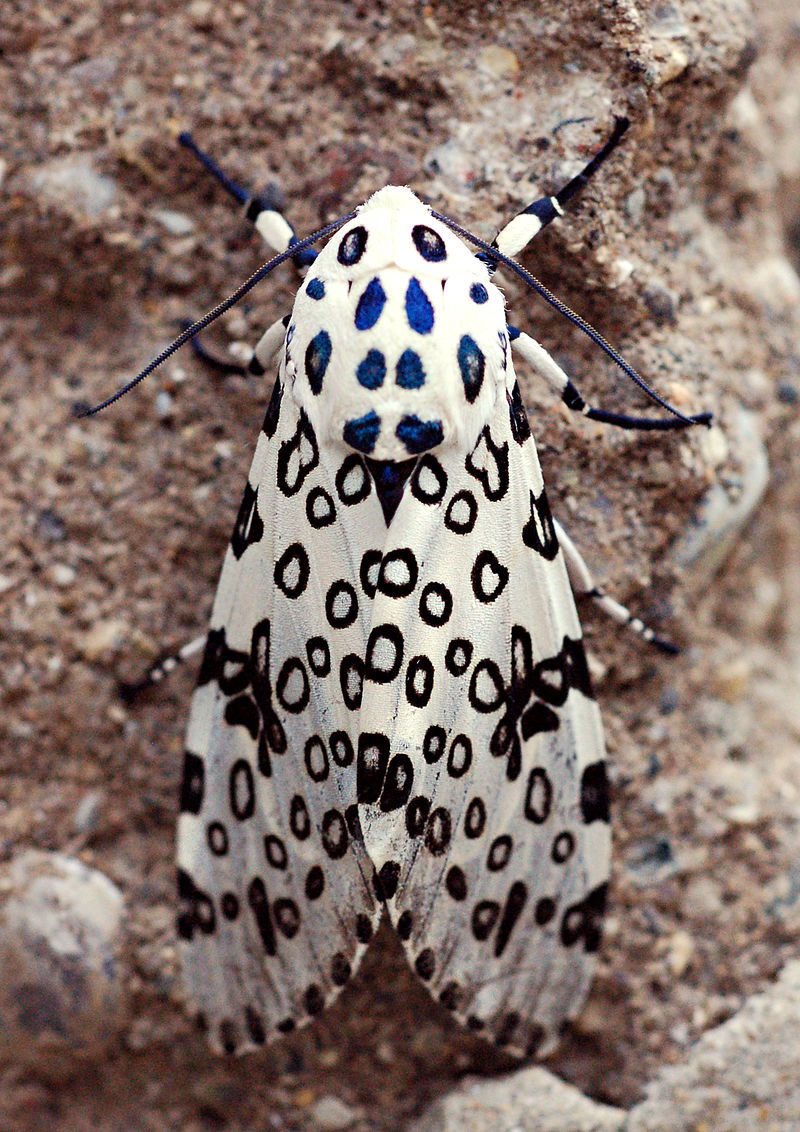
At first I thought it was a wooly seed of some kind. Further investigation through my iSeek app revealed that it was a caterpillar curled up in defensive mode. If all goes well, it will eventually morph into a Giant Leopard Moth.
While I contemplate renewing my focus on writing–that is, finishing my novels–I’ve been knitting. In early November I started knitting an intarsia shawl. Kind of like painting but with yarn. The shawl is still in progress but I wanted to share a couple of photos.
While intarsia isn’t difficult, the changing shapes and colors can be a challenge.
Here’s what the finished shawl should look like when completed.
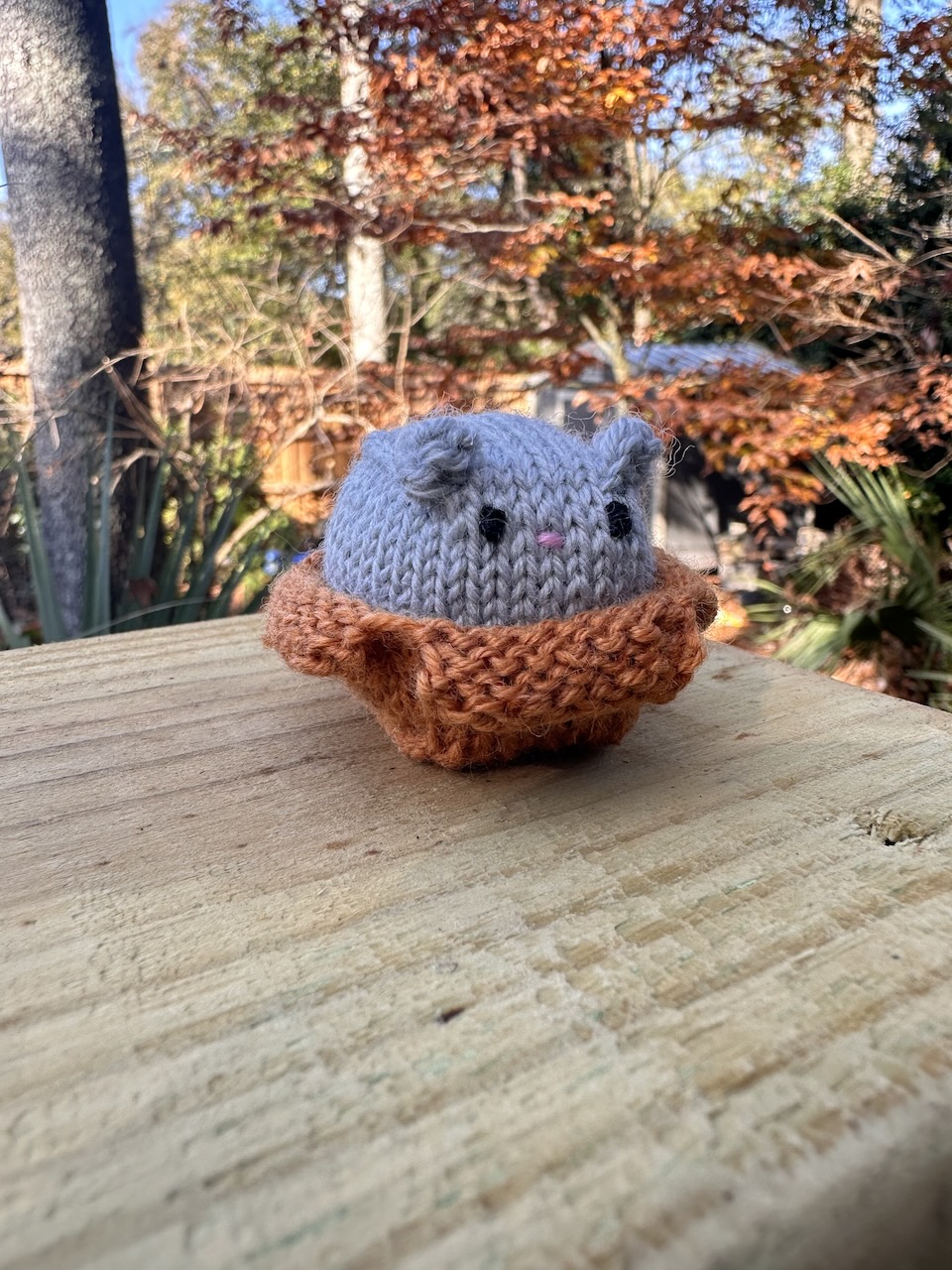
I don’t work on this shawl every day. What I like least about knitting is the finishing process (well, I guess that’s true with almost everything I do) so, as with writing, I procrastinate. One afternoon I procrastinated by taking a virtual workshop on knitting little cats.
This is supposed to be a cat in a box but with the edges curled under, I think the box looks more like a bed. And I like it like that.
Which leads me to my fifth thing at the end of 2024.
Cats
Wendy isn’t so much reaching out to touch Raji as she is letting him know that he better not get any closer to her.
Thank you for reading. I hope you all have (or had) a Happy New Year. Here in the U.S., some of us feel dread as we begin 2025. I hope it’s many of us feeling that dread because we’ll need a lot of us to show up in 2026 and vote out the authoritarians and broligarchs and vote in Democracy. We won’t be alone. We’ll have lawyers: Democracy2025.
As one of my favorite lawyers, Joyce White Vance, would say, “We’re in this together.”
In her Author’s Note, Casey Mulligan Walsh begins her tough, bittersweet and unflinching memoir with this quote from Barbara Kingsolver.
Memory is a complicated thing, a relative to truth, but not its twin.
Casey notes that The Full Catastrophe is “a true story to the best of my recollection.” And a reader cannot expect better than that. Some writers of memoir will ask family members or friends to fact-check their memories, but I’ve often thought of memoir as a window into one person’s perception of their life and take it as such. It’s not autobiography. It’s that person’s truth, the essence, of what they remember.
What impressed me more than anything while reading this book was Casey’s seeming determination to not whitewash her story, to not spare herself any blame criticism in how her life turned out.
I started to use the word blame but that wouldn’t have been fair. Casey turns a critical eye on herself, but in such a way that allows her to rise above where she feels she might have gone wrong. Hers is a story of how the best of intentions can lead one astray and how being honest with oneself can save a life (hers) and a family.
Determination, I see now, is not always a positive quality. It can spur you to great things. It can also make you blind, unable to see when enough is simply enough.
When still a young girl, both of Casey’s parents died. Several years later, her only sibling–a beloved brother–also died, leaving Casey alone and adrift in an unfriendly world. She was placed with relatives who weren’t shy about showing her their displeasure in having to be responsible for her.
In such an environment, it’s easy to imagine any young woman jumping at the first chance to leave. In this case, that chance was an ill-fated marriage.
All Casey wanted was to feel safe in the world and to shower love on a family of her making. She really wasn’t asking for much, not considering how hard she was willing to work for what she believed in. Unfortunately, she and her husband were a “mismatched pair.” Later Casey also learns that his parents (who she had believed accepted her as much as they would their own daughter) were perhaps her greatest enemies, siding with her husband during their separation and subsequent divorce, and coming between Casey and her children.
It’s not enough that Casey struggles to keep together the family she always wanted. Two of her three children, her first-born son and then her daughter, are born with a genetic condition, a form of high cholesterol called familial hypercholesterolemia (FH). Can you imagine the worry, the fear for your children, knowing they have a condition that can lead to a premature death?
As Casey’s marriage deteriorates, she becomes more controlling of her children and her husband. She admits this. In the context of her children’s health, it makes sense. In the context of all her losses, the deaths of her parents, her brother, other family members and friends, it makes sense. In the context of her husband’s drinking and combativeness, it makes sense. Her world was falling apart, and she was desperate to keep it together. As anyone would be.
And then her oldest son dies. Not from FH as Casey feared, but from something so random and so common as a car accident. Casey holds it together until she can’t. She finds comfort and strength in the outpouring of love and support she and her family receive, but then dissolves in tears at the end of TV news story about Eric.
The Full Catastrophe is a story of love and loss, the devastating grief of losing a child, the determination to make a family, to make a home. All along I was taken with Casey’s resolve to do the right thing by her children, sometimes to the point of seeming to turn them against her. Tough love, you might call it, but love nonetheless.
I often thought of my mother as I read Casey’s memoir, recalling how my mom tried to protect me from the big, bad world, how her efforts to protect me drove me away from her. I wondered if at times she too blamed herself for her children’s failures. I can only hope that, like Casey, she came to realize that she had done the best she could have done given her circumstances and that her love would ultimately bring me back to her.
The following quote from The Full Catastrophe is one that I keep nearby, a reminder that while death is inevitable, love never dies:
Just in time, I understood our connection to those we love doesn’t end with death, that nothing can separate us unless we choose to walk away. That it will all be over so soon for all of us, and what’s important is what we do while we’re here.
I highly recommend The Full Catastrophe for all readers, but especially those interested in memoir and who may be experiencing their own never-ending grief.
All orders placed at Battenkill Books will be fulfilled with a signed copy.
To further entice you into preordering, Casey has some bonuses for you! After you’ve ordered, head over to her website at https://caseymulliganwalsh.com/preorder-the-full-catastrophe-now/. Scroll down to the preorder form and provide your name, email, order number, and supplier. Hit submit and you’ll receive the link to three preorder bonuses:
Five Ways to Support Those Who Grieve, a concise sheet with advice about ways to support grievers when you struggle, as we all do, with ideas of what to do or say, and a list of supportive podcasts, books, and websites
The Full Catastrophe Spotify playlist—hours of music that became the soundtrack for the life Casey lived, then captured in her memoir
Finally, a link to an ask-Casey-anything zoom call/celebration on launch day, February 18, 2025 (time TBD).
(If you plan to order from Amazon on launch date, just enter “00000” in the order # space on the form, and you’ll receive these bonuses as well.)
I’ve been a bit “out of it” lately due to world events and general procrastination. I keep meaning to get back into the swing of things so when I (finally) sat down to catch up with my online community, I came across this Lens-Artist Challenge is hosted by Leya. She encourages us to share what makes us smile. For some, smiles these days might be hard to come by so this is a particularly timely challenge.
What makes me smile? Here’s a few:
Nature
Whether it’s an Eastern Carpenter Bee getting up close and personal with Kay’s Pink Roses (photo featured above) …
Or the tell-tale sign of a raccoon visiting our campsite at night …
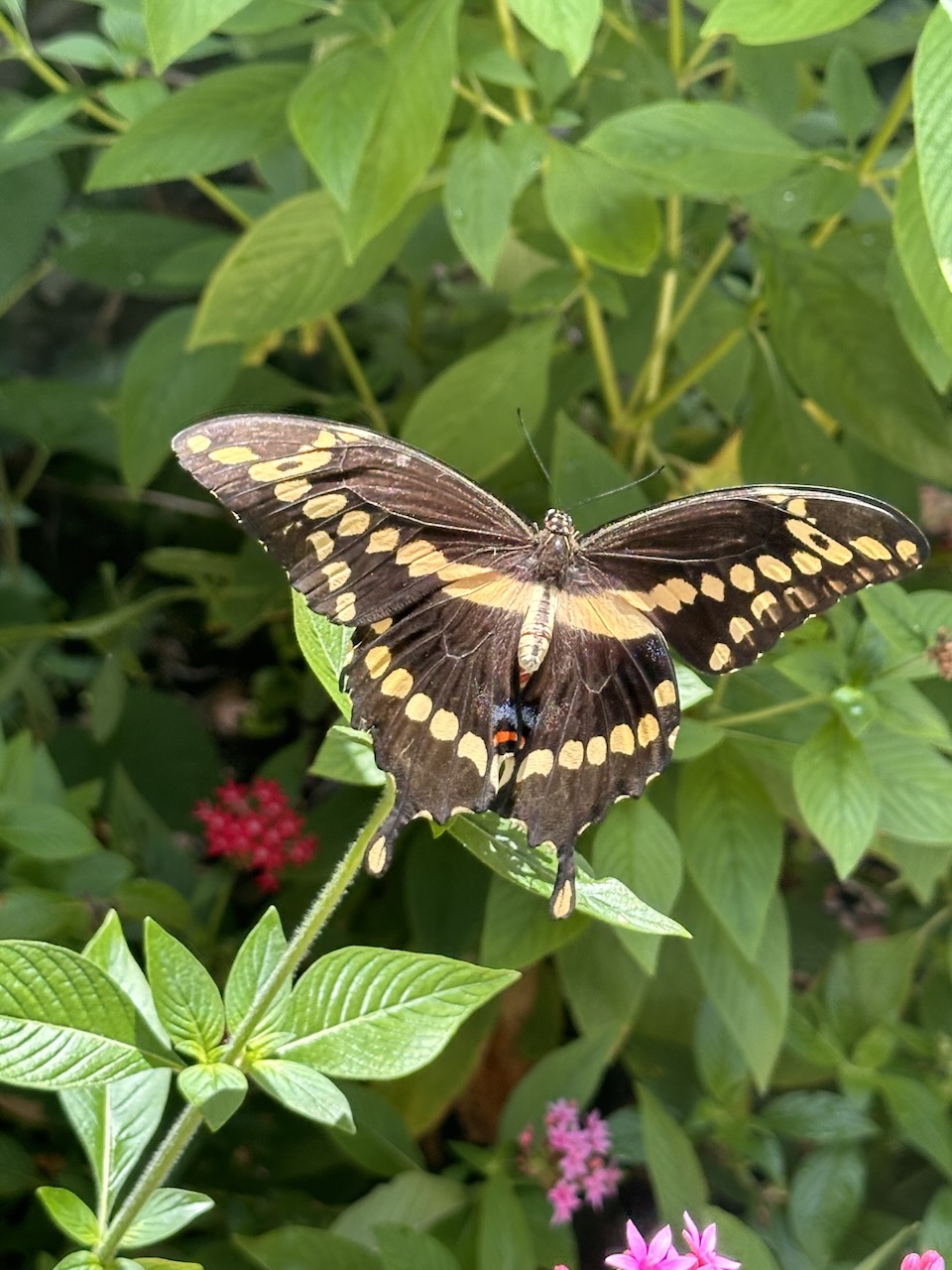
Or a swallowtail butterfly feasting on penta blooms …
Or a praying mantis praying that it is blending in …
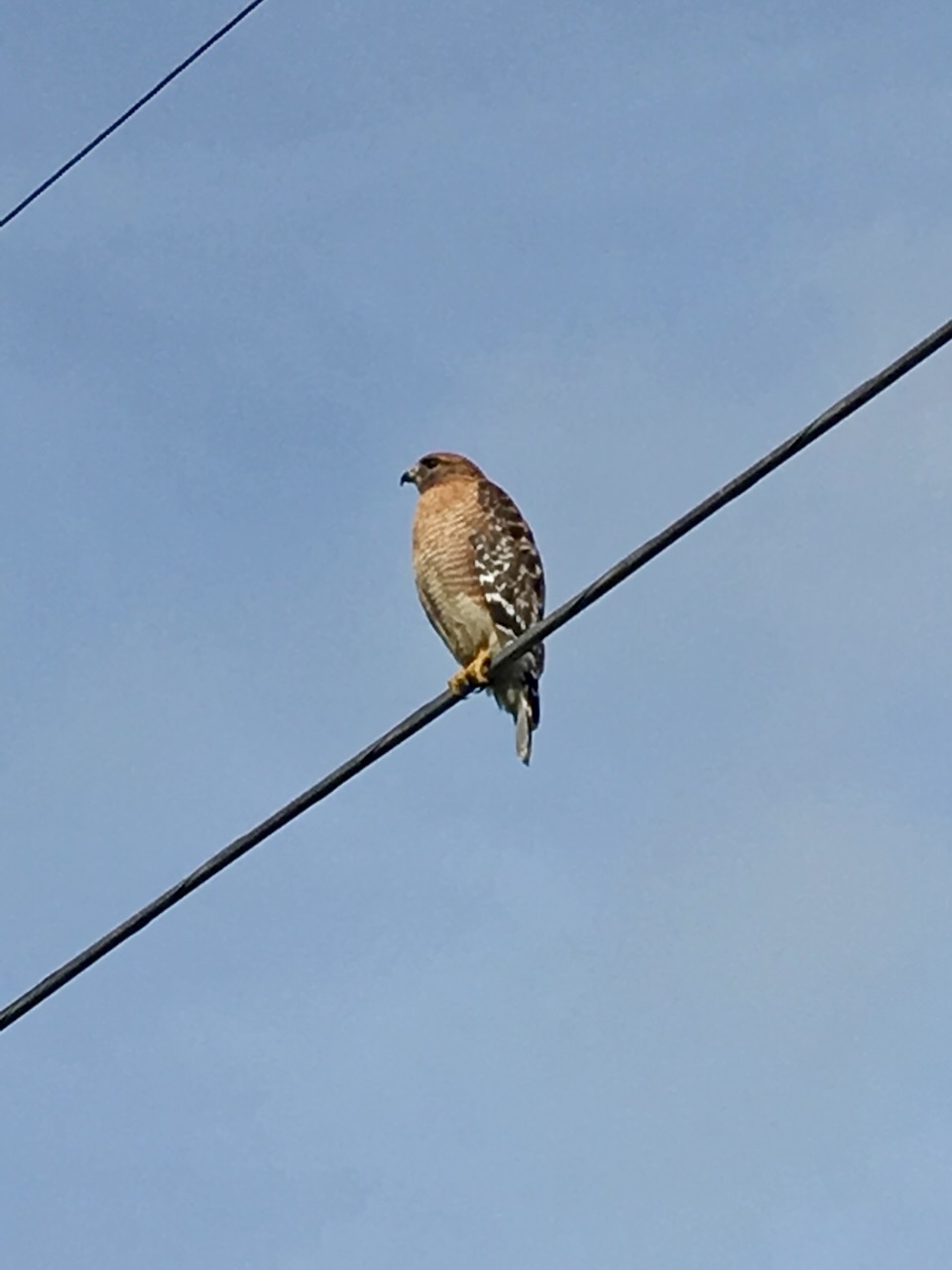
Or an red-tailed hawk just hanging out in the ‘hood …
Or a momma gator and her baby.
Sometimes Art makes me smile …
Sonic Blooms, Seattle, Washington, 2014
From the exhibit: Created by Seattle-based artist Dan Corson in a collaboration between Pacific Science Center and Seattle City Light, these sun loving, harmonic blooms use regionally manufactured, custom solar panels to generate their own power. Each flower top contains 48 solar cells that produce 4.6 Wp (watts at peak production) for a total of 1,104 Wp for all 5 flowers.
The electricity generated will make the flowers dance with light through the evening and sing through the day, 365 days of the year. Sonic Bloom combines art and science to help educate about solar energy in the Pacific Northwest and inspire people to consider how they can incorporate renewable energy into their lives.
Especially funny signs or photos …
A bigger smile from me when they refer to knitting …
What makes me smile the most? Cats, always the cats …
Junior (RIP) and Maxine (RIP) staking out their territory on my husband. Wendy and Raji zonked out in the sun.
I hope you got some smiles out of my selection! Let me know what makes you smile.
If you want to participate in this Lens-Artists challenge, remember to tag with Lens-Artists and link to Ann-Christine’s original post.
Next week, Sofia will lead us from her beautiful site Photographias – be sure to visit on Saturday 30!
To all of you who celebrate Thanksgiving, I hope you have a wonderful time with family and friends. Despite current world events, we still have much to be grateful for. I know I am grateful for each one of you.
Today we honor those who fought on behalf of our country.
Theodore Albers, Army
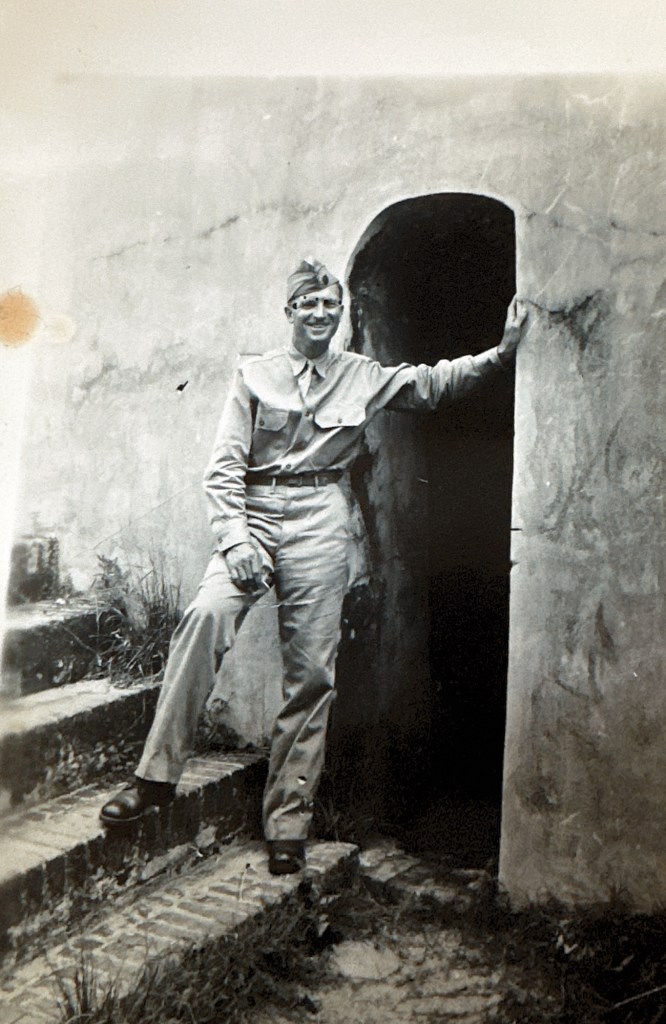
I honor my dear surrogate grandfather, Ted Albers (RIP), who was drafted into the Army at the age of 34, captured at the Battle of the Bulge, and held as a POW under the end of WWII …
Greg admiring some tall Horrible Thistles at our happy place, St Marks National Wildlife Refuge.
I honor my husband, a Vietnam-era Navy veteran who flew in P3s looking for Russian submarines …
To honor them, I’ve made a donation to The New York Bar Foundation’s fundraiser to assist veterans in need of legal services (https://nylawyerslovevets.swell.gives/).
Don’t just thank a veteran for his or her service. Hug them. Hold them close and tell them you love them.
Support them. Make sure that what they fought for is not denied to them. Last week’s election should have secured their rightfully deserved benefits. Now their benefits are at risk by people who know nothing of sacrificing for their country and who consider POWs and wounded soldiers losers.
Do what you have to do to honor those who risked their all for our freedoms.




















 Marie at 1 Write Way