I’m paddling away on my novel for Camp NaNoWriMo!
Current word count is 16,239! At this rate, I’ll make 50,000 by May 11. So, I have a hell of a lot more paddling to do :(
(photo from omtimes.com; Sphinx pose)
“Take a deep breath, stretch, and sigh it all out!” I love hearing these words from my yoga teacher near the end of our yoga practice. My body by then–after a series of vinyasas, sun salutations, and (failed) attempts at crow pose, to name a few–is warm, loose, and calm. Much like my head feels now after reaching 10,000 words in my novel for Camp NaNoWriMo ;)
Of course, I’ve lost some ground and my new expected end date at this pace is May 30. But tomorrow (Saturday) is the Camp NaNoWriMo marathon and I plan to participate. In fact, I’ll be writing tonight since my husband will be out so maybe I can bump up my projections and get myself a better footing for finishing on time.
In the meantime, I’m counting my blessings for slow-running SQL queries. As millions of data records are being recoded, categorized, and/or linked, I can take the dead time to write a chapter or two on my iPad. Life is good.
I didn’t think I would have it in me to write today. Last night (or rather this morning) I was up until 1 AM. Fortunately I had the day off work, but I kept napping and we had “stuff” to do so I didn’t get to writing again until late. I thought for sure I would blow it off and lose ground. Many thanks to my fellow bloggers who have been encouraging me: I thought about them as I sat down to give it another go. Now I am up to 8,538 words with an expected finish date of May 18 if I keep at this rate. Oh, but I won’t. I WILL finish my 50k at the end of April. I’ll make it happen, even if it means the kitties have to wait a bit longer for their meals :)
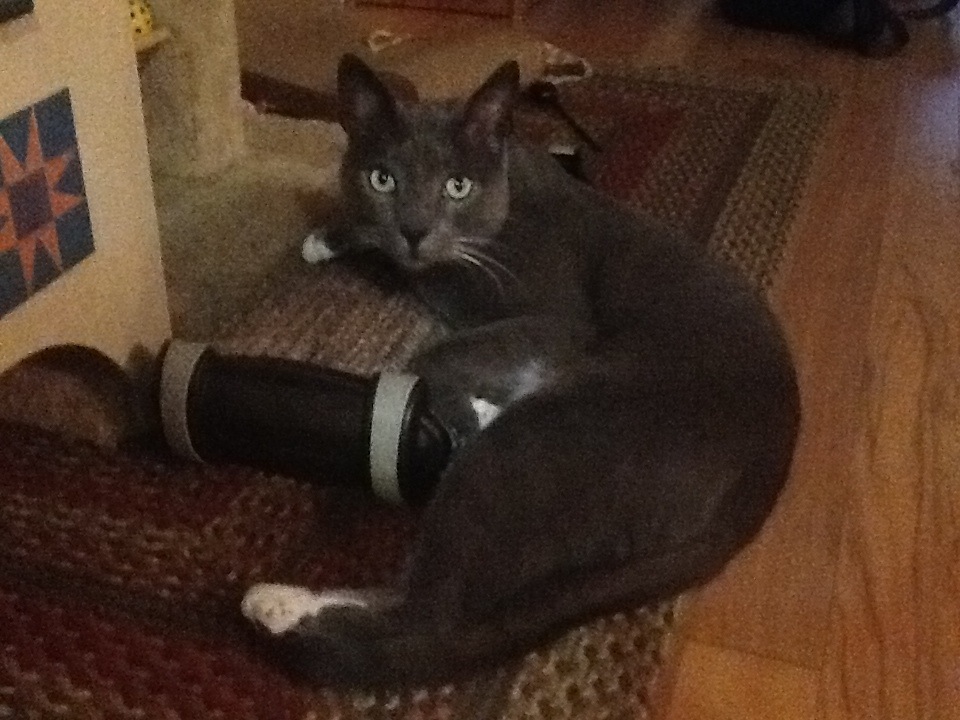
(She looks like she can afford to wait, doesn’t she?)
The road trip is over. I’m home and, although exhausted from all the driving, was willing to suffer more fanny fatigue for the sake of Camp NaNoWriMo. I’ve now completed 6,080 words, almost 3,000 more since my last post. At this rate, I will make my 50k mark by May 28. However, if I write 1,830 words a day, I’ll finish end of this month.
Some might say that should be easy. Just write, even if it’s garbage, it’s the number of words that count. We write during NaNoWriMo; we edit later. But I’m thinking (and not terribly clearly at the moment), that the more my novel makes sense now, the less editing (or interpreting) I’ll need to do later. Of course, I have yet to edit the novel I wrote in November. Truth be told, I didn’t even finish it. I wrote over 50,000 words, and then abruptly stopped. What I thought was a few days’ break has now been a few months’ break.
But, gee, I’ve never had two novels in the cooker before. I’ve always been a short-story writer. While I love to read novels, I’ve always distrusted my ability to sustain an interest in writing novel-length stories. I find that very interesting: I love the slower pace of novels (at least the ones I read) where settings and characters come alive, where the novelist takes the time to describe the smell of snow or the main character’s fondness for cream sherry. But when I try to write like that, the voice at the back of head is practically screaming “Boring!” But that’s the beauty of NaNoWriMo (Camp or otherwise): The deadline helps me ignore that annoying voice.
So, I’ll try to persevere. Maybe I’ll even finish this novel.
I’ve learned today that while it is possible to type on my iPad while a passenger in a speeding Infinity, it is not necessarily productive or advisable. It took a few minutes before my desire to hurl finally abated, and I think my husband was disappointed that I would be unavailable to carry on a conversation with him, or at least verbally sympathized while he negotiated rush-hour traffic.
Also, while I appreciate the ability of the iPad’s keyboard to anticipate and correct my typos, it isn’t perfect. To make any sense of what I was trying to write, I had to keep backspacing and correcting the garbage provided by Apple’s brain. Yes, I have a portable keyboard but my lap isn’t big enough to support both the iPad and the keyboard (thankfully).
So to date, my word count for Camp NaNoWriMo is abysmal: 3,267 out of 50,000. At this rate, I will finish in mid-June.
I’m procrastinating at the moment. Past time to go to bed but just a few more minutes on the computer … so I go ahead and check my stats on my blog and I have 12 spam messages. Usually I just delete them, but some of them are quite funny so I decided to share the content of the messages. For obvious reasons, I won’t share the links.
Spam #1: “This original content is out of the ordinary. I appreciate that you’ve gone off the beaten path with your points and I agree with most.”
I wish I could say my content was out of the ordinary, but I believe I’m beating the same path that many of my fellow bloggers are.
Spam #2: “Can I just say what a relief to find an individual who actually knows what theyre talking about online. You certainly know the right way to bring an problem to light and make it valuable. Extra people must read this and fully grasp this side of the story. I cant think youre not more well-known considering that you certainly have the gift.”
Now, why couldn’t a real person leave such a comment on my blog! I definitely need “extra” readers who also believe I “have the gift.”
Spam #3: “Terrific work! This is the type of info that are meant to be shared across the net. Shame on Google for no longer positioning this submit higher! Come on over and seek advice from my site . Thanks =)”
Yes, shame on Google, but thanks but no thanks on advice from this site.
Spam #4, 5, & 6: “You need targeted traffic to your website so why not try some for free? There is a VERY POWERFUL and POPULAR company out there who now lets you try their traffic for 7 days free of charge. I am so glad they opened their traffic system back up to the public! Check it out here [spam link]”
Three spams all saying the same thing. How boring. Do people really fall for this?
Spam #7: “Performing Respiration ExercisesWhen you actual observation force, your material substance reacts physically. Some nation actual observation an increased organ of circulation fixed measure, sweat, headaches, or shallow, quickened breathing. Respiration exercises can take the severity out of a stressful location to help you think more calmly and clearly. A simple breathing use includes inhaling slowly for five seconds through the nose and exhaling slowly for five seconds through the chaps. Point of concentration your breathing on seeing your packing-box rise and drop down versus seeing your stomach go in and out. It should not be used as a exchange for professional of medicine recommendation, diagnosis or usage. LIVESTRONG is a registered trademark of the LIVESTRONG Base. Moreover, we do not prefer every advertiser or information|proclamation|trumpeting|advertisement} that appears on the web website-many of the advertisements are served by third coterie advertising companies.”
Spam #7 is my favorite because it is so lengthy. I’m sure it’s just an algorithm (I have not studied spam so I don’t know how it’s developed and spewed across the interest universe), but it’s a long one … and almost coherent.
Enough procrastination. I’m participating in Camp NaNoWriMo and way behind in my word count. My goal is 50,000 words and at the rate I’m going, I’ll be done in June :( Still, it’s late, my cats are demanding to be fed, and I still have to take my clothes out of the dryer.
Pleasant dreams my fellow bloggers.
A brief exchange between me and another blogger about the need for solitude in which to write led me to thinking about what would be the perfect writing space. Writers have lives that include families, friends, coworkers, and pets. Those who have children (especially young children) can find it very hard to secure a quiet spot for writing, if that is what they need. I like reading about other writers’ work spaces and see the variety from an ascetic outbuilding to a corner room overflowing with books and papers ( http://www.pw.org/content/writing_spaces; http://www.themillions.com/2012/02/where-we-write.html). I know perhaps one or two people who have the ability to tune out everything around them and be perfectly focused on their writing in the midst of total noisy chaos. I am definitely not one of those people.
I need complete quiet, which shouldn’t be too hard since it’s just me and my husband and three cats. However, the oldest cat, Luisa, can be very vocal, especially when you put a closed door between you and her. I have a room of my own where I do most of my writing, but Luisa “shares” the room with me. When I’m in there, she has to be in there too. If I’m lucky, she’ll eventually curl up on the guest bed and fall asleep. Usually, though, she has to “Meow” and Me-OOOW” and paw at my chair several times before she settles down.
As I face opening day of Camp NaNoWriMo, I wish I could spirit myself to the St. James Hotel in New Orleans where, during NaNoWriMo 2012, just me, my iPad and a keyboard huddled together and wrote for hours while my husband was at a conference in another hotel. My first day I wrote over 4,000 words. What a joy it was!
Of course, most of those words were crap, but to have unbroken concentration was liberating. And right now I can only fantasize about an ideal writing space. More than likely I’ll be folded into a corner of our couch (which also serves as my reading and knitting corner) with my iPad on a TV tray and the keyboard on my lap. If I’m lucky, I can sneak some time at work, although I can’t prevent surprise visits from colleagues and I’d probably get written up if I put a “Do Not Disturb” sign on my door. Actually, such a sign would attract attention, not deflect it.
And there is that room of my own (except when I share it with Luisa). My 20-inch Mac desktop has a lot more flexibility than my iPad; much easier to hop between Pages and Evernote and FireFox, multitasking my way through a novel. No surprise that I write less when I’m on my desktop than with my iPad ;) Even now, as I try to write this post, I spend most of my writing time jumping back and forth between Evernote, Pinterest, and Calibri … looking for pictures to add, downloading books to my Kobo … when I’m supposed to be writing. So the iPad will win out as my best avenue to focused writing. It was truly wonderful in NOLA.
What is your favorite writing space? How does where you write help you write?
Do you have a fantasy writing space? I often imagine myself going on a retreat of some sort, preferably one where everyone has to take a vow of silence. Or a lonely cabin in the woods … or on the beach … or in the desert. For me, location would not be so important as solitude. While I got a lot of writing done in New Orleans, it was NEW ORLEANS and so my afternoons and evenings were spent walking and eating and talking with my husband. In other words, I could have gotten a lot more writing done if I had been in a city I really didn’t care for and if I had been by myself. Then again, you could argue I had the best of both worlds for a few days ;)
In an earlier post, I wrote that I do feel regret over some things I’ve done (or not done) in my life. These posts are driven in part by the fact that I have less than half of my life to live and I’m still not living the way I want to. Of course, it’s taken me this long to figure out what I want to do for the remainder of my life (besides eat great food, have great sex, read great books and listen to great music, most of which I do enjoy now). What I want to do it be true to myself. Perhaps my biggest regret is feeling that I’ve been living (and am still living) a lie for the past 20+ years. Career-wise, I’ve taken a path far away from where I originally started. I was never good at math, abysmal at statistics when I was high school and college, but today I am a “health statistics analyst,” spending my days writing SQL code to make disparate data sets “communicate” so my state can eventually have a complex understanding of the health and health outcomes of its citizens. Nice work, actually, and it pays well. But it is not at all what I had intended, and even though the work is interesting and my coworkers are wonderful, supportive, dedicated people, I could walk away and never miss the job, never think to myself, “if only I had written more code.”
My detour began when I was a teenager. I grew up in a very small, sparsely populated area of the Northeast where the local jobs tended to be at fast-food restaurants. I hated high school but I loved community college and often wondered if I could make a career out of being a college student. (I nearly succeeded, having been to five universities/colleges, obtained two masters degrees, finished two years of doctoral coursework and a spattering of miscellaneous classes.) The problem is I didn’t want to teach, and all my advisers argued that the only way I could write was if I also taught. As I’ve said in previous posts (and I will say often), I am a shy, sensitive introvert. I spent most of my childhood trying to disappear into corners and shadows. In college, I would drop classes if any of the assignments involved presentations (except for those classes I was compelled to take in order to get my degree). Ironically, because of my foray into public health, the list of presentations I’ve given over the last ten years is longer than the body of my resume. But I still hate giving presentations.
I just wanted to write, but I was too naive and introverted to figure out how to make a living at it without having to teach as well. I was the only one in my immediate family who had even set foot in a college, and for that I was an oddity. Becoming a teacher would have made me even more odd in their eyes. I kept trying to come up with more marketable plans, ideas for jobs that my family would appreciate and understand (like owning a greenhouse or working in a hospital), but I was very unhappy at every thing I tried. The only times when I was happy was when I was reading literature, writing, and sitting in class.
So I made a hard left at a detour and moved to the other side of the continent, upsetting my family, not finishing college (yet), not knowing what the hell I was getting myself into. On the West Coast, I had the opportunity to be true to myself but unfortunately I got stuck in a rut with drugs and drinking and general flaying about. I was a mess. It’s a long story about how I eventually cleaned myself up (with plenty of help from someone who is still in my life). But once I was cleaned up and again thinking about how can I make a living as a writer, I took a hard right on another detour and wound up in the Southeast. It’s too embarrassing to say exactly where I am. Although the current fix I’m in has paid well and allowed me to save and anticipate a comfortable if modest retirement, it’s taken a chunk of my life. Worse, it has nearly destroyed me as a writer.
While I was studying writing and literature, I felt validated as a writer and encouraged by my peers and professors. But at the time the local job market for writers and editors was pathetic and eventually I embarked on yet another detour, this time into the social sciences. You don’t write up research findings like you write a short story. It didn’t take long before I was convinced that I was a mediocre writer. Only by participating in NaNoWriMo a few years ago, did I realize how I had screwed myself as a writer, let myself down by internalizing the judgments of others.
And now that I’m facing retirement in a few years (hopefully with the same good health that I have now), I want to stop taking detours. I want to get back on The Path and not believe it’s too late. This blog is one step in that direction. Zoetrope.com has made it possible to participate in a writing group without having to change out of my jammies, and NaNoWriMo gives me that somewhat gentle kick-in-the-butt to just sit down and write. Times like these, I have regrets, but they just give me more drive to make up for lost time.
Another thought-provoking blog post from Eric John Baker … this one on writing groups.
The first writing group I ever belonged to was in my community college and we actually called ourselves a “literary guild.” We had a faculty adviser and a small stipend to produce a literary magazine. They were a very encouraging, supportive group and the faculty adviser provided much needed guidance. Everyone was published in the journal. No one was left out. We also had quarterly readings and met for group readings and critiques about once a week. For a very young writer, it was a wonderful experience. But I was very young (still in my teens) and everyone was so much older (like 20 or so) and I was pretty much treated with kid gloves which was fine because my skin was very thin. I wrote more than I would have without them, and my writing improved because they did offer constructive criticism.
That said, I haven’t had quite the same experience since. I’ve tended to “join” groups such as university writing workshops, probably trying to replicate the experience of my community college days. I like having a faculty member who guides the group; the faculty is usually the one (for me, anyway) who offers the most useful advice. And I have gained, both in quantity and quality, from the workshop experience. But occasionally someone rakes you over the coals, and having that happen in public is unnecessarily humiliating. It can stop your writing dead in its tracks and has no useful purpose. I don’t think a writer has to have a thick skin. She just has to keep writing.
I recently commented on Eric’s blog about an experience I had many years ago but still resonates with me today. I was taking an Article & Essay Writing class for my graduate degree in English. We had been assigned to small groups where each of us would read and critique the other student’s paper. A couple of students in my group were PhD students. I chose to write a book review of a biography of Virgina Woolf and was quite pleased with the scholarly style of my paper (omniscient third-person). I believed the PhD students would like it, even praise it for being far advanced for your average Masters student. But they were not pleased. They tried to be kind but before they could even get the words out I knew what they were going to say: it was boring. My paper was boring. I don’t know if there is any more devastating critique of writing but to say that it is boring. They did try to be kind (they actually were very nice people), but their struggle to find something redeemable in my review was painful to watch. And I was devastated and I know I didn’t hide it very well. Later that day I went home and cried and cried and cried. I would have stopped writing, too, except that this was for a class and I didn’t want to flunk it.
I had to revise my paper. That was part of the course. That was the purpose of the groups: to get feedback and then revise. But every time I sat at the computer and started to revise, I broke down crying. I felt ashamed that I had even thought of myself as a writer. Still, I had to do something. And then I remember one thing that each of the students said to me: “I want to know what you think of the biography. What did the biography mean to you?” And then I realized what they meant and why the review was boring to them. It was such an objective review that there was no life to it. It was as dry as the desert. So I threw away the original and started over. I wrote about my personal interest in Virgina Woolf and why I thought this particular biography was the best of all that I had read. I wrote about why it interested me as a writer. I used “I” throughout my review.
I submitted the final paper to the class at large and had the pleasure not only of hearing that it was wonderful to read, but also that it was far, far better than what I had originally turned in. On a lark, I sent the review to the Journal of Biography and a year later it was published. When I received the galleys for my review, I compared the edited copy to my original. They had only changed one word.
I came so close to just giving up. Fortunately, I had an obligation to deal with that paper and, fortunately, I had received excellent advice. I had only needed to be open to it. I only had to write the kind of book review that I would enjoy reading!
So groups are tricky. I’m partial to university-style writing workshops but maybe that’s because they are so familiar to me (having spent the bulk of my adult life in college). I shy away from local writing groups because I’m shy. I’m not physically or psychologically comfortable in group settings. Instead I prefer online writing groups such as Zoetrope.com. I’ve gotten a mix of feedback from writers on Zoetrope, but there’s always at least a couple that provide good, solid criticism. And I can read those critiques in the comfort and solitude of my room.
[Full disclosure: I do not belong to a writing group]
Writers are often told by the experts to join a writing group. Having other writers critique your work can help you identify your weaknesses and improve your ideas, so the reasoning goes. Therefore, writing groups are good. That makes sense to me.
I’m not convinced it’s true, though. In my recent post about self-doubt, some people commented that they lost their motivation to write or otherwise had their confidence shattered after being bashed by other writers in a writing group. I’ve encountered similar claims in the past.
Speaking broadly, the problem with expert advice in an arts-related field is the lack of supporting science for its validity. How do we know writing groups are necessary? Because an expert said so? Because it seems logical? It’s very possible that, if you took a random sample over an appropriate time frame, a…
View original post 497 more words
Self-doubt, self-publishing, and other selfish writer-isms. This blog post by Eric John Baker is worth a read not just for the post itself, but also for the comments. The debate of traditional vs self-publishing is still raging, only now I think with more nuance. Not only is it easier to produce hard copies of our novels, poems, and stories, but there are also more venues for selling your work than there were just a few years ago (think: Amazon, Smashwords). Writers aren’t stuck with the old vanity presses that took your $$$ and gave you a printout with a cardboard cover in return. Each route has its downside, though, and deciding which way to go is tricky. Getting picked up by a traditional publisher can take years, even with an agent. Sending out submissions can be time-consuming, costly (postal fees), and deflating (as when the number of rejections you get equal the number of submissions you’ve sent). Self-publishing might be less expensive (relative to postal fees of submissions) and quicker, but then who is going to market your book, who is going to make it sell? Then again, even in traditional publishing, writers are expected to go on book tours. They might have help with their itineraries, perhaps some of their travel expenses are reimbursed. But they are the ones selling their books, they are the ones doing the hawking. Getting published by a traditional press might give a writer a bit more “legitimacy,” but the writer still has to put as much if not more work into the process, especially post-publication when the book is suppose to sell and make the publisher a lot of money.
I suspect that eventually I will self-publish. I’m not a patient person generally, and I’m getting less patient as I get older. I am easily dismayed by rejection letters (especially form letters). And I’m an introvert, a shy, sensitive introvert. Not the person you want to send on a book tour. I won’t give up entirely on traditional publishing. I can still keep submitting and hope that the rejection letters eventually become more personalized. But given the short time-frame I have before me, the best I can hope for is to bring a novel or collection of short stories to a point where it is ready for prime-time (meaning I will employ a professional editor) and then self-publish and, in my own quiet way, spread the news and hope for the best. And the best might be the two or three total strangers who pay to read my book. And that will be okay.