From Interesting Literature: Guest Blog: Why Read Dickens?

This quote sums it up: “We need to read Dickens’s novels,” she wrote, “because they tell us, in the grandest way possible, why we are what we are.”

via Guest Blog: Why Read Dickens?.

Things Are In the Saddle

These lines–Things are in the saddle, And ride mankind–should be familiar to any college student who had to read early American literature.  These are lines that, when I first read them, I didn’t quite understand them.  It was the late 1980s and while my husband and I were starting to tread carefully into personal computer ownership, we were still technologically young enough to be giddy over our remote controlled TV and new CD player.  As the years passed and we accumulated more gadgets and at a faster rate than we could have anticipated, those lines of Emerson‘s spring to my mind more and more frequently.

In a society where consumerism is nearly a religion and oftentimes used to show “patriotism,”  it’s difficult not to fall into a depression of sorts when the It of “is this it?” is not enough.  You buy gadgets that reportedly will enhance your life, and six months later they are obsolete.  So you purchase anew to feel purpose in life and the cycle continues.  It’s not only a sad way to live, it’s unsustainable.  Unless you’re incredibly wealthy, at some point you run of money to buy the things that you think will give your life meaning.  Hence, the lottery.  A quick fix.  A desire to be wealthy without having to work for it (unless you consider standing in line work).  When I’m in one of my Peggy Lee moods and start humming Is That All There Is?, I:

  • go for a walk without my iPod so I’m not distracted from the song and flight of birds, the squirrels chasing each other up and down trees, the hum of insects;
  • pick up a hardcover book and feel it’s weight in my hands and the dryness of paper as I flip through the pages;
  • hug my husband;
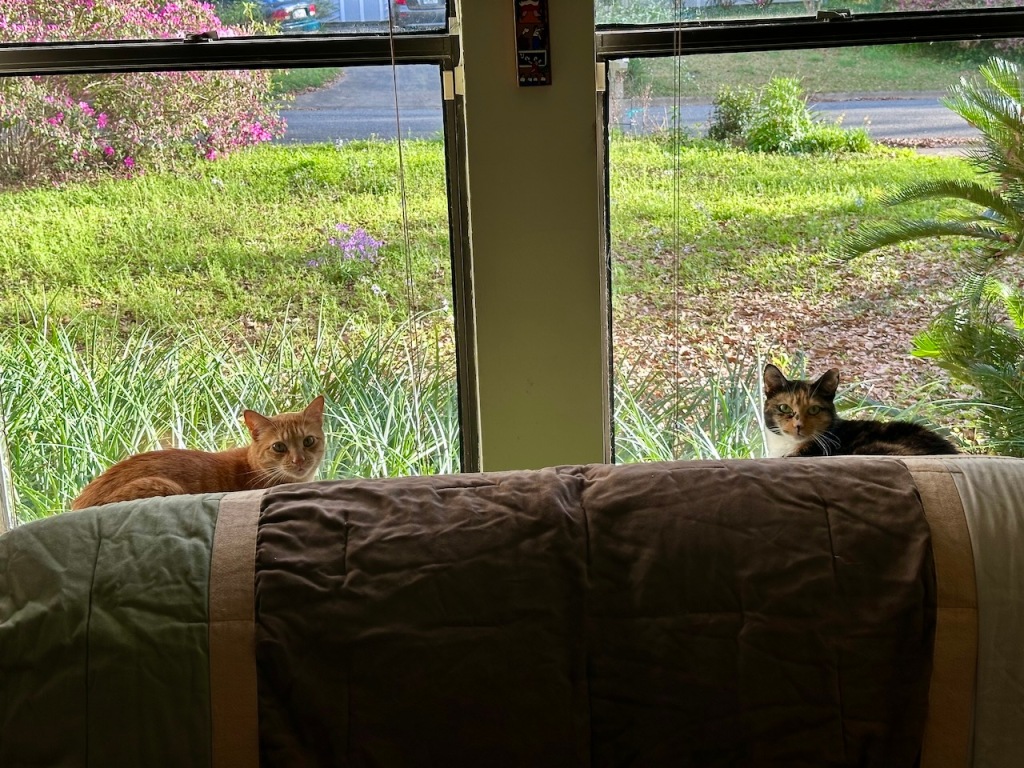
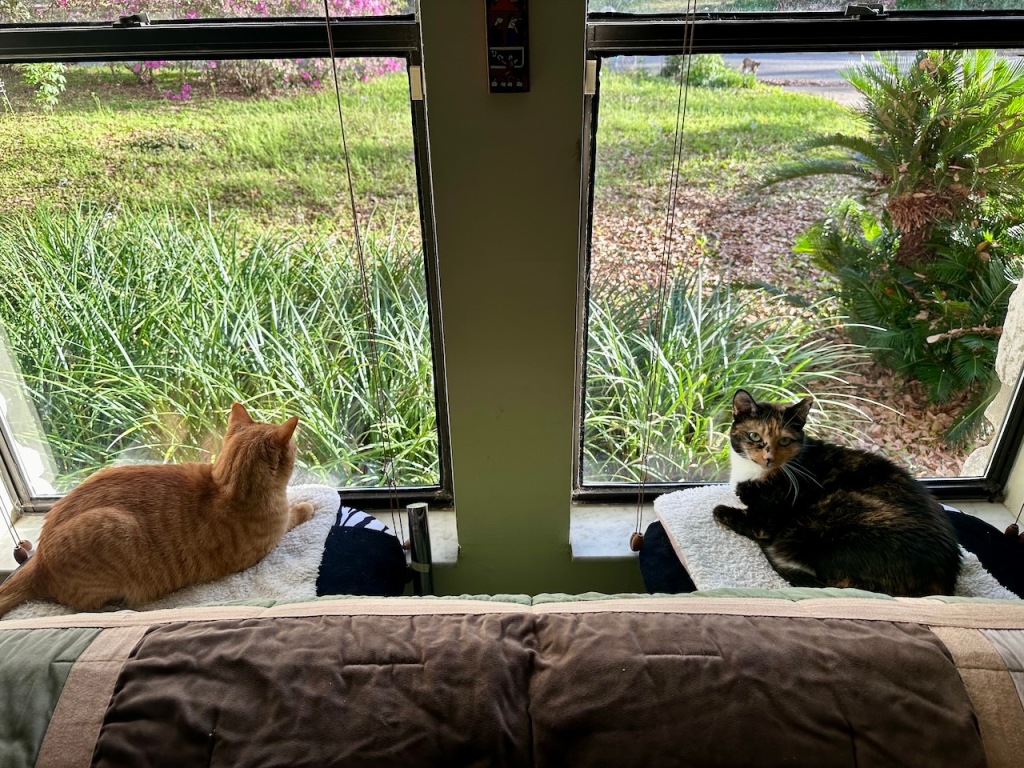
  • pet my cats;
  • call a friend;
  • write

Granted, some of these things cost money:  shoes for walking, books for reading, food for husband and cats, phone for calls, pen and paper for writing.  But none of them requires a gadget, a technological device that has been partly designed to make me feel lost without it (even the phone mentioned is one that we’ve had for about 20 years).  We are existential beings struggling to make sense of a world that often makes little sense.  We are sold things with the promise that we can derive meaning for our lives through these things.  But do we?  How many of us, every so often, decide to go “off the grid” in a quest to find true meaning, sustainable meaning, meaning that will outlast every technological advance we embrace?

Recently, our DSL had an interruption in services for at least a day.  I admit, when I realized that I could not connect to the Internet, that I could not check my blog or my favorite blogs, I panicked.  I didn’t know why I couldn’t connect and the thought of being disconnected for unknown hours was chilling.  It was early morning, before I had to leave for work and I was in a panic that I could not “log on” and get my blog fix before setting off for my day job.  But, my husband was still there.  In fact, he was oblivious to my panic because he was on the porch reading a book, his morning routine before setting out for work.  My cats were still there and actually annoyed that I was in more of a tizzy over the loss of my Internet access than I ever am when it’s their feeding time.  My books hadn’t disappeared, and I still had drawers of pens, pencils and paper to write on.  I didn’t check my phone because I actually hate phones.

It was a wake-up call for me.  Should I be so dependent on technology that I stop breathing when I open Firefox and get the message:  “Error.  Server unavailable”?  Should I allow these things to ride me?  Or should I embrace the sudden silence, the sense of time slowing, the drawn-out minutes when I can pick up an unread issue of the New York Review of Books or Harper’s or The New Yorker and feel reconnected to that time, 30-some years ago, when I read these periodicals as soon as they arrived in the mail?

I don’t want to go totally off-the-grid.  I wouldn’t have a blog if I did, but I don’t like feeling controlled by technology, made to feel that every second I don’t own an iPhone is a second lost to me.  [Disclaimer:  I do own and love my iPad2, but note it is an iPad2, not the newest iPad and, like all my other gadgets, I'll likely still be using it long past its obsolescence.]  So, fellow bloggers, and any one else who stumbles across this post, are you in the saddle, or are things?

Poem: The Astronomer’s Wife

Supernova Remnant Cassiopeia A.  Credit:  NASA, ESA, and Hubble Heritage (STScl/AURA)-ESA/Hubble Collaboration

Supernova Remnant Cassiopeia A

Do you remember when you left

Was it when
You looked up into the night sky
And saw the brilliant stars
The expanding universe
The mysteries of the galaxies
The endlessness of Time

Was it when
You looked down into my eyes
And saw the faintest of light
The boundaries of my soul
The simpleness of my mind
The finity of my existence

You are drawn to the solitude of cool darkness
Not even wanting the moon as a companion
You are pulled away by a gravity stronger
Than your love for me ever was

I wait, linger
At the border between light and dark
Ashamed of my insignificance

I want to explode like a dying star
My heart collapsing into a million black holes
And then my gravitational pull

My love

Will swallow you whole

All About That English Major Life

Reblogged from Life Measured in Coffee Spoons:

As graduation season rolls around once again, the ratio of meaningful life reflections to "It's Gonna Be May" Justin Timberlake memes scattered throughout my Newsfeed peeks at an astonishing 5:1.  These personal progress reports, ranging from the 140-character tweet (respect) to the facebook note novella, spark pre-mature nostalgia and prompt me to reflect on my own collegiate transitions. For one, I can no longer imagine an existence without the aid of Google Calendar, those merciful colored blocks, and the illusion of order they lend my life.

Read more… 580 more words

Here's a post that wonderfully describes the difficult but subsequent joy of following your heart. In a comment to this post, I wrote that as English majors we study (or studied as in my case): language, culture, gender, psychology, sociology, political systems, economics ... in effect, we study the world.

8 Things You Need To Know About Character Arcs

Reblogged from MOON IN GEMINI:

Click to visit the original post

1. Character arcs are not 100% necessary. I’m going to get this out of the way first thing.

This argument is made all the time, and there’s some truth to it. There are some very successful characters that never have a character arc. James Bond is the one most mentioned. While he was retooled somewhat when Daniel Craig took over the role in the movies, the character has never undergone a significant arc.

Read more… 1,115 more words

This is a wonderful post for all of you currently writing fiction and needing advice/suggestions about character arcs. As I was reading Debbie's post, I realized that I provided different arcs for different characters in my last two NaNoWriMo novels. That's a good thing, but I hadn't put much thought into why I was doing that. Debbie's post actually gives me an understanding of what I've done and (hopefully) how to make sure the arcs worked for the characters.

Book Review: Twelve Days–The Beginning by Jade Reyner

In exchange for an honest review, Ms. Reyner provided me with a copy of her debut novel, Twelve Days–The Beginning.  My intent in reviewing her book was mainly to provide feedback regarding a particular chapter that she had softened out of concern that detailed content might be too brutal.  So I read her novel in the space of two days (including the wee hours of one morning) and provided her with the following review.  Ms. Reyner gave a kind review of my review so I’ve since posted it on Goodreads and Amazon, and now here:

Twelve Days – The Beginning is an emotional whirlwind of a novel.  At first, Elise Grayson seems to have it all:  great marriage, great job, great friends, great looks.  But author Jade Reyner doesn’t take long to start peeling back the layers of deception in Elise’s life, as she tries and fails to keep her secrets.  First, her best friend and favorite “eye candy,” Cole Andrews, sees through all her lies; ironically, he is the one she confides in, not her best girlfriends who are left in the dark until the truth refuses to be hidden.  Then Elise meets Vaughn Granger, a tall, dark, and handsome, and highly sexed man who serves as Elise’s boss.  Initially she fights her attraction to him, and initially I wanted her to because I was afraid he would be no better than her husband, that he would be just another man to dominate and control Elise.

But Granger is different and he shows Elise what it means and how it feels to be truly loved and worshiped.  Although married for ten years, Elise has had limited sexual experience.  Granger not only opens a new sensual and sexual world for her, but Elise also experiences a sexual awakening, the kind of awakening that, at least in our dreams, can only happen with someone who truly, truly loves us.  The sex scenes are explicit but not gratuitous:  there’s a context for every touch, every kiss, every caress.  The same is true of the physical and sexual violence that occurs: the detail provides a searing look at Elise’s reality and an unforgiving portrayal of the monster that is her husband.

I did find myself frequently arguing with the characters–usually Elise–as I read along, a good sign that I was hooked, that I was invested in their exploits and decisions.  Admittedly, Elise and her sermons on the sanctity of marriage and her stubbornness often drove me up the wall.  She makes some, what I can only call, stupid decisions, but  she makes them because she really thinks she is doing the right thing.  I’ve worked with survivors of domestic violence, and it never ceased to amaze me how desperately some of the women I worked with wanted to believe that only if they acted rationally, then all would be OK.  They needed to believe that their lives were not the nightmare that everyone else told them it was.  I see Elise going through this, wanting to believe that there still some rational part of her husband that she could reason with.  So, while I was sometimes angry with her, I also understood her need, her desire that everything turn out OK.

Of course, in real life, things don’t turn out quite OK and the novel has a hell of a cliffhanger.  Fortunately, Ms. Reyner provides her readers with a taste of the sequel, Twelve Days – The Future, and we can at least be assured that there is indeed a future for Elise and a future for us as Ms. Reyner’s readers.

Random Act of Kindness

I just want to give a big thanks and shout-out to Rachel at Spilledxink.wordpress.com for nominating me for the Sunshine Award.  Since I’ve also received the award earlier from another blogger friend, I’ll forego the “rules” except the one about thanking the blogger who nominated me ;)   Please click on her link and see what Rachel is up to.  She’s less than half my age but has already written three times as many novels!  Her enthusiasm is an inspiration.  Thanks, Rachel!

"Sharkovsky slid through the narrow opening..."

Reblogged from Alec Nevala-Lee:

Click to visit the original post
  • Click to visit the original post

(Note: This post is the forty-seventh installment in my author’s commentary for The Icon Thief, covering Chapter 46. You can read the earlier installments here.)

I've written before about how research for a novel is less about factual accuracy than about finding material for dreams. In particular, it's a valuable source of specificity. When you first start writing a story, your ideas tend to be vivid in certain areas and amorphous in others, and research is one way of acquiring a useful stash of facts, images, and concrete details—the building blocks out of which all good fiction is assembled.

Read more… 681 more words

Alec Nevala-Lee offers a good argument on the importance of research in writing a novel. Whether you're trying to develop a strong and plausible sense of place, or you need to prove that the suicide of character A was really a murder, you need to do your research. If you don't, your readers will find you out and they won't be happy :)

E-book Reader Blues

I’m not really a gadget geek.  Really, I like to keep things simple.  I like the simplicity of picking up a book and leafing through its pages.  Still, several years ago, I became smitten by e-book readers.

I don’t remember how the love affair began.  It was the early 2000s and discussions about ebooks and ebook readers were slowly making their way into the mainstream.  Somewhere, somehow I got wind of a Gemstar eBook reader that I could purchase online for roughly $99 (or $149 for a color version).  I opted for the black and white version, wanting to keep things simple.  And thus the affair began.

Gemstar GEB 1150

Gemstar GEB 1150

My Gemstar is a solid 22 ounces, about the size of a paperback, with a grip on the left side that makes it easy to hold with one hand.  It has a touch screen, a stylus specifically for navigating the “Bookshelf” and two buttons on the left side for paging through books.  It has about 8 MB of memory and I also use a smart media disk of 128 MB.  On my Gemstar, I have contemporary books such as Newjack by Ted Conover, classics such as Les Miserables by Hugo, and lesser-known works such as The Amateur by Richard Harding Davis.  I must have purchased the Gemstar around 2003 because I also have a few articles from the New York Review of Books saved there from that year.

Alas, within a few short years, support for the Gemstar evaporated entirely:  no technical support, no online bookstores dedicated to the Gemstar.  The flame had gone out of the affair.

And, yet there was still a spark.  A few years later, on a camping trip, my husband and I huddled together in our small tent, on a dark windy night.  I pulled out my Gemstar and read parts of Newjack to him until he was ready for sleep.  I often said then and I’ll say it again now that the portability of an ebook reader is its greatest advantage.  I had a long list of books for my husband to choose from that night, and I could not have backpacked all those books into camp.  While the Gemstar was my first love, it may also be my last.  I have since bought a 3rd-Gen Kindle (right before Amazon came out with the Fire and substantially dropped the price … damn you, Amazon!)  But I missed the expanded memory that I had with my Gemstar, the touch screen, the ability to add books and articles of various formats.  I liked the Kindle at first but now it’s primarily an overpriced word game player.

Then I got an iPad 2 which I bought with some hard-earned second job money and found (oh, crap!) that I could have just put the Kindle app on my iPad and been done with it.  I love the touch screen and would read books or catch up with news on the iPad during my lunch hour.  But still, I wasn’t satisfied.  I was itching for something simpler, something more ebook dedicated, something I could read in bed without the lights on, without an LCD burning my eyes out.  I have read review after review after review comparing the Kindle with the Nook with the Kobo with the iPad.  Although we have a Barnes & Noble in town, I was hesitate to buy a Nook.  B&N may not be as big as Amazon, but, bleeding heart liberal that I am, I wanted something more “indie.”

In April I purchased a Kobo Glo.  I had found good reviews of the device, it’s capacity for storage, various ebook formats, and its “night light.”  Unfortunately I had to buy it online since the one independent bookstore in my town didn’t carry it.  Here’s where the blues comes in:  I can’t get the wireless to work, no matter what we do (reset, factory reset, unsecure our network, secure our network).  The device doesn’t always recognize the memory card, and the touch screen can be a little quirky.  I’m using Calibre to download and add books outside the Kobo BookStore, but that can be a little squirrelly too.  And even though I thought I had thoroughly vetted the Kobo, I’ve since learned from Calibre that “The Kobo has very buggy firmware” (from their manual).

Sigh.  When my Kobo works, it’s wonderful, and I have enjoyed using it to read at night.  Nobody is disturbed by the gentle light around the edges of the screen, and my eyes don’t get fried.  Yet, today it took several attempts to transfer a bundle of new books from Calibre to my Kobo.  Admittedly, I may have not been syncing correctly.  All these gadgets seem so sensitive to how they are handled.  Even some of the apps on my iPad are having hiccups following the latest system update.

My Gemstar and I never had such problems.  To remind myself of how advanced technology was, I’m recharging my Gemstar and recharging our affair.

The Great Big Blue

On the trail at Chimney Rock, Point Reyes National Seashore Park, California July 2012

On the trail at Chimney Rock, Point Reyes National Seashore Park, California
July 2012

It’s been a week since I submitted my final word count to Camp NaNoWriMo and my brain still feels as empty as this great expanse of sky. I’ve written little since: mostly comments, an attempt at poetry during a downturn in my mood, and the ubiquitous note-keeping I do at my day job. I had thought of planning to edit one or both of the novels I’ve written in the past 6 months. Remember, they are both first drafts so editing will open the opportunity (and challenge) of rewriting. But … always there is a but … my physical environment is suffering from neglect and my other projects are demanding their due.

For one, I’m engaged in The Knitting Guild Association’s (TKGA’s) Master Hand Knitting Program, Level 1. For those of you interested in such endeavors, here’s a link: http://www.tkga.com/?page=AboutTKGAMasters

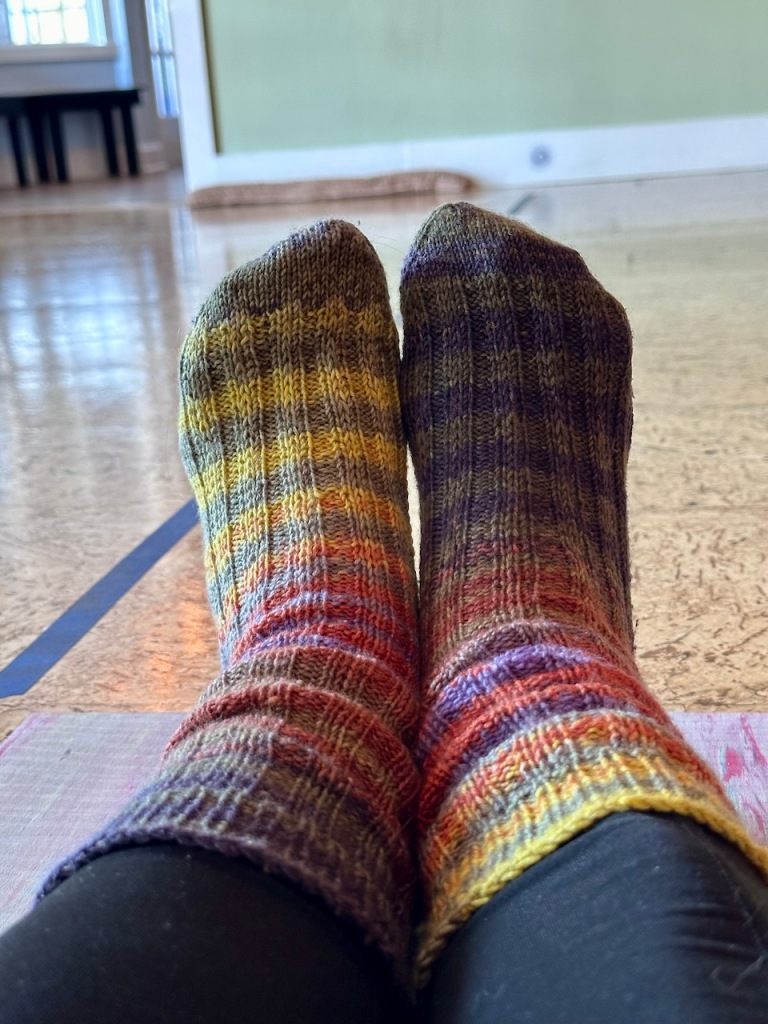
I actually had completed Level 1 almost 20 years ago, started Level 2 and then just quit. I am an avid knitter and have been knitting for over 40 years. I can also sew and crochet, but knitting has always defined me. I’ve made everything from baby blankets to cardigans to socks to shawls to scarves to pullovers. As the years go by, my knitting has become simpler, except for the socks and a venture into Entralec.

20130505-133850.jpg
In recent years, I’ve resisted patterns like cardigans that require lots of finishing. Even with socks, I prefer to knit toe-up two-at-a-time because that method requires the least amount of planning and finishing. So why am I enrolled in the Level 1 Master program again? (Beside the fact that after 20 years, the association has updated its standards and requirements.) In truth, because I thought if I ever attempt to sell my knitting, it might be helpful if I could be “certified” as a Master Knitter and for that, you need to complete all three levels of the Master program. But knitting is labor-intensive and selling would only work if I was willing to do it for free. And, once knitting becomes a job, the joy goes out of it for me.

My writing is much like my knitting: I love the process (the knitting, the writing). I love the end product (the sweater, the novel), but I don’t like everything I have to do to get there (the sewing of seams, the editing). And, as with knitting, once the “fun” goes out of writing, so goes the writing.

After all these years of writing and knitting, I feel like I’m still discovering myself as a writer and a knitter. And I’m starting to let go of that urgency to “Be” something or someone, to define myself by someone else’s precepts. I’m a contrary student: I love to learn but I hate instructions. I love to find out something new, but I hate being told what to do.

Yet I intend to finish Level 1 of the Master program, even if I have to write a two-page, single-spaced report on blocking (really, is there that much to be said on blocking?). Level 2 will depend on how much of Level 1 I might be asked to re-do. And with my writing, it will be easier to simply create anew rather than rework what I already have. We’ll see. For now, I have some knitting to finish.

20130505-140249.jpg

Touch2Touch

"Only connect!" -- E.M. Forster

The IDEA Bucket

Simple ~ Happy~ Debt-free lives

suzanne wood - wanton word flirt

tossing out words, recklessly and playfully

Second Breakfast

Still Hungry? Try feeding your mind: book reviews, quotes, and more.

Isabella Stines

A creative writing blog. Simple as that.

What The Hell

Kevin Brennan Is Self-Publishing His New Novel

readful things blog

An opinion on everything literary

The Amazon Iowan

Blog of Author Heidi Cullinan

BREVITY's Nonfiction Blog

(Somewhat) Daily News from the World of Literary Nonfiction

Life Measured in Coffee Spoons

Musings on Life and Literature

MOON IN GEMINI

Debbie's Blog About Writing And Pop Culture

Hope for Binati

Hand delivering love & hope to those who need it :)

Source of Inspiration

All is One, co-creating with the Creator

Busy Mind Thinking

Wait! What?!

Creative Writing with the Crimson League

Creative Writing Tips and Authorial Support from Fantasy Writer Victoria Grefer

Michelle Proulx - The Blog

Shameless self-promotion for my books, plus lots of awesome.

Chris The Story Reading Ape's Blog

My New (to me) Authors Blog (9 out of 10 Vets recommend it, the 10th is seriously reconsidering his first response, while he recuperates from his unfortunate 'accident')

О Женщина...

дневник бывшей американской жены

Maxima

Electronic thoughts Follow me and enjoy !

According to Dave

On life and writing ...

Imponderabilia

Digital Public History and Material Culture

change it up editing

I'm Candace Johnson, and I love words. Especially yours. Let me help you say it the way you mean it!

Alec Nevala-Lee

Thoughts on art, culture, and the writing life.

Malcolm's Corner

Financial, economic and wealth related issues in the broadest sense of the word.

countingducks

reflections on a passing life

The RunningFather Blog

Transpersonal Spirituality as expressed in: Religion, Philosophy, Psychology, Science, Mysticism, Metaphysics, Education, Consciousness, the Spiritual disciplines, the arts, and LIFE!

Jade's Jungle

A Self-Publishing Safari

Lea At Sea

I love to write, I love to read and I love the sea.

Writings of a Mrs

Follow my journey to writing, Blogging and publishing my musings..

Watch out, world

I got my sassy pants on today.

stillness of heart

MUSINGS : CRITICISM : HISTORY : PASSION

literarylandofalysia

There is nothing better than a good book

Writing Research Reading

A great WordPress.com site

Of Life and Lies

Seek More From This Provincial Life.

~ Iconicallyrare ~

~ Acts & Deeds of the Élégant ... Explores Sartorial Excellence, Travel and Creative Philanthropy ~

My Own Fantasy

A part beginner blogger and a huge fangirl of many things. Posts about fandoms and maybe some reviews every once in awhile.

Talking Experience

Life is a journey where choices are made every moment

The Culture Monk

Photographs & Philosophy - The Periphrastic Mind of Kenneth Justice

The Jenny Mac Book Blog

Jenny Mac and the Man of Secrets

Daily (w)rite

A daily ritual of writing

The Clearing

The Clearing is a magazine of bold new writing intended to explore and energise the cultures of place in the twenty-first century.

Englishman in Italy

An Englishman, his Sicilian wife and an Italian / English Dictionary

Rant Against the Random

Collected thoughts, rages, and rambles on life

thelissachronicles

More than Just another WordPress.com site

Collecting Childhood

Objects and stories from the Museum of Childhood

Follow

Get every new post delivered to your Inbox.

Join 122 other followers

%d bloggers like this: